Café owners in Pakistan ask government to remove sheesha ban

1 / 2
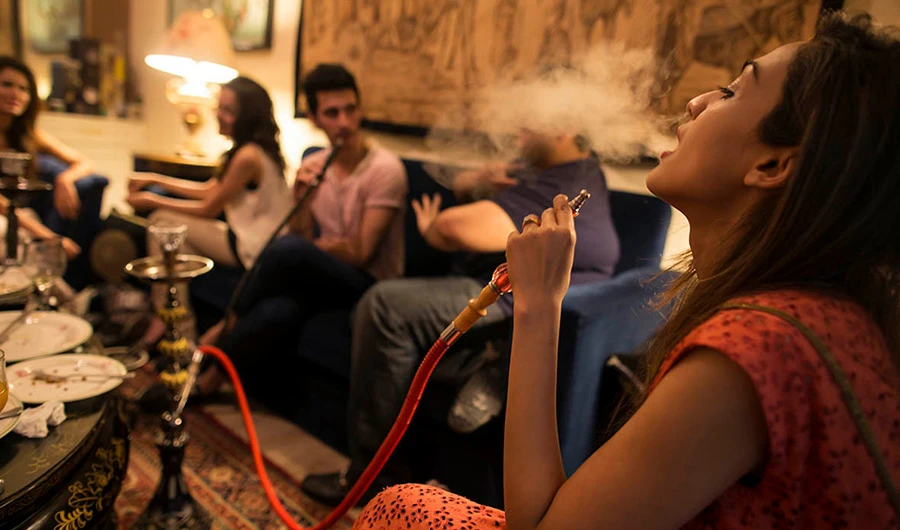
A group of girls and boys smoking smoke a water pipe, also known as a narghile, as they sit with friends at home in Islamabad May 8, 2014. (Reuters)
2 / 2
Owners of sheesha cafés in Karachi are addressing a news conference at the press club on November 15, 2019. The smoking device in question can also be seen in the image. (AN Photo)
Updated 17 November 2019
Follow

Café owners in Pakistan ask government to remove sheesha ban

  • The prohibition was ordered by the Supreme Court of Pakistan in 2015
  • Café owners say a regulated use of sheesha can help the country collect Rs100 million in sales tax from Karachi alone

KARACHI: Owners of sheesha cafés in Karachi on Friday urged the provincial administration of Sindh to regulate the use of sheesha – a glass-based instrument used to smoke flavored tobacco – in line with the World Health Organization rules since that would “create employment opportunities, earn the government nearly Rs100 million in revenue and promote tourism in the country.”
Addressing a news conference at the Karachi Press Club (KPC), owners and the legal counsel of All Pakistan Café and Restaurant Association (APCRA) said that provincial governments had not come up with any regulations despite clear orders from the apex court to prevent the misuse of sheesha.
“The ban on sheesha in cafés has led to its spread to people’s houses,” Syed Maaz Shah, the association’s coordinator said, adding: “A few days ago, two highly educated people, including a doctor, were sent to prison after police recovered sheesha from their car. A close relative of one of the detainees passed away due to cardiac arrest [caused by emotional distress] after she heard the news and saw their pictures plastered on social media.”
“When a thing is unregulated, it is misused. This is why we have filed an appeal in the apex court and are requesting the provincial authorities to legislate in accordance with the WHO regulations,” he continued.
Shah argued that sheesha was the modern form of hookah, which was used by people like Dr. Muhammad Iqbal, one of the founding fathers of the country, former prime minister, Zulfiqar Ali Bhutto, and a noted politician, Nawabzada Nasrullah Khan.
“I don’t say it’s not injurious to health. But it’s less injurious than cigarettes which are regulated,” he argued, adding that his association was taking an action against the cafés offering sheesha services to students.
“There are nearly 200 cafés in Karachi. Whereas the number of cafés in Pakistan’s other urban centers may accumulate to more than 2000,” he said. “We are ready to be regulate these places. In Karachi alone, the government can earn Rs100million from annual sales tax on such cafés.”
In 2015, the Supreme Court had asked provincial administrations to regulate the sale of sheesha while ordering to the closure of sheesha bars across Pakistan.
In July this year, the Senate Standing Committee on National Health Services Regulation and Coordination had requested the Ministry of National Health Services (NHS) to enact proper laws and allow sheesha smoking in the country.
Imran Khan not a ‘national security threat,’ ex-PM’s party responds to Pakistan military

Updated 4 sec ago
Follow

Imran Khan not a ‘national security threat,’ ex-PM’s party responds to Pakistan military

  • Pakistan’s military spokesperson on Friday described Khan’s anti-army narrative as a “national security threat”
  • PTI Chairman Gohar Ali Khan says words used by military spokesperson for Khan were “not appropriate”

ISLAMABAD: Former prime minister Imran Khan’s Pakistan Tehreek-e-Insaf (PTI) party on Saturday responded to allegations by Pakistan military spokesperson Lt. Gen. Ahmed Sharif Chaudhry from a day earlier, saying that he was not a “national security threat.”

Chaudhry, who heads the military’s media wing as director general of the Inter-Services Public Relations (ISPR), spoke to journalists on Friday, in which he referred to Khan as a “mentally ill” person several times during the press interaction. Chaudhry described Khan’s anti-army narrative as a “national security threat.”

The military spokesperson was responding to Khan’s social media post this week in which he accused Chief of Defense Forces Field Marshal Asim Munir of being responsible for “the complete collapse of the constitution and rule of law in Pakistan.” 

“The people of Pakistan stand with Imran Khan, they stand with PTI,” the party’s secretary-general, Salman Akram Raja, told reporters during a news conference. 

“Imran Khan is not a national security threat. Imran Khan has kept the people of this country united.”

Raja said there were several narratives in the country, including those that created tensions along ethnic and sectarian lines, but Khan had rejected all of them and stood with one that the people of Pakistan supported. 

PTI Chairman Gohar Ali Khan, flanked by Raja, criticized the military spokesperson as well, saying his press talk on Thursday had “severely disappointed” him. 

“The words that were used [by the military spokesperson] were not appropriate,” Gohar said. “Those words were wrong.”

NATURAL OUTCOME’

Speaking to reporters earlier on Saturday, Pakistan’s Defense Minister Khawaja Asif defended the military spokesperson’s remarks against Khan.

“When this kind of language is used for individuals as well as for institutions, then a reaction is a natural outcome,” he said. 

“The same thing is happening on the Twitter accounts being run in his [Khan’s] name. If the DG ISPR has given any reaction to it, then I believe it was a very measured reaction.”

Khan, who was ousted after a parliamentary vote of confidence in April 2022, blames the country’s powerful military for removing him from power by colluding with his political opponents. Both deny the allegations. 

The former prime minister, who has been in prison since August 2023 on a slew of charges he says are politically motivated, also alleges his party was denied victory by the army and his political rivals in the 2024 general election through rigging. 

The army and the government both deny his allegations.