KUWAIT: The Kuwaiti prime minister resigned on Thursday along with his cabinet amid allegations of infighting between ministers and criticism of their performance.
Prime Minister Sheikh Jaber Mubarak Al-Sabah "submitted the resignation of the cabinet to the emir... in order to allow for a cabinet reshuffle," government spokesman Tareq Al-Mazrem said.
Emir of Kuwait Sheikh Sabah Al-Ahmad Al-Sabah accepted his resignation, the official KUNA news agency reported.
Minister of Finance Nayef Al-Hajraf resigned last month to avoid being questioned in parliament over violating Islamic law by charging interest on loans taken by retired Kuwaitis from the state-run pension agency.
And Public Works Minister Jenan Bushehri announced her resignation following a lengthy grilling in parliament during which she came under fire for alleged mismanagement of her portfolios and poor use of public funds.
On Tuesday, parliament also grilled Interior Minister Sheikh Khaled Al-Jarrah Al-Sabah, a member of the ruling family, over similar accusations and MPs filed a no-confidence motion to oust him.
Independent MP Saleh Ashour told AFP that as well as those criticisms, disputes between ministers over the current composition of the cabinet had also triggered the resignation.
Parliament speaker Marzouk Al-Ghanem told reporters Thursday that "a large group of MPs believe that the problem lies in the government team because it is not homogenous".
He however ruled out the possibility that parliament could be dissolved by the emir.
After accepting the resignation, the emir can rename the outgoing premier or appoint a new head of government to form the cabinet, the eighth since 2011.
Kuwait is the only Gulf state with a fully elected parliament that enjoys wide legislative powers and can vote ministers out of office.
The country has been shaken by political disputes between lawmakers and the ruling family-led government for over a decade, with parliament and cabinets dissolved several times.
A demonstration held outside parliament last week over alleged rampant corruption was reminiscent of past crises that have marred political life in the country.


Kuwait’s government resigns ahead of anticipated elections
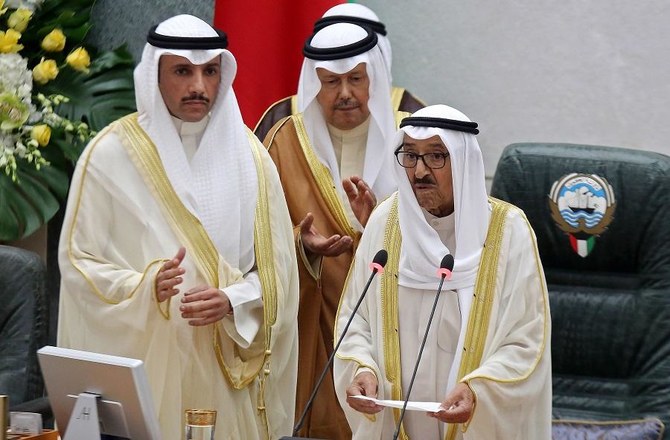
Kuwait’s government resigns ahead of anticipated elections

- An election is also expected for the 50-seat parliament in early 2020
- Emir of Kuwait accepted the resignation Prime Minister Sheikh Jaber Mubarak Al-Sabah


UN chief condemns Israeli law blocking electricity, water for UNRWA facilities
- The agency provides education, health and aid to millions of Palestinians in Gaza, the West Bank, Jordan, Lebanon and Syria
United Nations Secretary General Antonio Guterres condemned on Wednesday a move by Israel to ban electricity or water to facilities owned by the UN Palestinian refugee agency, a UN spokesperson said.
The spokesperson said the move would “further impede” the agency’s ability to operate and carry out activities.
“The Convention on the Privileges and Immunities of the United Nations remains applicable to UNRWA (United Nations Relief and Works Agency for Palestine Refugees in the Near East), its property and assets, and to its officials and other personnel. Property used by UNRWA is inviolable,” Stephane Dujarric, spokesman for the secretary-general, said while adding that UNRWA is an “integral” part of the world body.
UNRWA Commissioner General Phillipe Lazzarini also condemned the move, saying that it was part of an ongoing “ systematic campaign to discredit UNRWA and thereby obstruct” the role it plays in providing assistance to Palestinian refugees.
In 2024, the Israeli parliament passed a law banning the agency from operating in the country and prohibiting officials from having contact with the agency.
As a result, UNRWA operates in East Jerusalem, which the UN considers territory occupied by Israel. Israel considers all Jerusalem to be part of the country.
The agency provides education, health and aid to millions of Palestinians in Gaza, the West Bank, Jordan, Lebanon and Syria. It has long had tense relations with Israel but ties have deteriorated sharply since the start of the war in Gaza and Israel has called repeatedly for UNRWA to be disbanded, with its responsibilities transferred to other UN agencies.
The prohibition of basic utilities to the UN agency came as Israel also suspended of dozens of international non-governmental organizations working in Gaza due to a failure to meet new rules to vet those groups.
In a joint statement, Canada, Denmark, Finland, France, Iceland, Japan, Norway, Sweden, Switzerland and the United Kingdom said on Tuesday such a move would have a severe impact on the access of essential services, including health care. They said one in three health care facilities in Gaza would close if international NGO operations stopped.


