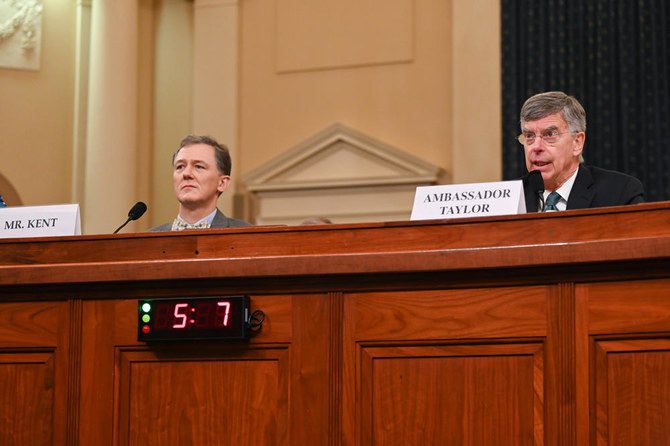

WASHINGTON: For the first time, the Democrats’ case for President Donald Trump’s impeachment streamed from Americans’ TVs Wednesday, including a new contention that he was overheard asking about political “investigations” that he demanded from Ukraine in trade for military aid.
On Day One of extraordinary public US House hearings — only the fourth formal impeachment effort in US history — career diplomats testified in the open after weeks of closed-door interviews aimed at removing the nation’s 45th president.
The account they delivered was a striking though complicated one that Democrats say reveals a president abusing his office, and the power of American foreign policy, for personal political gain.
“The matter is as simple and as terrible as that,” said Rep. Adam Schiff, the Democratic chairman of the Intelligence Committee, as he opened the daylong hearing. “Our answer to these questions will affect not only the future of this presidency but the future of the presidency itself.”
Career diplomat William Taylor, the charge d’affaires in Kyiv, offered new testimony that Trump was overheard asking on the phone about “the investigations” of Democrats that he wanted Ukraine to pursue that are central to the impeachment inquiry.
Trump said he was too busy to watch on Wednesday and denied having the phone call. “First I’ve heard of it,” he said when asked.
All day, the diplomats testified about how an ambassador was fired, the new Ukraine government was confused and they discovered an “irregular channel” — a shadow US foreign policy orchestrated by the president’s personal lawyer, Rudy Giuliani, that raised alarms in diplomatic and national security circles.
The hearing, playing out on live television and in the partisan silos of social media, provided the nation and the world a close-up look at the investigation.
At its core, the inquiry stems from Trump’s July 25 phone call when he asked Ukraine’s newly elected president, Volodymyr Zelenskiy, for “a favor.”
Trump wanted the Ukraine government to investigate Democrats’ activities in the 2016 election and his potential 2020 rival, Joe Biden — all while the administration was withholding military aid for the Eastern European ally that is confronting an aggressive neighbor, Russia.
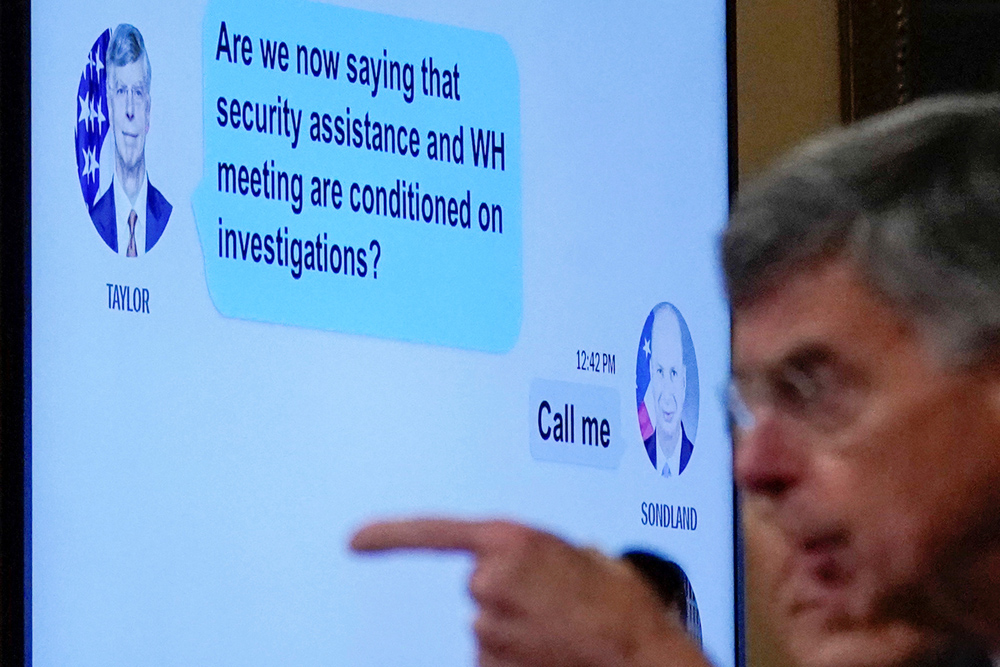
A text exchange between US Ambassador Bill Taylor (Ukraine) and Gordon Sondland (EU) shows on a screen as Taylor (R) testifies on the Trump impeachment inquiry in Washington on Nov. 13, 2019. (REUTERS/Jonathan Ernst)
Both sides tried to distill it into soundbites.
Democrats said Trump was engaged in “bribery” and “extortion.” Republicans said nothing really happened — the military aid was ultimately released after Congress complained.
Trump restated his aggressive defense with rapid-fire tweets, a video from the Rose Garden and a dismissive retort from the Oval Office as he met with another foreign leader.
“It’s a witch hunt. It’s a hoax,” he said as he appeared with visiting Turkish President Recep Tayyip Erdogan by his side.
Across the country, millions of Americans were tuning in — or, in some cases, deliberately tuning out.
Viewers on the right and left thought the day underscored their feelings. Anthony Harris, cutting hair in Savannah, Georgia, had the hearing on in his shop, but he said, “It’s gotten to the point now where people are even tired of listening.”
The hours of partisan back-and-forth did not appear to leave a singular moment etched in the public consciousness the way the Watergate proceedings or Bill Clinton’s impeachment did generations ago.
“No real surprises, no bombshells,” said committee member Rep. Chris Stewart, R-Utah.
Still, the session unspooled at least partly the way Democrats wanted with the somber tones of career foreign service officers telling what they knew. They sounded credible.
The witnesses, the graying Taylor and Deputy Assistant Secretary of State George Kent in his bow tie, defied White House instructions not to appear. Both received subpoenas.
They are among a dozen current and former officials who already testified behind closed doors. Wednesday was the start of days of public hearings that will stretch into next week.
Taylor, who was asked by Secretary of State Mike Pompeo to return to Ukraine as Trump was firing Ambassador Marie Yovanovitch, introduced new information Wednesday.
He testified that a staff member recently told him of overhearing Trump when they were meeting with another diplomat, Ambassador Gordon Sondland, at a restaurant the day after Trump’s July 25 phone call to the Ukraine president that sparked the impeachment investigation.
The staff member explained that Sondland had called the president and they could hear Trump on the phone asking about “the investigations.” The ambassador told the president the Ukrainians were ready to move forward, Taylor testified.
In the face of Trump’s denial, Schiff expects the person to appear before investigators for a closed-door deposition. He is David Holmes, the political counselor at the embassy in Kyiv, according to an official unauthorized to discuss the matter and granted anonymity.
Republicans argued that even with the diplomats at the witness table the Democrats have only second- or third-hand knowledge of Trump’s alleged transgressions.
A Trump ally on the panel, Rep. Jim Jordan of Ohio, mockingly called Taylor the Democrats’ “star witness” and said he’d “seen church prayer chains that are easier to understand than this.”
Taylor, a West Point graduate and former Army infantry officer in Vietnam, responded: “I don’t consider myself a star witness for anything.”
The top Republican on the panel, Rep. Devin Nunes of California, said Trump had a “perfectly good reason” for wanting to investigate the role of Democrats in 2016 election interference, giving airtime to a theory that runs counter to mainstream US intelligence which found that Russia intervened and favored Trump.
Nunes accused the Democratic majority of conducting a “scorched earth” effort to take down the president after the special counsel’s Russia investigation into the 2016 election failed to spark impeachment proceedings.
The veteran foreign service officers delivered heartfelt history lessons about Ukraine, a young and hopeful democracy, situated next to Russia but reaching out to the West.
Asked about Trump’s withholding military aid from such an ally, Taylor said, “It was illogical. It could not be explained. It was crazy.”
Both men defended Yovanovitch, a career officer who Kent has said was subject to Giuliani’s “campaign of lies.” She is to testify publicly Friday.
Kent, in his opening remarks, directly contradicted a core complaint against Joe Biden being raised by allies of the White House. While he said he himself raised concerns in 2015 about the vice president’s son, Hunter Biden, being on the board of Burisma, a Ukraine gas company, he “did not witness any efforts by any US official to shield Burisma from scrutiny.”
Republicans sought to hear from the anonymous whistleblower by subpoenaing him for a closed-session. The panel voted down the request and Schiff and repeatedly denied the GOP claim that he knows the person.
“We will do everything necessary to protect the whistleblower’s identity,” Schiff declared.
The Constitution sets a dramatic but vague bar for impeachment, There’s no consensus yet that Trump’s actions at the heart of the inquiry meet the threshold of “high crimes and misdemeanors.”
The anonymous whistleblower first alerted officials to concerns about the Trump phone call with Zelenskiy. The White House released a rough transcript of the telephone conversation, with portions deleted.
House Speaker Nancy Pelosi was initially reluctant to launch a formal impeachment inquiry. But she pressed ahead after the whistleblower’s complaint. She said Wednesday it was sad that the country has to undergo the inquiry with Trump, but “he will be held accountable.”