

Chinese buyout marks new chapter in British Steel history

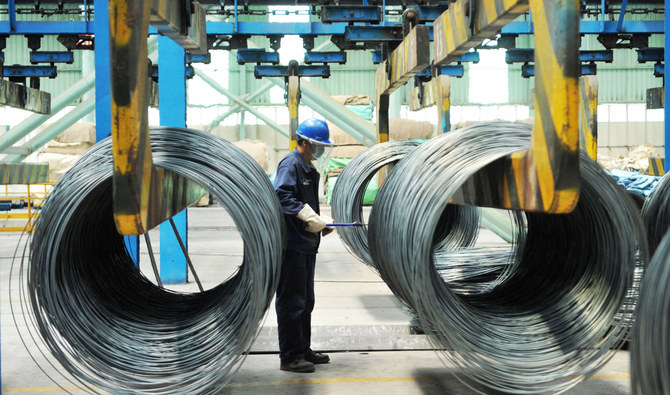
British Steel, which makes high-margin, long steel products used in construction and rail, would give Jingye access to European infrastructure market. (AFP)
Updated 13 November 2019
Follow

Chinese buyout marks new chapter in British Steel history

  • UK Steel calls it ‘positive news’ for the steelmaking industry

LONDON: A Chinese buyout marks a new chapter in the tumultuous history of steelmaking in the UK, which has been characterized by nationalization, privatizations and recurring crises.

Despite having an economy dominated by the services sector, steelmaking retains a special place in British hearts, where it is an enduring symbol of a bygone golden industrial age.

That explains the huge interest in Monday’s announcement of a buyout of British Steel by China’s Jingye, which made national headlines even with an election campaign in full swing.

The takeover should be a breath of fresh air for some 4,000 British Steel employees, most of whom work at the Scunthorpe site in northern England.

Professional body UK Steel called it “positive news for British Steel and its workers,” assessing it would go toward “delivering a sustainable future” for the industry.

Jingye for its part has promised to invest £1.2 billion (€1.4 billion, $1.5 billion) over the next decade, without elaborating on how it will turn around the loss-making firm.

FASTFACTS

•China’s Jingye has promised to invest $1.5 billion over the next decade.

•The takeover is seen as a breath of fresh air for some 4,000 British Steel employees.

•British Steel has its roots as far back as the Industrial Revolution but took shape in 1967.

“It’s not a huge investment,” said Jonathan Owens, director of the business and management program at Salford University, and a former worker at British Steel.

“My worry would be that it is only a short-term investment. Are they just buying the knowledge of the high-quality steel production that goes on at Scunthorpe?”

So far Jingye has only said it would keep on as many employees as possible, without committing to a figure, and said cost-cutting would be necessary. It is difficult to say if the Chinese group will succeed where others have failed to ensure a future for British Steel, which is responsible for one-third of the country’s production.

British Steel has its roots as far back as the Industrial Revolution but took shape in 1967 when the Labour government nationalized the industry, which at the time employed nearly 270,000 people.

The 1980s were painful, as global demand declined and steel plants turned loss-making. A series of strikes saw the Conservative government under the “Iron Lady” Margaret Thatcher privatize the firm in 1988. That signaled the start of a long decline that involved deep cuts in the workforce, the closure of sites and the loss of the company’s name before Tata Steel bought it in 2007.

In 2016, the investment fund Greybull Capital bought part of its activities for a symbolic one pound.

Greybull Capital brought back the name British Steel for its long steel products business, mainly in rail and construction, hoping to make it a European leader. But the dream did not become a reality and it went bust in May this year.

The slump again reflected difficulties in the sector, which now employs no more than about 32,000 people and has been hit by fierce competition from China and uncertainty over Brexit cutting demand from European clients.

The relaunch of British Steel, which is the second-biggest steelmaker in the country, will face as much scrutiny as the future of Tata Steel, which currently holds the top spot.

The Indian giant has revealed little of its plans for the UK since the recent failure of a tie-up between its European business and Germany’s Thyssenkrupp, prompting fears for the future of Tata’s Port Talbot plant in south Wales.

Port Talbot employs some 4,000 of Tata’s 8,000 employees in Britain.

A third business is still trying to make its mark, the Liberty House group of the British-Indian tycoon Sanjeev Gupta.

He has quietly built up his portfolio, notably by buying out steelmaking firms in former industrial areas, and is reported to be interested in some British Steel assets.

Another potential investor is the government, although under the ruling Conservatives it has been quieter on big industrial issues in recent years.

Arab food and beverage sector draws $22bn in foreign investment over 2 decades: Dhaman 

Updated 28 December 2025
Follow

Arab food and beverage sector draws $22bn in foreign investment over 2 decades: Dhaman 

JEDDAH: Foreign investors committed about $22 billion to the Arab region’s food and beverage sector over the past two decades, backing 516 projects that generated roughly 93,000 jobs, according to a new sectoral report. 

In its third food and beverage industry study for 2025, the Arab Investment and Export Credit Guarantee Corp., known as Dhaman, said the bulk of investment flowed to a handful of markets. Egypt, Saudi Arabia, the UAE, Morocco and Qatar attracted 421 projects — about 82 percent of the total — with capital expenditure exceeding $17 billion, or nearly four-fifths of overall investment. 

Projects in those five countries accounted for around 71,000 jobs, representing 76 percent of total employment created by foreign direct investment in the sector over the 2003–2024 period, the report said, according to figures carried by the Kuwait News Agency. 

“The US has been the region's top food and beverage investor over the past 22 years with 74 projects or 14 projects of the total, and Capex of approximately $4 billion or 18 percent of the total, creating more than 14,000 jobs,” KUNA reported. 

Investment was also concentrated among a small group of multinational players. The sector’s top 10 foreign investors accounted for roughly 15 percent of projects, 32 percent of capital expenditure and 29 percent of newly created jobs.  

Swiss food group Nestlé led in project count with 14 initiatives, while Ukrainian agribusiness firm NIBULON topped capital spending and job creation, investing $2 billion and generating around 6,000 jobs. 

At the inter-Arab investment level, the report noted that 12 Arab countries invested in 108 projects, accounting for about 21 percent of total FDI projects in the sector over the past 22 years. These initiatives, carried out by 65 companies, involved $6.5 billion in capital expenditure, representing 30 percent of total FDI, and generated nearly 28,000 jobs. 

The UAE led inter-Arab investments, accounting for 45 percent of total projects and 58 percent of total capital expenditure, the report added, according to KUNA. 

The report also noted that the UAE, Saudi Arabia, Egypt, and Qatar topped the Arab ranking as the most attractive countries for investment in the sector in 2024, followed by Oman, Bahrain, Algeria, Morocco, and Kuwait. 

Looking ahead, Dhaman expects consumer demand to continue rising. Food and non-alcoholic beverage sales across 16 Arab countries are projected to increase 8.6 percent to more than $430 billion by the end of 2025, equivalent to 4.2 percent of global sales, before exceeding $560 billion by 2029. 

Sales are expected to remain highly concentrated geographically, with Egypt, Saudi Arabia, Algeria, the UAE and Iraq accounting for about 77 percent of the regional total. By product category, meat and poultry are forecast to lead with sales of about $106 billion, followed by cereals, pasta and baked goods at roughly $63 billion. 

Average annual per capita spending on food and non-alcoholic beverages in the region is projected to rise 7.2 percent to more than $1,845 by the end of 2025, approaching the global average, and to reach about $2,255 by 2029. Household spending on these products is expected to represent 25.8 percent of total expenditure in 13 Arab countries, above the global average of 24.2 percent. 

Arab external trade in food and beverages grew more than 15 percent in 2024 to $195 billion, with exports rising 18 percent to $56 billion and imports increasing 14 percent to $139 billion. Brazil was the largest foreign supplier to the region, exporting $16.5 billion worth of products, while Saudi Arabia ranked as the top Arab exporter at $6.6 billion.