

PML-N condemns government for conditionally allowing ailing Sharif to travel

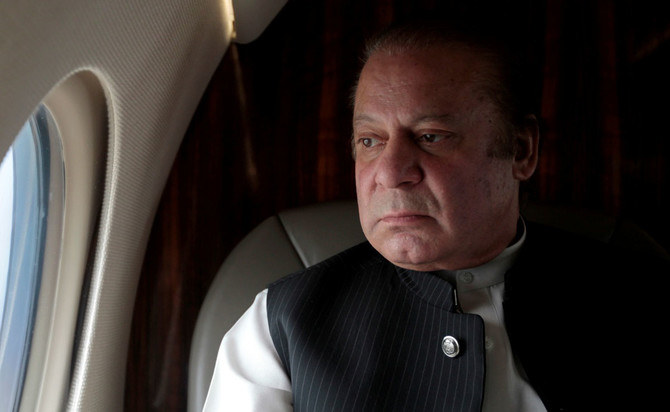
Former Prime Minister Muhammad Nawaz Sharif. (REUTERS)
Updated 14 November 2019
Follow

PML-N condemns government for conditionally allowing ailing Sharif to travel

  • Raja Zafarul Haq calls it the worst example of political victimization
  • Says the decision to accept or reject the offer solely rested with Sharif and his family

LAHORE: The Pakistan Muslim League-Nawaz (PML-N) on Wednesday described the government’s decision to conditionally allow its ailing leader, Nawaz Sharif, to travel abroad for medical treatment as the worst case of political victimization.

“The PML-N strongly condemns the government’s decision to seek surety bonds before allowing Nawaz Sharif to leave the country for treatment,” the party’s chairman, Raja Zafarul Haq, said while talking to Arab News. “It is the worst form of political victimization.”

Earlier in the day, the country’s law minister, Farogh Naseem, told a news conference in Islamabad that a sub-committee looking into the issue had decided to allow the former prime minister to leave the country for medical treatment.

“However, this will be one-time permission that will be subject to the provision of indemnity bonds worth Rs7 billion rupee,” he told the media. “Sharif will be allowed to go anywhere in the world but will have to return in four weeks.”

Naseem said the permission was granted to fulfill the government’s obligation in view of the former prime minister’s “critical medical condition.”

Reacting to the conditional permission, Haq told Arab News that the government was admitting that Sharif was seriously ill but was also creating hurdles in his way to travel abroad for medical treatment.

“The court has granted him an eight-week bail,” he added, “but the government is reducing that to four weeks and imposing an irrational condition. It is highly condemnable and we strongly protest this decision.”

However, he added the decision to accept or reject the government’s offer “solely rested with Nawaz Sharif and his family.”


Pakistan’s deputy PM says country seeks to convert $1 billion UAE deposit into investment

Updated 28 December 2025
Follow

Pakistan’s deputy PM says country seeks to convert $1 billion UAE deposit into investment

  • Ishaq Dar says the UAE will acquire shares in Pakistani companies using the amount, with transaction to be completed by March 31
  • The UAE’s remaining $2 billion in deposits, part of funds used to shore up Pakistan’s foreign reserves, are due for rollover in January

ISLAMABAD: Pakistan is seeking to convert part of its financial support from the United Arab Emirates into long-term investment to reduce external debt, Deputy Prime Minister Ishaq Dar said on Saturday, following talks with UAE President Sheikh Mohamed bin Zayed Al Nahyan during his visit to Islamabad.

Dar said Pakistan was engaged with the UAE on converting $1 billion in deposits into equity investment, potentially involving stakes in companies linked to the Fauji Fertilizer Group, a move that would end Pakistan’s repayment obligation on that portion of the funds.

The UAE has been one of Pakistan’s key financial backers in recent years, providing $3 billion in deposits to the central bank as part of a broader effort to stabilize the country’s external finances and unlock support from the International Monetary Fund.

Speaking at a year-end briefing, Dar said Pakistan had already begun discussions with the UAE on rolling over the first $1 billion tranche, but Islamabad now wanted to replace short-term borrowing with investment.

“They will be acquiring some shares, and this liability will end,” Dar said, adding that discussions were under way for the transaction to be completed by March 31.

Dar said the Fauji Foundation Group was taking the lead in the process, with plans for partial disinvestment by Fauji-linked and other companies to facilitate the deal.

He added that Pakistan also raised the issue of a separate $2 billion rollover due in January during talks with the UAE leadership, saying Islamabad had conveyed that converting debt into investment would be preferable to repeated rollovers.

The issue was discussed during Al Nahyan’s visit, which Dar described as cordial, adding that the UAE had expressed willingness to expand its investment footprint in Pakistan.

Pakistan has relied on repeated rollovers of deposits from friendly countries to manage its balance-of-payments pressures, a practice economists say provides short-term relief but adds to debt vulnerabilities unless replaced with foreign direct investment.

The country acquired $5 billion from Saudi Arabia and $4 billion from China, which, along with the UAE, helped shore up its foreign reserves and meet IMF conditions at a time when its external account was under severe pressure.

Dar said Pakistan was now focused on shifting from temporary financing toward longer-term capital inflows to stabilize its economy and reduce reliance on external borrowing.