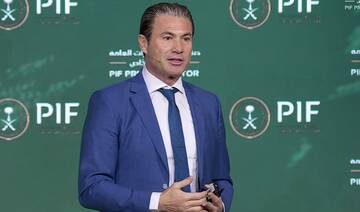
Six Flags names chief of Qiddiya theme park project, outside Riyadh

Brian Machamer
Updated 11 November 2019
Follow

Six Flags names chief of Qiddiya theme park project, outside Riyadh

  • Machamer is a leading name in the entertainment industry
  • He has more than 25 years’ experience developing many of the world’s top-level theme parks in several countries

JEDDAH: Six Flags International, the world’s largest amusement park company, has named Brian Machamer as president of Saudi Arabia’s first Six Flags theme park, which will be built in Qiddiya, outside the capital Riyadh.

The appointment comes as Riyadh strengthens plans to become the Kingdom’s entertainment, sports and arts showpiece.

Machamer is a leading name in the entertainment industry and has more than 25 years’ experience developing many of the world’s top-level theme parks in countries such as Singapore, the UAE, Malaysia and Saudi Arabia.


World-class destination

Commenting on the move, David McKillips, president of Six Flags International, described the Qiddya theme park as “one of the most exciting entertainment projects in the world” and said Machamer’s experience will ensure the establishment of a world-class destination.

Machamer said: “This is a lifetime opportunity to collaborate in introducing the Six Flags brand to Saudi Arabia.” 

This is a lifetime opportunity to collaborate in introducing the Six Flags brand to Saudi Arabia. The Six Flags Qiddiya will change the region’s game rules for family entertainment.

Brian Machamer

He said that Six Flags Qiddiya “will change the region’s game rules for family entertainment.”

Machamer began his career with Universal Studios in Florida, where he worked for 10 years from 1990. As president of Six Flags Qiddiya, he will oversee all park-related operations, including strategic planning, budgeting and operations.


Entertainment

Six Flags Qiddiya will be unveiled as part of the first phase of the Qiddiya project. The 32 hectares park will include 28 games and landmark attractions in six areas of the project: The City of Thrills, Discovery Springs, Steam Town, Twilight Gardens, Valley of Fortune and Grand Exposition.

The park will also feature rides, such as the Falcon’s Flight, and the world’s tallest, highest and fastest roller-coaster. It is expected to open officially in 2023.

Saudis spend $30 billion on tourism abroad every year. By providing new entertainment options for citizens and residents of Saudi Arabia, this project aims to redirect some of the overseas tourism spending back into the Kingdom.

This supports Vision 2030’s objective to increase spending within the Kingdom on culture and entertainment activities, from about 3 percent of household income to 6 percent.


Restaurants helps POS spending stay above $3bn: SAMA

Updated 59 min 21 sec ago
Follow

Restaurants helps POS spending stay above $3bn: SAMA

RIYADH: Spending in restaurants and cafes helped Saudi Arabia’s weekly point-of-sale transactions stay above the $3 billion mark during the week ending Dec. 13, coming in at SR13.31 billion ($3.54 billion).

According to the latest data from the Saudi Central Bank, expenditure in the sector reached SR1.73 billion, marking a 3.7 percent week-on-week increase, with the number of transactions surging by 3.2 percent to 58.49 million.

Despite this surge, the overall POS value dropped 7.9 percent, with transactions representing a 0.03 percent weekly decrease to 236.12 million.

The seven-day period saw broad declines across several sectors. Spending on freight transport, postal, and courier services recorded the sharpest drop, falling 43.3 percent to SR34.57 million. Education followed with a 42.9 percent decrease to SR124.91 million, while expenditure on laundry services declined by 15.6 percent to SR51.58 million.

Expenditure on apparel and clothing fell by 8.7 percent, and spending on telecommunications dropped by 15.5 percent. In contrast, jewelry was the only category to register growth, edging up 1.2 percent to SR329.70 million.

Spending on car rentals declined by 7.2 percent, and airline expenditure fell by 4.1 percent to SR44.39 million.

Expenditure on food and beverages saw a 14.3 percent decrease to SR2.01 billion, claiming the largest share of the POS, followed by restaurants and cafes, which retained the second position.

The Kingdom’s key urban centers mirrored the national decline. Riyadh, which accounted for the largest share of total POS spending, saw a 5.2 percent dip to SR4.63 billion, down from SR4.89 billion the previous week. 

The number of transactions in the capital settled at 74.57 million, up 0.5 percent week-on-week.

In Jeddah, transaction values decreased by 7.1 percent to SR1.77 billion, while Dammam reported an 8.7 percent dip to SR651.55 million.

POS data, tracked weekly by SAMA, provides an indicator of consumer spending trends and the ongoing growth of digital payments in Saudi Arabia. 

The data also highlights the expanding reach of POS infrastructure, extending beyond major retail hubs to smaller cities and service sectors, supporting broader digital inclusion initiatives. 

The growth of digital payment technologies aligns with the Kingdom’s Vision 2030 objectives, promoting electronic transactions and contributing to the nation’s broader digital economy.