BEIRUT: Several petrol stations in protest-hit Lebanon stopped services Saturday, as reserves ran dry due to a shortage of US dollars to pay suppliers, a syndicate head said.
The shuttering of petrol stations came as demonstrators again took to the street across the country, keeping up their three-week-long movement against a political class regarded as inefficient and corrupt.
“The petrol stations that opened today are the ones that still have reserves. They will close down as soon as supply runs out,” said Sami Brax, the head of the Syndicate of Gas Station Owners.
He said if officials do not facilitate access to dollars by Tuesday, “we will be forced to stop imports and close down all petrol stations.”
Petrol stations receive payment from customers in Lebanese pounds but have to pay importers and suppliers in dollars.
For two decades, the Lebanese pound has been pegged to the US dollar, with both currencies used interchangeably in daily life.
But banks have been reducing access to dollars since the end of the summer, following fears of a shortage in central bank dollar reserves.
In recent days, banks halted all ATM withdrawals in dollars and severely restricted conversions from Lebanese pounds.
Many Lebanese have had to instead buy dollars from money changers at a higher exchange rate, in what amounts to a de-facto devaluation of the local currency that has sparked price hikes.
The official exchange rate has remained fixed at 1,507 Lebanese pounds to the dollar, but the rate in the parallel market has surpassed 1,800.
“The banks are under pressure from people, both inside Lebanon and abroad,” said economist Naseeb Ghabreel, after many rushed to withdraw their dollar savings or convert Lebanese pound accounts.
Since September, petrol station owners have accused banks of failing to provide them with the dollars they need and threatened strikes.
In response, the central bank last month pledged to facilitate access to the greenback for importers of petroleum products, wheat and medicine.
But the measure has not yet gone into effect.
Lebanon has since October 17 witnessed an unprecedented popular uprising against everything from power cuts and poor social security to alleged state corruption.
The government yielded to popular pressure and stepped down last month, with the World Bank urging for the quick formation of a new cabinet to prevent the economy from further deteriorating.

Petrol pumps shut down in protest-hit Lebanon over dollar shortage
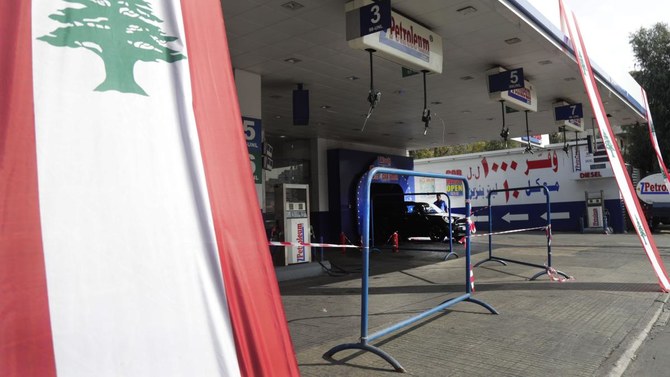
- The shuttering of petrol stations came as demonstrators again took to the street across the country
- Petrol stations receive payment from customers in Lebanese pounds but have to pay importers and suppliers in dollars
January settler attacks cause record West Bank displacement since Oct 2023: UN
RAMALLAH: Israeli settler violence and harassment in the occupied West Bank displaced nearly 700 Palestinians in January, the United Nations said Thursday, the highest rate since the Gaza war erupted in October 2023.
At least 694 Palestinians were forcefully driven from their homes last month, according to figures from the UN’s humanitarian agency OCHA, which compiles data from various United Nations agencies.
The UN Human Rights Office (OHCHR) said in late January that settler violence has become a key driver of forced displacement in the West Bank.
January’s displacement numbers were particularly high in part due to the displacement of an entire herding community in the Jordan Valley, Ras Ein Al-Auja, whose 130 families left after months of harassment.
“What is happening today is the complete collapse of the community as a result of the settlers’ continuous and repeated attacks, day and night, for the past two years,” Farhan Jahaleen, a Bedouin resident, told AFP at the time.
Settlers in the West Bank, which Israel has occupied since 1967, use herding to establish a presence on agricultural lands used by Palestinian communities and gradually deny them access to these areas, according to a 2025 report by Israeli NGO Peace Now.
To force Palestinians out, settlers resort to harassment, intimidation and violence, “with the backing of the Israeli government and military,” the settlement watchdog said.
“No one is putting the pressure on Israel or on the Israeli authorities to stop this and so the settlers feel it, they feel the complete impunity that they’re just free to continue to do this,” said Allegra Pacheco, director of the West Bank Protection Consortium, a group of NGOS working to support Palestinian communities against displacement.
She pointed to a lack of attention on the West Bank as another driving factor.
“All eyes are focused on Gaza when it comes to Palestine, while we have an ongoing ethnic cleansing in the West Bank and nobody’s paying attention,” she told AFP.
West Bank Palestinians are also displaced when Israel’s military destroys structures and dwellings it says are built without permits.
In January, 182 more Palestinians were displaced due to home demolitions, according to OCHA.
Excluding Israeli-annexed east Jerusalem, the West Bank is home to more than 500,000 Israelis living in settlements and outposts considered illegal under international law.
Around three million Palestinians live in the West Bank.
At least 694 Palestinians were forcefully driven from their homes last month, according to figures from the UN’s humanitarian agency OCHA, which compiles data from various United Nations agencies.
The UN Human Rights Office (OHCHR) said in late January that settler violence has become a key driver of forced displacement in the West Bank.
January’s displacement numbers were particularly high in part due to the displacement of an entire herding community in the Jordan Valley, Ras Ein Al-Auja, whose 130 families left after months of harassment.
“What is happening today is the complete collapse of the community as a result of the settlers’ continuous and repeated attacks, day and night, for the past two years,” Farhan Jahaleen, a Bedouin resident, told AFP at the time.
Settlers in the West Bank, which Israel has occupied since 1967, use herding to establish a presence on agricultural lands used by Palestinian communities and gradually deny them access to these areas, according to a 2025 report by Israeli NGO Peace Now.
To force Palestinians out, settlers resort to harassment, intimidation and violence, “with the backing of the Israeli government and military,” the settlement watchdog said.
“No one is putting the pressure on Israel or on the Israeli authorities to stop this and so the settlers feel it, they feel the complete impunity that they’re just free to continue to do this,” said Allegra Pacheco, director of the West Bank Protection Consortium, a group of NGOS working to support Palestinian communities against displacement.
She pointed to a lack of attention on the West Bank as another driving factor.
“All eyes are focused on Gaza when it comes to Palestine, while we have an ongoing ethnic cleansing in the West Bank and nobody’s paying attention,” she told AFP.
West Bank Palestinians are also displaced when Israel’s military destroys structures and dwellings it says are built without permits.
In January, 182 more Palestinians were displaced due to home demolitions, according to OCHA.
Excluding Israeli-annexed east Jerusalem, the West Bank is home to more than 500,000 Israelis living in settlements and outposts considered illegal under international law.
Around three million Palestinians live in the West Bank.
© 2026 SAUDI RESEARCH & PUBLISHING COMPANY, All Rights Reserved And subject to Terms of Use Agreement.


