ISLAMABAD: Pakistan’s opposition party, Jamiat-e-Ulema-e-Islam (JUI-F), on Friday said it would scale up its anti-government protest from next week if Prime Minister Imran Khan refused to step down or call fresh elections in the country.
“We have devised our future strategy to increase pressure on the government for the fulfillment of our demands,” Hafiz Hussain Ahmad, JUI-F information secretary, told Arab News.
He said that negotiations with the government had failed to break the impasse since “we are not ready to back down from our demands.”
“All opposition parties have agreed in principle to scale up the protest and announce their next strategy on Sunday,” he said. “The government won’t be able to survive our next phase of protest.”
Ahmad, however, did not share the nuts and bolts of his strategy, but hinted that it might entail closure of highways and motorways across the country. “We have a number of options ready and will exercise them one by one,” he said.
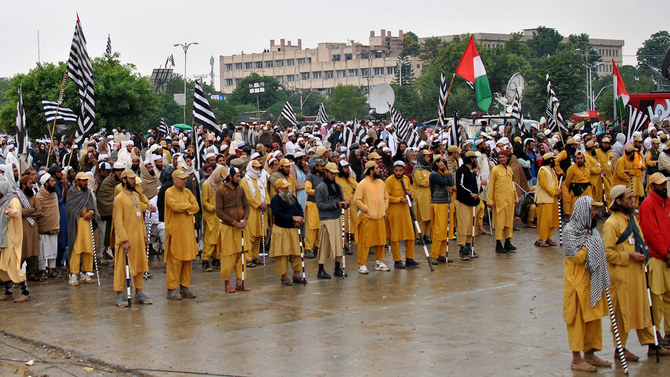
The JUI-F chief, Maulana Fazlur Rehman, has been leading tens of thousands of anti-government protesters in Islamabad, demanding the prime minister’s resignation and fresh elections in the country. The demonstrators have been camping in the federal capital since October 31 to force the government to fulfill their demands.
Several rounds of negotiations between the government and opposition representatives have so far failed to result in an agreement. “The government committee has nothing to offer to make us call off our protest,” the JUI-F information secretary said.
On the other hand, the government said the resignation of the prime minister was “off the table,” but they were ready to address the opposition’s “genuine demands.”
The firebrand religious cleric, who is known for his support base in religious schools across the country, enjoys the support of at least eight other opposition parties as well in seeking the prime minister’s resignation and calling for fresh polls in the country.
In a noisy National Assembly session on Friday, Defense Minister Pervez Khattak, who is leading the government negotiations committee, urged the opposition parties “to come to the table” and help the government resolve their genuine grievances.
“Keep sitting [in the ongoing sit-in], but don’t harm the country,” Khattak said while expressing the government’s resolve to sort out all issues with the opposition through dialogue.
The government earlier also offered the opposition parties formation of a judicial commission to probe the alleged rigging in July 2018 general elections, but the JUI-F chief rejected the proposal.
“We reject every proposal for the formation of the commission,” Rehman said.


![]()

JUI-F says protest will be scaled up amid deadlock with government
JUI-F says protest will be scaled up amid deadlock with government
- Oposition parties set to announce their next protest strategy on Sunday
- Tens of thousands of anti-government protesters have staged a sit-in since October 31
Latest updates


Recommended


© 2026 SAUDI RESEARCH & PUBLISHING COMPANY, All Rights Reserved And subject to Terms of Use Agreement.