LAHORE: Pakistan’s provincial administration of Punjab was forced to close all schools in this bustling eastern metropolis on Thursday, as the city was engulfed by smog once again and the poor quality of air raised alarm about the health of its 11 million residents.
“Lahore is among the top 10 most polluted cities in the world, according to Air Visual,” Nazifa Butt, Climate Manager at WWF Pakistan, told Arab News while referring to an organization that was set up in 2015 to monitor air pollution. “The ideal range for good air quality is between zero and 100. Lahore’s air quality went beyond 600 on 6th November, causing significant concern.”
The hazardous air pollution level compelled the province’s chief minister, Usman Buzdar, to announce the closure of schools on Thursday in a Twitter post.
“Due to the sudden increase in smog, all schools in Lahore will remain closed tomorrow (Thursday),” he tweeted from his official social media account on Wednesday night.
Pakistan’s cultural capital, Lahore, is no stranger to thick layers of smog that hang all over the city in winter season. The country’s second largest metropolis suffers due to smoke emissions from dozens of bricks kiln and mills that are located in and around its neighborhoods.
The authorities also burn all the garbage produced in the city, and farmers mostly set rice stubbles on fire before plowing their fields again.
Apart from all these issues, Lahore has lost significant number of trees as its settlements expand further and developmental activities take place.
Experts believe the poor air quality mostly affect the health of children and elderly people.
“There are 4.32 million students in Lahore who are only enrolled in private schools,” said Kashif Mirza, president private schools’ association, while talking to Arab News. “Last night [on Wednesday], the smog situation became extremely bad and there was a concern it could pose a threat to children’s health. However, the situation improved due to short intervals of rain that somewhat brought down the level of air pollution.”
The Punjab environment department’s officials, however, blamed Indian farmers for the situation since Lahore is located right next to the country’s eastern border.
“The smog increased in Lahore due to the burning of residues of produce in Indian cultivated areas and changing of the direction of the wind,” said an official handout issued by Chief Minister’s Secretariat on Thursday.
“Be that as it may, people are suffering from diseases related to chest and throat,” Dr. Saleem Shehzad Cheema, Medical Superintendent of Services Hospital, told Arab News. “Children are the most vulnerable residents of the city. In the last three hours, we have treated more than 50 people, 35 of them children. We are hoping that the situation will get better, though, in the next few days since a few rain spells may minimize the smog level.”


![]()

Toxic smog forces schools closed in Pakistani city of Lahore
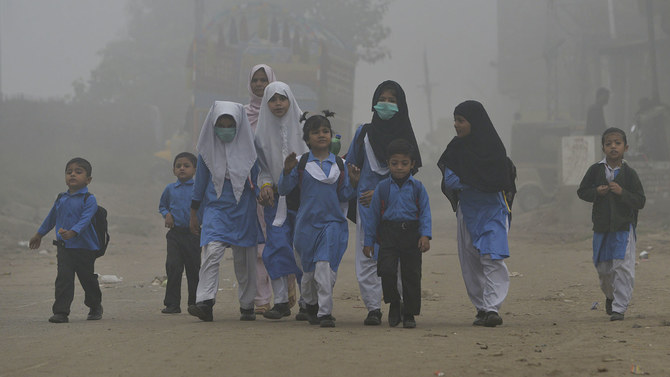
Toxic smog forces schools closed in Pakistani city of Lahore
- Places like Lahore has lost significant number of trees as it expands and undergoes developmental activities
- Medical practitioners say they have been getting cases where people are suffering from throat- and chest-related diseases
Latest updates


Recommended


© 2026 SAUDI RESEARCH & PUBLISHING COMPANY, All Rights Reserved And subject to Terms of Use Agreement.