BOGOTA: Colombia’s defense minister resigned Wednesday after coming under fire for failing to disclose the deaths of several minors in a military operation against dissidents belonging to the nation’s once largest guerrilla.
Guillermo Botero submitted a resignation letter to President Iván Duque, touting his achievements in reducing crime while stating that the current “political circumstances” had compelled him to step down.
“I’ve accepted the resignation,” Duque announced on Twitter. “I want to thank him for his commitment, sacrifice and leadership.”
The former minister has been facing mounting criticism over his handling of several incidents highlighting Colombia’s ongoing struggle to defeat illegal armed groups without repeating past errors and rights abuses.
On Tuesday, Sen. Roy Barreras accused Botero of neglecting to inform the public that at least seven minors had been killed in a military operation against dissidents with the former Revolutionary Armed Forces of Colombia during a heated debate in congress.
Botero described the accusations as “speculative information” and the military denied it knew that minors were present.
Nonetheless, the chief prosecutor’s office confirmed Wednesday that eight minors died in the late August operation in San Vicente del Caguán, a region once controlled by the rebels, who signed a historic peace accord ending Latin America’s longest-running conflict in 2016.
“I’m convinced the minister withheld information not just from Colombians but from the president,” Barreras said Wednesday. “This is a wake-up call for the government, demanding they redirect the national agenda.”
The outrage over the deaths follows a number of other incidents raising concerns about the military’s conduct and their response to a growing tide of violence against indigenous communities and social leaders.
In one recent incident, a man living in the violence-plagued region of Cauca was killed in what the military has described as an operation against dissident guerrillas but which nearby residents contend was a homicide.
Two separate massacres in Cauca in late October, including one that left five indigenous leaders dead, outraged Colombians and underlined continuing security threats in regions where remnant illegal armed groups are battling over territory and lucrative drug routes.
Legislators debated removing Botero back in June, following revelations that an army general had commanded troops to double the number of leftist guerrillas and criminals killed, captured or forced to surrender in combat. The guidelines raised concerns about a heightened risk of civilian casualties.
Colombia’s military has been blamed for as many as 5,000 extrajudicial killings at the heights of the country’s armed conflict in the mid-2000s as troops under pressure by top commanders inflated body counts, in some cases dressing up civilians as guerrillas in exchange for extra pay and other perks.
What became known as the “false positives” scandal cast a dark shadow over the military’s record of battleground victories.
Botero first denied the existence of the new guidelines, but the military later announced it was retracting the order.
“This is clearly somebody who should have never been appointed to that position,” said José Miguel Vivanco, Americas director of Human Rights Watch. “I’m frankly surprised that he survived for so long.”


Colombia defense minister quits amid firestorm over deaths
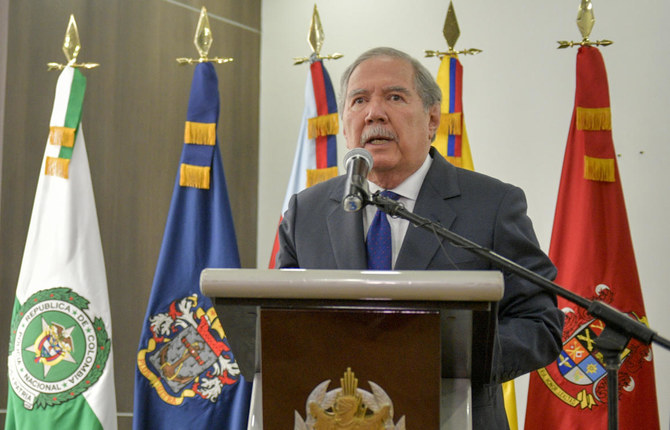
Colombia defense minister quits amid firestorm over deaths

- Guillermo Botero submitted a resignation letter to President Iván Duque
- The former minister has been facing mounting criticism over his handling of several incidents

EU regulator backs approval for Moderna’s combined COVID and flu vaccine
- Currently people need two separate shots to protect them against COVID-19 and influenza
- Moderna is banking on the COVID-flu combination shot
BRUSSELS: Europe’s medicines regulator recommended approval for Moderna’s COVID and flu combination vaccine on Friday, putting it on track to become the first single shot to protect people aged 50 and older against both illnesses.
Currently people need two separate shots to protect them against COVID-19 and influenza and the vaccines are updated regularly to match the viral strains in circulation.
Moderna is banking on the COVID-flu combination shot and also an mRNA-based flu shot to help it return to revenue growth as demand for COVID vaccines has collapsed in the years after the pandemic.
It hopes international markets will drive revenue growth this year, as anti-vaccine activist US Health Secretary Robert F. Kennedy Jr has disrupted the domestic market.
MODERNA SHARES HAVE PLUNGED FROM 2021 HIGHS
Shares of the biotech, which were flat in US premarket hours on Friday, have declined by nearly 90 percent from 2021 highs.
Last year, Moderna withdrew its US application for its COVID-flu combination shot to wait for efficacy data from a late-stage trial of its influenza vaccine.
Earlier this month, the company said it was waiting for guidance from the Food and Drug Administration on refiling the application.
US regulators initially refused to review a separate mRNA-based flu vaccine from the company, then reversed course a week later after Moderna amended its application.
EMA’s recommendation on Friday was based on data from a study of 8,000 participants that showed those who received mCombriax generated more antibodies than those who received separate shots against the viruses.
The study compared mCombriax with a combination of Moderna’s COVID-19 shot Spikevax and traditional flu shots from GSK and Sanofi.
EMA also considered data from a study of a similar mRNA flu vaccine, in which mCombriax triggered an adequate immune response. The shot contains messenger RNA with instructions for making proteins found on some strains of the influenza virus and SARS-CoV-2.
EMA’s recommendation will be reviewed by the European Commission, which will give the final sign off for marketing in the European Union. It was not clear how long that decision would take.