ISLAMABAD: The weeklong anti-government protest in Islamabad has hit the local economy hard, besides causing a nuisance to commuters in the federal capital, making businessmen fear that the demonstration would result in millions of rupees of losses and lead to low revenue collection for the government.
Tens of thousands of demonstrators led by Islamist cleric and chief of the opposition party, Jamiat-e-Ulema-e-Islam (JUI-F), Maulana Fazlur Rehman have camped in Islamabad since Thursday, demanding the resignation of Prime Minister Imran Khan and fresh elections in the country.
The anti-government protesters have blocked the main thoroughfare – the Kashmir Highway – that connects the federal capital with the rest of the country.

Supporters of religious and political party Jamiat Ulema-i-Islam-Fazal (JUI-F) wave flags and chant slogans during what participants call Azadi March (Freedom March) to protest the government of Prime Minister Imran Khan in Islamabad, Pakistan November 1, 2019. (Reuters)
Likewise, the local administration has blocked some other main arteries of the city with shipping containers to confine the demonstrators in the designated space and prevent their movement toward key government installations in Islamabad.
“Every business is affected in Islamabad due to the protest,” Ahmad Mughal, President of the Islamabad Chamber of Commerce and Industries, told Arab News on Wednesday. “Shops and businesses are deserted as thousands of people who visit the city on a daily basis from other places are not coming.”
Mughal said anti-government protests “affect the whole business environment across Pakistan,” adding that the low turnover of businesses would impact the government’s efforts to meet the revenue collection target of Rs5.5 trillion in this fiscal year. “If the sales are low, then obviously the tax collection, including the General Sales Tax and withholding tax, will also drop,” he said.
Islamabad has several hotels, restaurants, designer boutiques, foreign embassies, and important government offices which attract thousands of people from other cities.
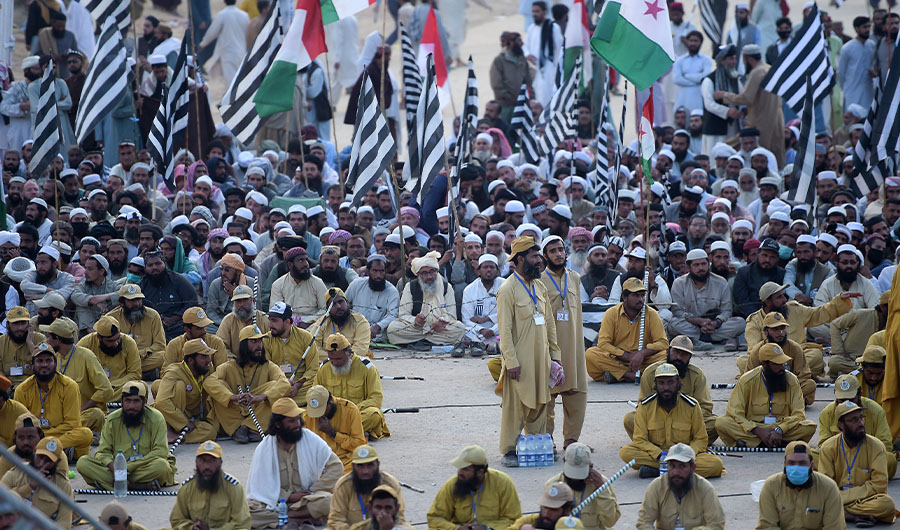
Activists and supporters of Islamic political party Jamiat Ulema-e-Islam (JUI-F) attend an anti-government "Azadi (Freedom) March" in Islamabad on November 5, 2019. (AFP)
“I was scheduled for a visa interview at the US Embassy in Islamabad last Friday, but it was canceled at the last moment due to the protest,” Shoaib Chattha, a resident of Multan, told Arab News on the telephone.
He said the political situation of the country had forced him to reschedule his plan to visit his relatives in Miami in the United States. “It is terrible,” he added. “The government should sort out this mess as quickly as possible.”
The local administration has also suspended the metro bus service between Rawalpindi and Islamabad for an indefinite period, causing trouble to thousands of commuters.

Activists of Islamic political party Jamiat Ulema-e-Islam (JUI-F) gather on containers during an anti-government "Azadi (Freedom) March" in Islamabad on November 1, 2019. (AFP)
“My traveling cost has increased about ten times [due to the closure of the metro bus service]. What is even worse is that it now takes me hours to reach the office since there are several detours,” Asad Jamal, who works with a software firm in Islamabad, told Arab News.
Economists and experts said the knock-on impact of the protests in the aviation, transportation and health care sectors would also push growth down in the coming months.
Pakistan’s economic growth already plummeted from 5.8 percent to 3.3 percent in the last year, and it is further expected to slow down to 2.5 percent this year due to the low industrial and agricultural production, double-digit inflation and increasing unemployment. The country signed off a $6 billion bailout package in July this year which entailed the International Monetary Fund’s tough economic conditions.
“The government should disperse the protesters as quickly as possible. Otherwise, it won’t be able to meet the IMF’s revenue collection target or succeed in economic reforms,” Mughal said.