Iraq PM says anti-government protests cost country ‘billions’

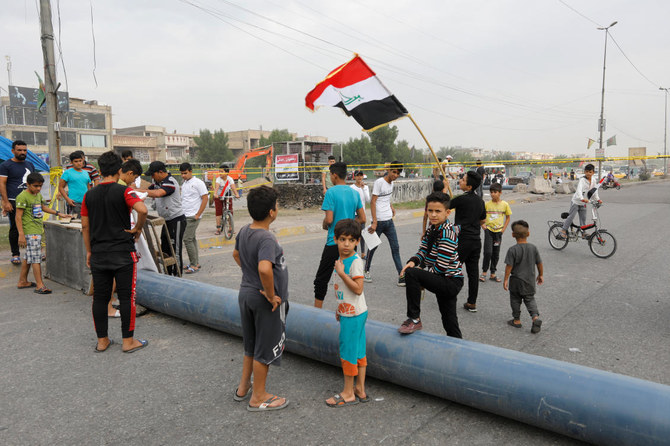
Iraqi demonstrators block the road during ongoing anti-government protests, in Baghdad, Iraq November 3, 2019. (Reuters)
Updated 03 November 2019
Follow

Iraq PM says anti-government protests cost country ‘billions’

  • Abdul-Mahdi said the protests have delayed the arrival of goods and this has contributed to an increase in prices paid by citizens
  • He differentiated between peaceful protesters and “saboteurs” who had used the demonstrators as “human shields”

BAGHDAD: Protests threatening the oil industry and blocking access to Iraq’s ports have cost the country “billions,” Prime Minister Adel Abdul-Mahdi said on Sunday.
The embattled leader issued a long statement in response to weeks of demonstrations against the government that have been met with a brutal response from the security forces, killing more than 250 people.
Abdul-Mahdi said the protests have delayed the arrival of goods and this has contributed to an increase in prices paid by citizens, the poor in particular.
He also said demonstrations have affected the growth of the economy and delayed the submission of the budget for 2020.
Last week, President Barham Salih said Abdul-Mahdi is willing to resign amid the crisis once political leaders agree on a replacement.
But the prime minister made no mention of standing down, instead focussing on the economic damage of the protests.
He said the Baghdad International Fair was delayed because of the demonstrations, and that sick people’s lives have been put at risk because medical clinics have been forced to close and ambulances obstructed.
He called on anti-government protesters to reopen roads saying “it’s time for life to return to normal.”
The prime minister differentiated between peaceful protesters, who he said had turned the demonstrations into “popular festivals” that bring the nation together, and “saboteurs” who had used the demonstrators as “human shields” while attacking security forces.
He also called for markets, factories, schools and universities to reopen after days of protests in the capital and across the mostly Shiite south.
Tens of thousands of protesters have gathered in Baghdad’s central Tahrir Square and across southern Iraq in recent days, calling for the overhaul of the political system established after the 2003 US-led invasion.
Protesters have also taken over a large tower in the square that was abandoned after it was damaged in the war.
Thousands of students have skipped classes to take part in the street rallies, blaming the political elite for widespread corruption, high unemployment and poor public services.
Earlier Sunday, protesters blocked roads around their main protest site with burning tires and barbed wire, unfurling a banner at one roadblock reading: “Roads closed by order of the people.”
They appeared to be borrowing a tactic from Lebanon, where similar anti-government demonstrations have been underway since Oct. 17, and have repeatedly blocked major roads in order to ramp up pressure on authorities.

(With AP)


Lebanon ex-central bank chief's corruption case being sent to top court, officials say

Updated 10 sec ago
Follow

Lebanon ex-central bank chief's corruption case being sent to top court, officials say

BEIRUT: The corruption case of Lebanon's former central bank governor, who is widely blamed for the country’s economic meltdown, has been transferred to the country's highest court, judicial officials told The Associated Press on Tuesday.
Riad Salameh was released on $14 million bail in September after a year in prison while awaiting trial in Lebanon on corruption charges, including embezzlement and illicit enrichment.
The trial of Salameh, 75, and his two legal associates, Marwan Khoury and Michel Toueini, will now be heard at the Court of Cassation, according to a copy of the notice obtained by the AP. Salameh and the others will be issued with arrest warrants if they don't show up for trial at the court.
No trial date has been set yet. Salameh denies the charges. The court’s final ruling can't be appealed, according to the four officials who spoke on condition of anonymity, because they weren't authorized to speak with the media.
In September 2024, he was charged with the embezzlement of $42 million, with the court later adding charges of illicit enrichment over an apartment rented in France, supposedly to be a substitute office for the central bank if needed. Officials have said that Salameh had rented from his former romantic partner for about $500,000 annually.
He was once celebrated for steering Lebanon’s economic recovery, after a 15-year civil war, upon starting his long tenure in 1993 and keeping the fragile economy afloat during long spells of political gridlock and turmoil.
But in 2023, he left his post after three decades with several European countries investigating allegations of financial crimes. Meanwhile, much of the Lebanese blame his policies for sparking a fiscal crisis in late 2019 where depositors lost their savings, and the value of the local currency collapsed.
On top of the inquiry in Lebanon, he is being investigated by a handful of European countries over various corruption charges. In August 2023, the United States, United Kingdom and Canada imposed sanctions on Salameh.
Salameh has repeatedly denied allegations of corruption, embezzlement and illicit enrichment. He insists that his wealth comes from inherited properties, investments and his previous job as an investment banker at Merrill Lynch.
Lebanon’s current central bank governor, Karim Souaid, announced last week that he's filing legal complaints against a former central bank governor and former banking official who diverted funds from the bank to what he said were four shell companies in the Cayman Islands. He didn't name either individual.
But Souaid said that Lebanon's central bank would become a plaintiff in the country's investigation into Forry Associates. The U.S. Treasury, upon sanctioning Salameh and his associates, described Forry Associates as “a shell company owned by Raja (Salameh’s brother) in the British Virgin Islands” used to divert about $330 million in transactions related to the central bank.
Several European countries, among them France, Germany, and Luxembourg, have been investigating the matter, freezing bank accounts and assets related to Salameh and his associates, with little to no cooperation from the central bank and Lebanese authorities.
Souaid said that he will travel later this month to Paris to exchange “highly sensitive” information as France continues its inquiries.