

‘By the people, for the people,’ Lebanese diaspora launches platform documenting Lebanon’s revolution

1 / 4
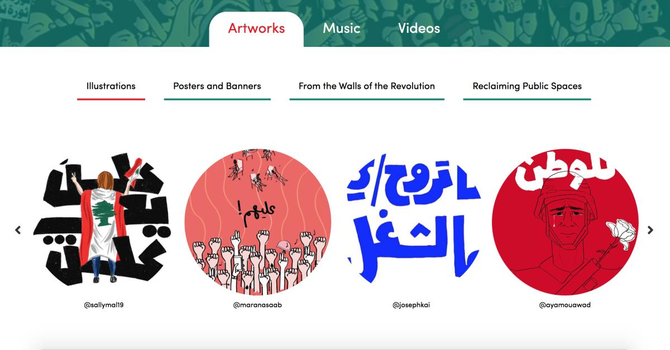
A group of Lebanese people from different ages and backgrounds launched the website “The Lebanese Revolution” to show solidarity with protestors. (Photo: The Lebanese Revolution's website)
2 / 4
A group of Lebanese people from different ages and backgrounds launched the website “The Lebanese Revolution” to show solidarity with protestors. (Photo: The Lebanese Revolution's website)
3 / 4
A group of Lebanese people from different ages and backgrounds launched the website “The Lebanese Revolution” to show solidarity with protestors. (Photo: The Lebanese Revolution's website)
4 / 4
A map showing the Lebanese diaspora's solidarity protests around the world. (Screenshot)
Updated 03 November 2019
Follow

‘By the people, for the people,’ Lebanese diaspora launches platform documenting Lebanon’s revolution

  • The website was born out of the frustration of a group of Lebanese people living in London
  • The site includes an interactive map of the world showing the different cities that held solidarity protests

LONDON: As the protests that began on October 17th unfurled into the Lebanese protesters’ October Revolution, those who were hundreds and thousands of kilometers away were attached to their phone screens, scrolling through social media sites like Twitter and Instagram in order to get all the news about what was going on in their home country.
Countless solidarity protests took place across the globe, from Sydney to Toronto, Lagos to Warsaw, while the Lebanese diaspora took to their online profiles to spread the news on the unprecedented unity among those on the streets back home against corruption.
The Lebanese in London had different ideas, in order to make an impact on the ground and help the cause, a group of people from different ages and backgrounds launched the website “The Lebanese Revolution”.
“The website, which was initially meant to be a simple blog, was born out of the frustration of a group of Lebanese living in London. A lot of their international friends were asking questions, and they were frustrated with how the media portrayed the start of the revolution, and with the fact that no news channel portrayed how the Lebanese population were coming together as one,” one of the members behind the website told Arab News.
The team decided they do not want reveal their names, so as not to associate the platform with anything other than the protest, and to keep the focus on the message and solidarity with the protesters on the ground.
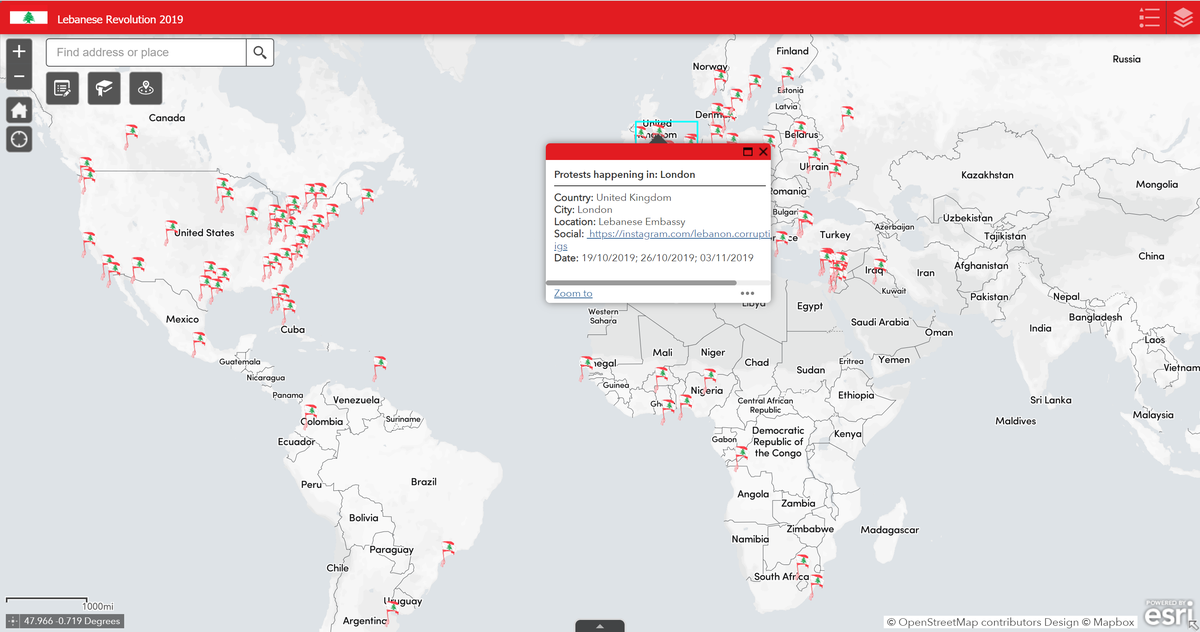


A map showing the Lebanese diaspora's solidarity protests around the world. (Screenshot)

“The site offers an overview of the revolution with its pillars and global impact, which includes a contribution section, where we’ll offer a forum for people to share articles they’ve written, pictures they’ve taken, or any other piece of information they want to share, and a timeline highlighting the most pressing news that occurred day by day since the start of the protests,” the anonymous member, who works on the site’s web strategy, added.
“The site’s mission is to share the Lebanese Revolution with the world by reporting vetted news, relaying a timeline of daily events, aggregating all the art that emerged from it, and offering a forum to exchange thoughts and perspectives.”

Other aspects of the site include an interactive map of the world showing the different cities that held solidarity protests, and a pledge section where people select a cause or causes they most identify with, or sign their own pledge (publicly or anonymously), for Lebanon.
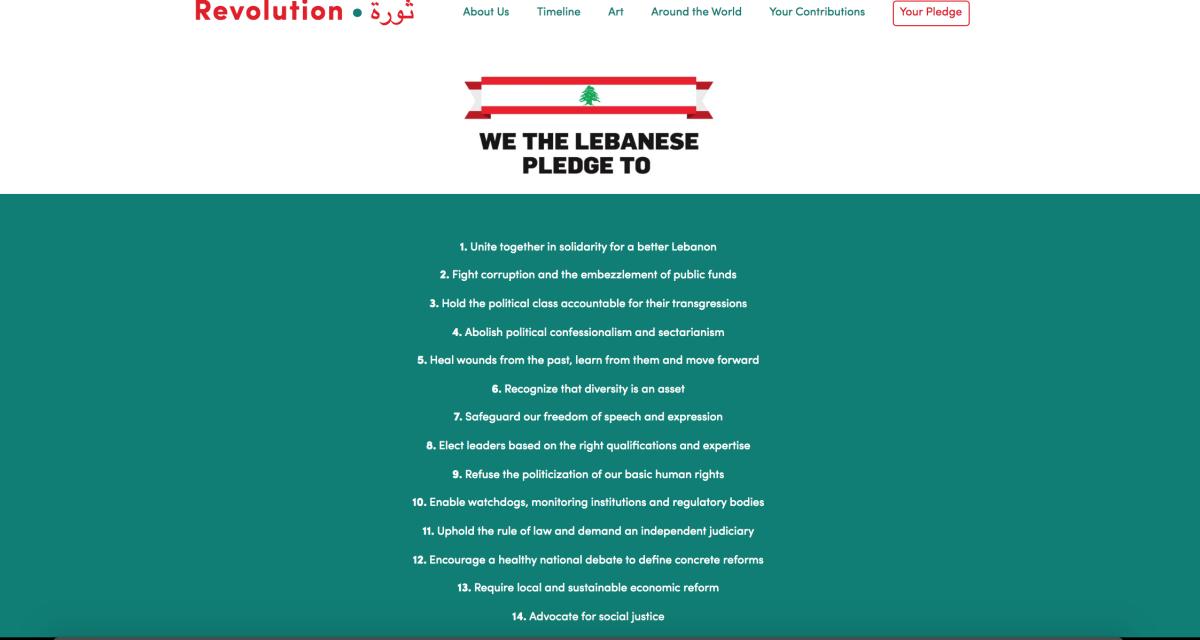


The pledge section where people select a cause or causes they most identify with, or sign their own pledge (publicly or anonymously), for Lebanon. (Screenshot)

“We truly believe that change starts from within. We wanted to offer a forum for people to speak their truths and share what they pledge to do in the name of a country they love,” the member said, adding: “The pledges we’ve had so far are extremely heartwarming, and makes it feel like we’re truly all in this together. One big family.”
The London team is not working alone. They are in constant contact with protesters on the streets daily, as well as other websites and initiatives that were born out of the protests.
“At the end of the day, it’s a website for the people, by the people. We’re all in this together,” they said.
Archiving art of the revolution
The website’s art section aims to centralize the art created through graphics, songs, videos, banners, or poems.
It is divided into four different sections, documenting illustrations, graffiti, slogans used during protests, and photos of public spaces which were previously closed off and are now being used for talks and open discourse among protesters.
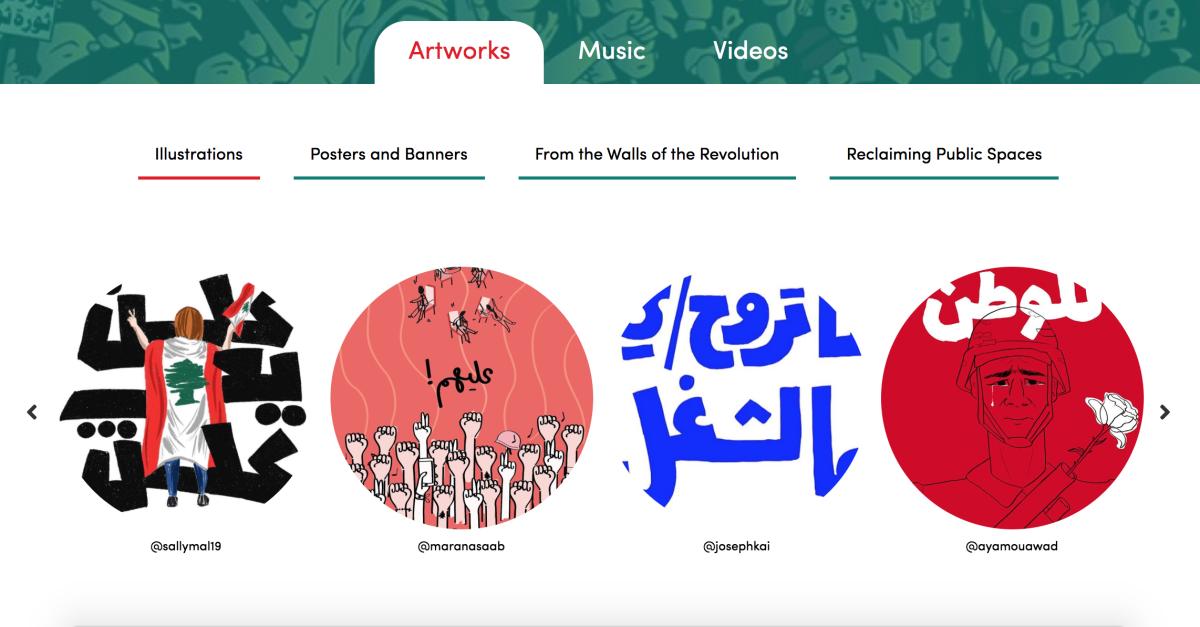


The art section is divided into four different sections. (Screenshot)

“Beirut always had a creative front and this was highlighted through the revolution,” another member of the team working on the art section told Arab News. “All of these illustrations and pictures are instantly shared through social media platforms, but how are we going to find them if we don’t document them in one place?”

Highlighting corruption
Another aspect of the website is the cooperation with Lebanese Corruption Facts, an instagram page focusing on economic statistics that highlight Lebanon’s corruption, as well as graphics to help explain them.
The page posts shot up to over 13,000 followers after its creation on Oct. 21, four days after the protests began.


32% of the annual government spend is on interest payments made to banks who own Lebanese government debt. 84% of total government debt is owned by local banks.⠀ ⠀ 43% of bank ownership can be attributed to individuals closely linked to politicians.⠀ ⠀ Politicians have no interest in reducing government debt as they are earning profit from the interest payments being made.⠀ ⠀ Through legal and judicial reforms to prevent abuse of public office, conflicts of interest and illicit enrichment this could generate a saving potential of $2bn every year through reduction in inflated interest payments.⠀ ⠀ SOURCE: McKinsey 2018 Lebanon Economic Vision & Economic Research Forum “I’ve got the Power: Mapping Connections Between Lebanon’s Banking Sector and the Ruling Class” Jad Chaaban 2016⠀ ⠀ #لبنان_ينتفض #LebanonRevolution

A post shared by FACTS (@lebanon.corruption.facts) on

“With the start of the revolution it only became logical to expose what we know, in a simple, clear and direct way; through facts and numbers,” The three-person team behind the instagram account, who didn’t want to be named so as to deliver their message without bias, told Arab News.
“As members of the Lebanese diaspora, unable to partake in the movement back home, we chose to support them from London by sharing information that should be readily available to the public but unfortunately isn’t,” they added.
Sources for these statistics include reports and analyzes publicly published by the International Monetary Fund, the World Bank, consulting firm McKinsey, and foreign media like the BBC and Sky News, as well as their followers after triple-checking the facts.


Lebanon’s consistently poor performance in these rankings is a symptom of government inefficiency and widespread corruption.⠀ ⠀ Indeed, according to the WEF, the 5 most problematic factors for doing business in Lebanon relate to government instability, corruption, inadequate infrastructure, inefficient government bureaucracy and policy instability. Despite “punching above its weight in terms of business sophistication, technological readiness and innovation” (Global Competitiveness Report 2017-18, pg. 178), Lebanon continues to be held back by its government.⠀ ⠀ SOURCE: 2017/2018 Global Competitiveness Report, World Economic Forum (WEF).⠀ ⠀ ‎#لبنان_ينتفض #LebanonRevolution⠀ ⠀

A post shared by FACTS (@lebanon.corruption.facts) on

“The problem is that the systemic corruption in Lebanon is not easy to understand, it is obfuscated and multi-layered, buried in long reports which are very detailed … but subsequently very complicated,” they said. “Our purpose is to deconstruct the systemic corruption one block at a time, one post at a time.”
The page posts its facts in both English and Arabic in order to reach the most people possible.
“By posting our facts in both Arabic and English we hope to raise awareness with the diaspora to lift the veil on what is happening back home. It is important for them to know these facts, as Lebanon is still a very significant place for them,” they said.


To infinity and beyond: Grendizer’s 50 years of inspiring Arabs

Updated 27 December 2025
Follow

To infinity and beyond: Grendizer’s 50 years of inspiring Arabs

  • ⁠ ⁠50 years after its creation, the Grendizer anime series continues to capture Arab imagination
  • ⁠ ⁠⁠Arab News Japan speaks to creator Go Nagai, Middle Eastern fans and retells the story behind the UFO Robot tasked with protecting our planet

LONDON: Few cultural imports have crossed borders as unexpectedly, or as powerfully, as Grendizer, the Japanese giant robot that half a century ago became a childhood hero across the Arab world, nowhere more so than in Saudi Arabia.

Created in Japan in the mid-1970s by manga artist Go Nagai, Grendizer was part of the “mecha” tradition of giant robots. The genre was shaped by Japan’s experience during the Second World War, and explored themes of invasion, resistance and loss through the medium of science fiction.

But while the series enjoyed moderate success in Japan, its true legacy was established thousands of kilometers away in the Middle East.

By the early 1980s, “Grendizer” had spread across the Middle East, inspiring fandoms in Saudi Arabia, Kuwait, Iraq and beyond. (Supplied)

The anime “UFO Robot Grendizer” arrived on television in the region in 1979, dubbed into Arabic and initially broadcast in Lebanon during the Lebanese civil war. The story it told of the heroic Duke Fleed, a displaced prince whose planet had been destroyed by alien invaders, struck a chord with children growing up amid regional conflict and occupation by Israel.

Its themes of defending one’s homeland, standing up to aggression and protecting the innocent were painfully relevant in the region, transforming the series from mere entertainment into a kind of emotional refuge.

Much of the show’s impact came from its successful Arabization. The powerful Arabic dubbing and emotionally charged voice-acting, especially by Lebanese actor Jihad El-Atrash as Duke Fleed, lent the show a moral gravity unmatched by other cartoons of the era.

While the series enjoyed moderate success in Japan, its true legacy was established thousands of kilometers away in the Middle East. (Supplied)

The theme song for the series, performed by Sami Clark, became an anthem that the Lebanese singer continued to perform at concerts and festivals right up until his death in 2022.

By the early 1980s, “Grendizer” had spread across the Middle East, inspiring fandoms in Saudi Arabia, Kuwait, Iraq and beyond. For many, it was not only their first exposure to anime, it also delivered lessons on values such as justice and honor.

Grendizer was so influential in the region that it became the subject of scholarly research, which in addition to recognizing the ways in which the plight of the show’s characters resonated with the audience in the Middle East, also linked the show’s popularity to generational memories of displacement, particularly the Palestinian Nakba.

By the early 1980s, “Grendizer” had spread across the Middle East, inspiring fandoms in Saudi Arabia, Kuwait, Iraq and beyond. (Supplied)

Half a century later, “Grendizer” remains culturally alive and relevant in the region. In Saudi Arabia, which embraced the original version of the show wholeheartedly, Manga Productions is now introducing a new generation of fans to a modernized version of the character, through a video game, The Feast of The Wolves, which is available in Arabic and eight other languages on platforms including PlayStation, Xbox and Nintendo Switch, and a new Arabic-language anime series, “Grendizer U,” which was broadcast last year.

Fifty years after the debut of the show, “Grendizer” is back — although to a generation of fans of the original series, their shelves still full of merchandise and memorabilia, it never really went away.


Grendizer at 50
The anime that conquered Arab hearts and minds
Enter
keywords