




Uncertainty looms as anti-government demonstrators camp in Islamabad

1 / 10
Activists of the Jamiat Ulema-e Islam part march along a road during an anti-government "Azadi (Freedom) March" in Islamabad on November 2, 2019. (AFP)
2 / 10
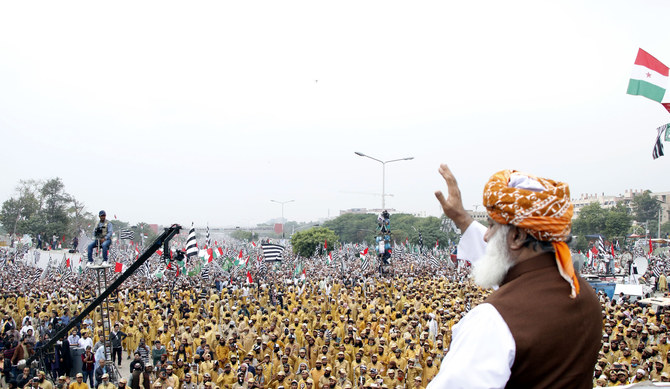
Chief of the Jamiat Ulema-e-Islam (JUI-F), Maulana Fazlur Rehman, waves at his supporters during the ongoing Azadi March in Islamabad on Nov. 1, 2019. (AN photo)
3 / 10
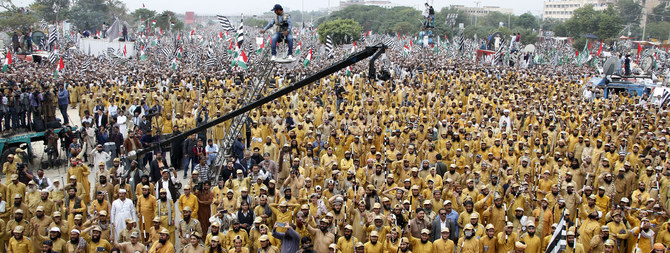
Scores of protesters took to the streets of Islamabad on Nov. 1, 2019, as part of the ongoing Azadi March led by Maulana Fazlur Rehman, chief of the Jamiat Ulema-e-Islam (JUI-F), seeking to topple Prime Minister Imran Khan's government. (AN photo)
4 / 10
Scores of protesters took to the streets of Islamabad on Nov. 1, 2019, as part of the ongoing Azadi March led by Maulana Fazlur Rehman, chief of the Jamiat Ulema-e-Islam (JUI-F), seeking to topple Prime Minister Imran Khan's government. (AN photo)
5 / 10
Scores of protesters took to the streets of Islamabad on Nov. 1, 2019, as part of the ongoing Azadi March led by Maulana Fazlur Rehman, chief of the Jamiat Ulema-e-Islam (JUI-F), seeking to topple Prime Minister Imran Khan's government. (AN photo)
6 / 10
Scores of protesters took to the streets of Islamabad on Nov. 1, 2019, as part of the ongoing Azadi March led by Maulana Fazlur Rehman, chief of the Jamiat Ulema-e-Islam (JUI-F), seeking to topple Prime Minister Imran Khan's government. (AN photo)
7 / 10
Scores of protesters took to the streets of Islamabad on Nov. 1, 2019, as part of the ongoing Azadi March led by Maulana Fazlur Rehman, chief of the Jamiat Ulema-e-Islam (JUI-F), seeking to topple Prime Minister Imran Khan's government. (AN photo)
8 / 10
Scores of protesters took to the streets of Islamabad on Nov. 1, 2019, as part of the ongoing Azadi March led by Maulana Fazlur Rehman, chief of the Jamiat Ulema-e-Islam (JUI-F), seeking to topple Prime Minister Imran Khan's government. (AN photo)
9 / 10
Scores of protesters took to the streets of Islamabad on Nov. 1, 2019, as part of the ongoing Azadi March led by Maulana Fazlur Rehman, chief of the Jamiat Ulema-e-Islam (JUI-F), seeking to topple Prime Minister Imran Khan's government. (AN photo)
10 / 10
Scores of protesters took to the streets of Islamabad on Nov. 1, 2019, as part of the ongoing Azadi March led by Maulana Fazlur Rehman, chief of the Jamiat Ulema-e-Islam (JUI-F), seeking to topple Prime Minister Imran Khan's government. (AN photo)
Updated 02 November 2019
Follow

Uncertainty looms as anti-government demonstrators camp in Islamabad

  • Says “sea of public” in Islamabad will decide the future course of action if Khan refused to step down within the deadline
  • Says protesters preferred peace but had the power to storm the PM house and “arrest” Khan themselves

ISLAMABAD: The leader of one of Pakistan’s largest religious parties, Fazl-ur-Rehman, on Thursday gave Prime Minister Imran Khan two days to resign or else thousands of protesters gathered in Islamabad would decide on the future course of action.
Rehman is leading tens of thousands of opposition supporters to demand the ouster of what they say is an illegitimate government, warning of chaos if their demands were not met.
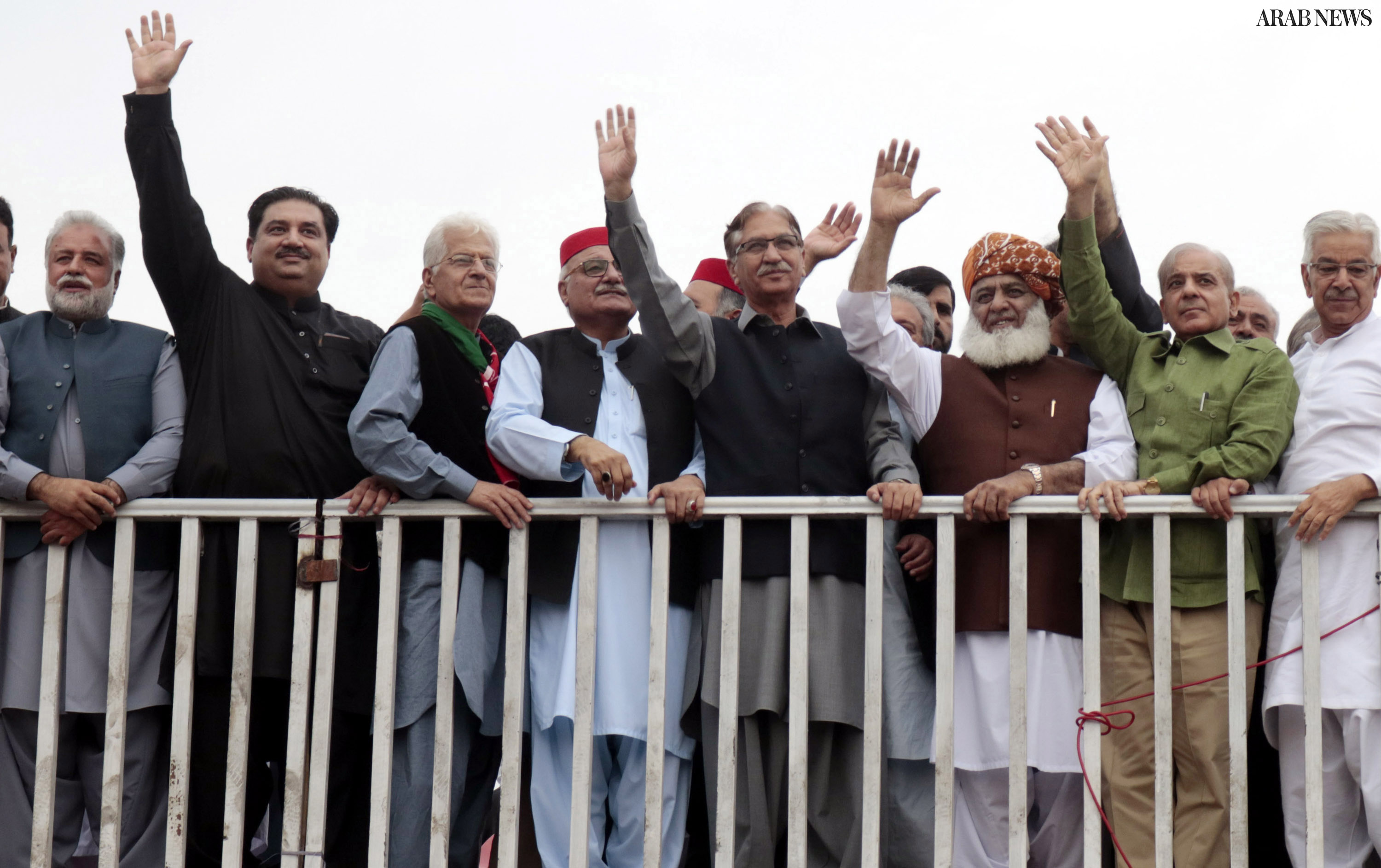


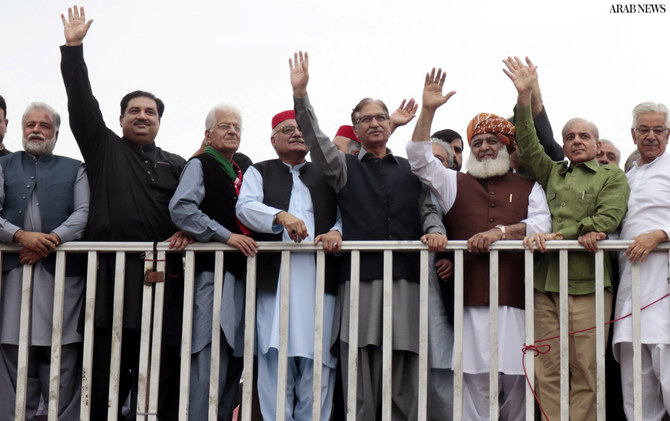
Leaders of opposition parties wave at protesters during the ongoing Azadi March in Islamabad on Nov. 1, 2019. (AN photo)

“You have two days time. You should tender your resignation. Otherwise the next day, we have to decide our future course of action,” the firebrand scholar said in an address to protesters on Thursday evening.
Khan has dismissed the opposition’s calls to step down and warned he will not tolerate chaos on the streets.
“We are peaceful people, that’s why we want that we stay within the ambit of peace,” Rehman told protesters, flanked by the leaders of major opposition parties. “Otherwise this sea of Pakistan’s public that has arrived in Islamabad has the power to go inside the prime minister’s house and themselves arrest the prime minister.”
Rehman said protesters did not want a confrontation with “institutions.”
“We want to see institutions powerful but we also want institutions to act with neutrality,” he said.


Scores of protesters took to the streets of Islamabad on Nov. 1, 2019, as part of the ongoing Azadi March led by Maulana Fazlur Rehman, chief of the Jamiat Ulema-e-Islam (JUI-F), seeking to topple Prime Minister Imran Khan's government. (AN photo)

However, he warned: “If we feel that this illegitimate ruler of ours [Imran Khan] is being protected by our institutions, then there is a deadline of two days. After that we should not be stopped from having an opinion about these institutions.”
Speaking at the protest rally, opposition leader Shehbaz Sharif, who is the president of the PMLN party of jailed ex-PM Nawaz Sharif, said Khan’s government had failed to deliver in the year since it had come to power, as was visible from protests by all segments of the society including traders, doctors and engineers.
“We have to move this movement forward ... and if given just six months, we will put this country back on track,” he said.
Bilawal Bhutto Zardari, the chairman of the opposition PPP party, said the government had burdened the poor through double-digit inflation and the country was plagued by increasing unemployment.
“I want to assure you on behalf of my party that we will stand by you in every democratic step you take,” he told the protesters. “Together we will send this puppet, selected PM, home.”
Security is tight in Islamabad with the government and diplomatic sector — just a few miles from the rally site — sealed off and roads blocked by barriers of shipping containers.
Media reported that schools were closed, public transport suspended and Internet services interrupted in some areas.
Khan won the 2018 election on promises of pulling 100 million people out of poverty. But an economy in crisis has forced his government, like many of its predecessors, to turn to the International Monetary Fund for a $6 billion bailout.
The government is trying to correct an unsustainable current account deficit and cut debt while trying to expand the tax base in the country of 208 million people, in which only 1% of people file returns. Inflation is squeezing household budgets and traders this week protested against new tax measures.


Pakistan clears global crypto exchanges Binance, HTX under new regulatory framework

Updated 7 sec ago
Follow

Pakistan clears global crypto exchanges Binance, HTX under new regulatory framework

  • NOCs allow Binance, HTX to conduct engagement activities within Pakistan, says regulator PVARA
  • Says move allows entities to open subsidiaries in Pakistan but doesn’t constitute as operating license

ISLAMABAD: The Pakistan Virtual Assets Regulatory Authority (PVARA) announced on Friday that it has granted no objection certificates (NOCs) to global crypto exchanges Binance and HTX, the latest in a series of moves by Islamabad to regulate its fast-growing virtual assets market. 

PVARA said the NOCs were granted following a review process it conducted with public sector stakeholders which focused on governance structures, compliance frameworks, risk management controls and alignment with Pakistan’s emerging regulatory requirements for virtual asset activities.

Pakistan has been moving to regulate its fast-growing crypto and digital assets market by bringing virtual asset service providers (VASPs) under a formal licensing regime. Officials say the push is aimed at curbing illicit transactions, improving oversight and encouraging innovation in blockchain-based financial services.

“The introduction of this structured NOC framework demonstrates Pakistan’s commitment to responsible innovation and financial discipline,” Finance Minister Muhammad Aurangzeb was quoted as saying in a press release issued by PVARA. 

The regulatory authority said the NOCs allow Binance and HTX to conduct preparatory and engagement activities within Pakistan under “defined regulatory oversight,” clarifying that it does not constitute a “full operating license.”

The NOCs allow Binance and HTX to begin registration on the FMU goAML, Pakistan’s anti–money laundering reporting platform, as reporting entries. It also allows them to engage with the Securities and Exchange Commission of Pakistan (SECP) regulator to incorporate their subsidiaries in the country. 

HTX and Binance can also prepare and submit their full VASP license applications once licensing regulations are promulgated and provide anti-money laundering (AML) registered services after the completion of their goAML registration.

“PVARA will continue to engage with domestic and international stakeholders as it advances subsequent phases of its regulatory framework,” the authority said. 

“Additional guidance regarding licensing standards, compliance obligations and supervisory expectations for virtual asset service providers will be issued in due course.”

Chairman PVARA Bilal Bin Saqib said issuing the NOCs marks the first step toward a fully licensed and regulated environment for digital assets in Pakistan. 

“By adopting a phased and internationally aligned approach, Pakistan is ensuring that only well-governed, fully compliant global platforms progress toward full licensing,” Saqib was quoted as saying by PVARA.

According to PVARA, Pakistan already ranks at number three in crypto adoption and is home to an estimated 30 to 40 million users.

It said industry-wide assessments estimate that annual digital asset trading activity linked to Pakistan exceeds $300 billion. 

The development takes place days after Prime Minister Shehbaz Sharif met a delegation of Binance in Islamabad, led by its CEO Richard Teng, to discuss regulating digital assets in Pakistan.