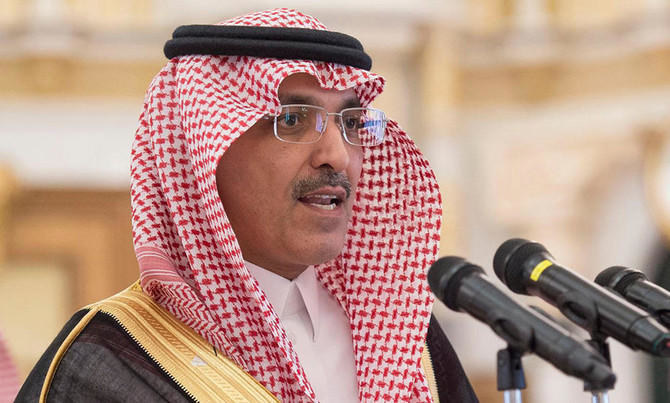
RIYADH: Saudi Finance Minister Mohammed Al-Jadaan is losing no sleep over the price of oil because he believes the Kingdom’s economy remains on track to hit key targets of the Vision 2030 strategy despite a recent downgrade in forecast growth.
Last week, the International Monetary Fund (IMF) slashed its 2019 gross domestic product (GDP) growth predictions for all Gulf countries, but with an especially steep fall for Saudi Arabia. The new IMF projection is for a mere 0.2 percent, down from 1.9 percent earlier this year.
Speaking to delegates at the Future Investment Initiative (FII) in Riyadh, Al-Jadaan said the key focus for the long-term strategy is to grow the non-oil sector of the economy.
“What we’re focusing on is non-oil GDP growth, and the IMF agrees that we’ve maintained that growth at 2.9 percent and that’s our target,” he added.
“Our key performance indicator for Vision 2030 is non-oil GDP and how we’re going to grow it.”
Asked if he was sleeping well despite the volatility in global crude prices, the minister said: “I watch the oil price regularly every day because we have a long-term focus. We want to get out of the interim volatility.”
He added: “I have no trouble sleeping, and I enjoy a good night’s sleep when the oil price is going up — but not too much.”
The IMF said lower oil production was the main reason for its cut in forecast, but added that the attacks on Saudi Aramco facilities at Abqaiq and Khurais in September “add uncertainty to the near-term outlook.”
Al-Jadaan said the IMF action was influenced by the oil market. “This year, Saudi oil production is minus 3 percent because we decided to reduce our oil production so we, and our partners in OPEC+ and the Gulf, make sure there’s a stable market in the world and long-term sustainability for the industry,” he added.
Saudi Energy Minister Prince Abdul Aziz bin Salman earlier told the FII of his strategy for long-term sustainability and profitability in the energy business, with the emphasis on downstream operations and on the “circular carbon economy” to reduced emissions of greenhouse gasses.
Al-Jadaan said the global economic situation had influenced the IMF toward downgrade. “They’re also looking at what’s happening globally, and we’re watching that very closely too so that we’re prepared, and that fiscal and economic policies can respond to these international challenges,” he added.
Al-Jadaan said improvement in the non-oil sector was due to greater competitiveness and structural reform pushed through by the government.
He pointed to the Kingdom’s recent 30-place leap up the World Bank ranking for ease of doing business to No. 62 globally. This improving business environment is being seen in certain sectors of the Saudi economy, he said.
Al-Jadaan highlighted tourism, technology, sports and entrainment as well as construction, where statistics showed a big turnaround to 3 percent growth — the first time there has been such an improvement since 2014, he added.
On an FII panel that also included Bahrain’s Finance Minister Shaikh Salman bin Khalifa Al-Khalifa and his Kuwaiti counterpart Naif Falah Al-Hajjraf, there was agreement that boosting the private sector is the way to go for oil-dependent regional economies.
Al-Khalifa said: “The importance of the private sector is critical for growth. We’re moving from government-led growth to enabling the private sector.”
Al-Hajjraf made an impassioned plea to maintain the economic infrastructure of the Gulf Cooperation Council (GCC) despite the tensions that have led Saudi Arabia, the UAE, Bahrain and Egypt to cut trading links with Qatar.
“What has been achieved in the GCC is too good to let go. We don’t just think of the GCC, we believe in the GCC,” he said.


Saudi finance minister losing no sleep over oil price
Saudi finance minister losing no sleep over oil price

- Speaking to delegates at the Future Investment Initiative (FII) in Riyadh, Al-Jadaan said the key focus for the long-term strategy is to grow the non-oil sector of the economy
- Al-Jadaan highlighted tourism, technology, sports and entrainment as well as construction, where statistics showed a big turnaround to 3 percent growth


Acwa signs key terms to develop 5GW of renewable energy capacity in Turkiye
JEDDAH: Saudi utility giant Acwa has signed key investment agreements with Turkiye’s Ministry of Energy and Natural Resources to develop up to 5 gigawatts of renewable energy capacity, starting with 2GW of solar power across two plants in Sivas and Taseli.
Under the investment agreement, Acwa will develop, finance, and construct, as well as commission and operate both facilities, according to a press release.
The program builds on the company’s first investment in Turkiye, the 927-megawatt Kirikkale Independent Power Plant, valued at $930 million, which offsets approximately 1.8 million tonnes of carbon dioxide annually, the statement added.
A separate power purchase agreement has been concluded with Elektrik Uretim Anonim Sirketi for the sale of electricity generated by each facility.
Turkiye aims to boost solar and wind capacity to 120GW by 2035, supported by around $80 billion in investment, while recent projects have already helped prevent 12.5 million tonnes of CO2 emissions and reduced reliance on imported natural gas.
Turkiye’s energy sector has undergone a rapid transformation in recent years, with renewable power emerging as a central pillar of its strategy.
Raad Al-Saady, vice chairman and managing director of ACWA, said: “The signing of the IA (implementation agreement) and PPA key terms marks a pivotal moment in Acwa’s partnership with Turkiye, reflecting the country’s strong potential as a clean energy leader and manufacturing powerhouse.”
He added: “Building on our long-standing presence, including the 927MW Kirikkale Power Plant commissioned in 2017, this step elevates our partnership to a new level,” Al-Saady said.
In its statement, Acwa said the 5GW renewable energy program will deliver electricity at fixed prices, enhancing predictability for grid planning and supporting long-term industrial investment.
By replacing imported fossil fuels with domestically generated clean energy, the initiative is expected to reduce Turkiye’s exposure to global energy market volatility, strengthening energy security and lowering long-term power costs.
The company added that the economic impact will extend beyond the anticipated investment of up to $5 billion in foreign direct investment, with thousands of jobs expected during the construction phase and hundreds of high-skilled roles created during operations.
The energy firm concluded that its existing progress in Turkiye reflects a strong appreciation for Turkish engineering, construction, and manufacturing capacity, adding that localization has been a strategic priority, and it has already achieved 100 percent local employment at its developments in the country.


