MILAN: The boards of Fiat Chrysler and PSA Peugeot have approved merging the two companies in a move that would create the world’s fourth-largest automaker with combined revenues of $188.8 billion, the companies announced Thursday.
The 50-50 merger is expected to create synergies of $4.13 billion, a figure that the automakers expect to achieve without any factory closures — a concern of unions in both France and Italy where the carmakers have more model overlap.
Once a merger is finalized, PSA Peugeot CEO Carlos Tavares will be chief executive of the new company with Fiat Chrysler Chairman John Elkann taking the role of chairman.
The automakers said that the new company would be able to meet the challenges of powertrain electrification, connectivity and autonomous driving “with speed and capital efficiency.”
The combined company will be able to share in the cost of developing those technologies with their “strong global R&D footprint,” they said. They will also save on investments in vehicle platforms and save money with greater purchasing power.
Both companies “share the conviction that there is compelling logic for a bold and decisive move that would create an industry leader with the scale, capabilities and resources to capture successfully the opportunities, and manage effectively the challenges in the new era in mobility,” the statement said.
The merger decision comes about five months after a similar deal with French automaker Renault fell apart.


![]()


Fiat Chrysler, PSA Peugeot boards approve merger
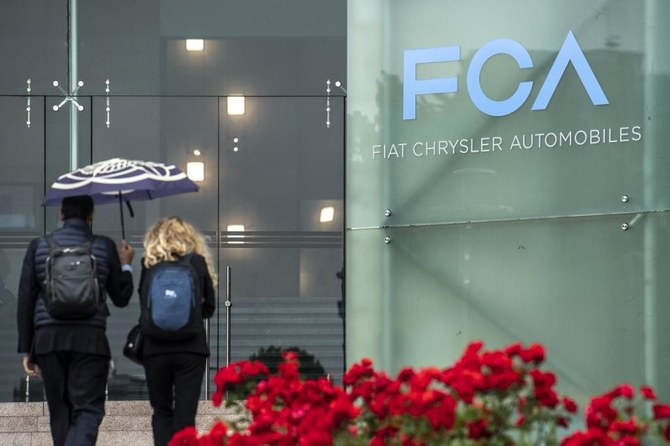
Fiat Chrysler, PSA Peugeot boards approve merger
- PSA Peugeot CEO Carlos Tavares will be chief executive of the new company
- The merger is expected to create synergies of $4.13 billion


Oil prices rise sharply after attacks in Middle East disrupt global energy supply
NEW YORK: Oil prices rose sharply Monday as US and Israeli attacks on Iran and retaliatory strikes against Israel and US military installations around the Gulf sent disruptions through the global energy supply chain.
Traders were betting the supply of oil from Iran and elsewhere in the Middle East would slow or grind to a halt. Attacks throughout the region, including on two vessels traveling through the Strait of Hormuz, the narrow mouth of the Arabian Gulf, have restricted countries’ ability to export oil to the rest of the world. Prolonged attacks would likely result in higher prices for crude oil and gasoline, according to energy experts.
West Texas Intermediate, the light, sweet crude oil produced in the United States, was selling for about $72 a barrel early Monday, up around 7.3 percent from its trading price of about $67 on Friday, according to data from CME group.
A barrel of Brent crude, the international standard, was trading at $78.55 per barrel early Monday, according to FactSet, up 7.8 percent from its trading price of $72.87 on Friday, which had been a seven-month high at the time.
Higher global energy prices could lead to consumers paying more for gasoline at the pump and shelling out more for groceries and other goods, at a time when many are already feeling the impacts of elevated inflation.
Roughly 15 million barrels of crude oil per day — about 20 percent of the world’s oil — are shipped through the Strait of Hormuz, making it the world’s most critical oil chokepoint, according to Rystad Energy. Tankers traveling through the strait, which is bordered in the north by Iran, carry oil and gas from Saudi Arabia, Kuwait, Iraq, Qatar, Bahrain, the UAE and Iran.
Iran had temporarily shut down parts of the strait in mid-February for what it said was a military drill, which led oil prices to jump about 6 percent higher in the days that followed.
Against that backdrop, eight countries that are part of the OPEC+ oil cartel announced they would boost production of crude Sunday. The Organization of Petroleum Exporting Countries, in a meeting planned before the war began, said it would increase production by 206,000 barrels per day in April, which was more than analysts had been expecting. The countries boosting output include Saudi Arabia, Russia, Iraq, the United Arab Emirates, Kuwait, Kazakhstan, Algeria and Oman.
“Roughly one-fifth of global oil supply passes through the Strait of Hormuz, a vital artery for world trade, meaning markets are more concerned with whether barrels can move than with spare capacity on paper,” said Jorge León, Rystad’s senior vice president and head of geopolitical analysis, in an email. “If flows through the Gulf are constrained, additional production will provide limited immediate relief, making access to export routes far more important than headline output targets.”
Iran exports roughly 1.6 million barrels of oil a day, mostly to China, which may need to look elsewhere for supply if Iran’s exports are disrupted, another factor that could increase energy prices.
Traders were betting the supply of oil from Iran and elsewhere in the Middle East would slow or grind to a halt. Attacks throughout the region, including on two vessels traveling through the Strait of Hormuz, the narrow mouth of the Arabian Gulf, have restricted countries’ ability to export oil to the rest of the world. Prolonged attacks would likely result in higher prices for crude oil and gasoline, according to energy experts.
West Texas Intermediate, the light, sweet crude oil produced in the United States, was selling for about $72 a barrel early Monday, up around 7.3 percent from its trading price of about $67 on Friday, according to data from CME group.
A barrel of Brent crude, the international standard, was trading at $78.55 per barrel early Monday, according to FactSet, up 7.8 percent from its trading price of $72.87 on Friday, which had been a seven-month high at the time.
Higher global energy prices could lead to consumers paying more for gasoline at the pump and shelling out more for groceries and other goods, at a time when many are already feeling the impacts of elevated inflation.
Roughly 15 million barrels of crude oil per day — about 20 percent of the world’s oil — are shipped through the Strait of Hormuz, making it the world’s most critical oil chokepoint, according to Rystad Energy. Tankers traveling through the strait, which is bordered in the north by Iran, carry oil and gas from Saudi Arabia, Kuwait, Iraq, Qatar, Bahrain, the UAE and Iran.
Iran had temporarily shut down parts of the strait in mid-February for what it said was a military drill, which led oil prices to jump about 6 percent higher in the days that followed.
Against that backdrop, eight countries that are part of the OPEC+ oil cartel announced they would boost production of crude Sunday. The Organization of Petroleum Exporting Countries, in a meeting planned before the war began, said it would increase production by 206,000 barrels per day in April, which was more than analysts had been expecting. The countries boosting output include Saudi Arabia, Russia, Iraq, the United Arab Emirates, Kuwait, Kazakhstan, Algeria and Oman.
“Roughly one-fifth of global oil supply passes through the Strait of Hormuz, a vital artery for world trade, meaning markets are more concerned with whether barrels can move than with spare capacity on paper,” said Jorge León, Rystad’s senior vice president and head of geopolitical analysis, in an email. “If flows through the Gulf are constrained, additional production will provide limited immediate relief, making access to export routes far more important than headline output targets.”
Iran exports roughly 1.6 million barrels of oil a day, mostly to China, which may need to look elsewhere for supply if Iran’s exports are disrupted, another factor that could increase energy prices.
Latest updates


© 2026 SAUDI RESEARCH & PUBLISHING COMPANY, All Rights Reserved And subject to Terms of Use Agreement.