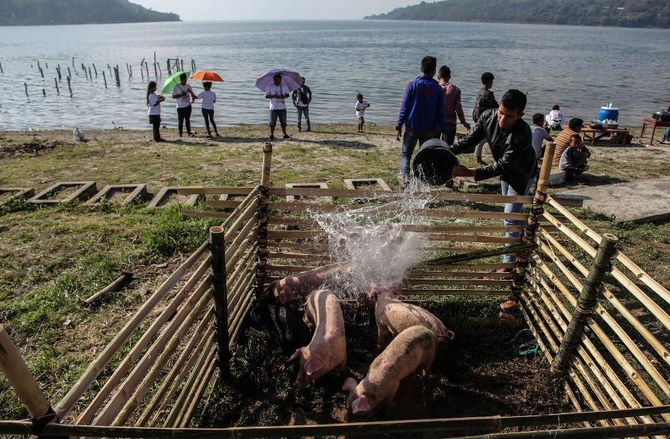
MUARA, Indonesia: Indonesia’s bid to lure more visitors by spreading halal tourism across the archipelago is facing a backlash, with a Christian celebration of pigs — forbidden for Muslims — the latest act of dissent.
The weekend festival-cum-protest in Sumatra, featuring pig racing, chubbiest hog contests and a porcine fashion show, comes as holiday hotspot Bali pushes back against rolling out more Muslim-friendly services on the Hindu island.
Critics say a government plan to cash in on halal tourism — part of a broader campaign to replicate Bali’s success nationwide — is another threat to minority rights in the world’s most populous Muslim-majority nation.
And critics have warned that the sprawling nation of 260 million — where nearly 90 percent of the population follows Islam — is taking hard-right turn with a conservative cleric now installed as vice president and hard-liners growing increasingly vocal in public life.
Indonesia’s reputation for tolerant Islam has been under fire for years.
Pushing halal tourism in areas with religious minorities — including Christians, Buddhists and Hindus — may do more harm than good, warned Ali Munhanif, an expert on political Islam at Syarif Hidayatullah State Islamic University Jakarta.
“The phenomenon signals an effort to institutionalize conservatism,” he said.
“Bali successfully manages its tourism sector without using a ‘Hindu’ label.”
But advocates say halal tourism is misunderstood.
“There is a public misperception that halal tourism is Islamization. That is wrong and it’s why some people overreact to the concept,” said Zainut Tauhid, Indonesia’s deputy minister of religious affairs.
“It is about providing necessary facilities for Muslim visitors such as prayer rooms. So it is facilitation rather than Islamization.”
That view isn’t shared by some around Lake Toba, a scenic crater lake in Sumatra where the weekend pig festival was held.
Most locals are Batak, a Christian ethnic group that puts pigs at the center of its traditional cuisine, with hog farming a key source of income.
Last month, provincial governor Edy Rahmayadi raised eyebrows when said he wanted to boost tourism with Islam-friendly facilities and services.
That included opening more halal restaurants and mosques, as well as banning the public slaughter of hogs, with the governor saying the practice could turn off Muslim visitors.
“This idea to bring in halal tourism is going to divide people,” festival organizer Togu Simorangkir told AFP
“It’s a step back for tourism here,” he added.
About 1,000 people dropped by the event, including children who scribbled in pig-themed coloring books and adults watching as hogs were judged on their plump proportions.
“Batak culture is particularly known for its pigs,” said higher schooler Edo Sianturi.
“We’ve been raising them and earning a living from them for generations.”
Visitor Sabrina Singarimbun, a Muslim student in a head-covering hijab, was keen to see which best-dressed pig would win the festival’s fashion contest.
“I disagree with the (halal tourism) idea because it’s Batak culture here and most people aren’t Muslim,” she said.
Elsewhere, halal tourism is often seen as a lucrative business opportunity.
Thailand and Taiwan are among regional destinations tapping the halal tourism sector, which a 2017 study found will be worth some $300 billion annually.
This month, Indonesia ushered in new halal labelling rules for consumer products and services, as the government eyes travelers from other Islamic nations to rev up its much-touted “10 New Balis” tourism push, which includes Lake Toba.
But efforts to cater to Muslim visitors has drawn controversy.
This summer, officials in Lombok — an island next to Bali that has many Muslim-friendly services — quickly rolled back plans to set up separate camping areas for male and female hikers in Mount Rinjani National Park after a public backlash.
Two restaurants in Makassar on Sulawesi island, meanwhile, were forced to close after a Muslim group in July complained that the smell of their pork dishes was wafting over to nearby mosques and halal restaurants.
Back in North Sumatra, the governor’s spokesman Muhammad Ikhsan said his boss was misunderstood.
“He just wants to make Lake Toba a friendly place for Muslim visitors,” Ikhsan said, adding that he hoped it would also curtail the environmental impact of pig farming.
“What we want is just to make things organized, not to make it a halal place.”


Indonesia’s halal tourism bid faces pig pushback
Indonesia’s halal tourism bid faces pig pushback

- Political Islam expert says pushing Halal tourism in religious minority areas may do more harm than good
- Indonesia’s deputy minister of religious affairs said halal tourism does not equal Islamization


India rolls out strictest anti-pollution curbs as toxic smog engulfs Delhi
- Private monitors in several parts of northern Delhi recorded AQI spikes between 550 and 700s
- Authorities invoked stage four of the capital region’s emergency pollution-control framework
NEW DELHI: India’s capital choked under a thick blanket of smog on Sunday, with the government imposing anti-pollution curbs after monitoring stations in some areas recorded extremely hazardous air quality.
Home to 30 million people, Delhi has not recorded a single “clean air” day in 2025, with Air Quality Index readings hitting high above the 50 score throughout the year.
On the AQI scale from 0 to 500, good air quality is represented by levels below 50, while levels above 300 are dangerous.
Worsening since late October, official records over the weekend were in the severe to severe-plus range of 400–500, but as 24-hour averages, they did not capture the peaks. Private monitors in several parts of North and North West Delhi recorded AQI spikes above 550 and even into the 700s in real-time.
On Saturday evening, the Ministry of Environment’s Commission for Air Quality Management invoked stage four — the highest level — of the Graded Response Action Plan for Delhi and surrounding areas.
To “prevent further deterioration of air quality in the region,” the commission suspended all non-essential construction, shut stone crushers and mining operations, stopped entry of trucks into the capital region, and ordered schools to shift to hybrid classes or online, where possible.
While authorities blamed the pollution on “adverse meteorological conditions,” residents have been demanding more government action.
“The situation is so bad in Delhi that we don’t have any option but to force kids to do online classes. The government has failed us; it has not done anything to address the issue,” said Nabanita Nayak, who decided for her teenage children to attend school online only, despite concerns over their screen addiction.
“If the kids are too much in front of laptops, that’s also an issue. As a mother, I am worried.”
Delhi’s pollution has been worsening since Diwali in late October, when the average AQI has been above 370, or “very poor.” Since mid-November, it has been over 400, which means “severe” air quality, with certain areas recording 500 and above, which is classified as a “hazardous” level.
“I don’t feel proud living in Delhi. It’s the capital city of the country … We talk about being a developed nation by 2047 — we have deadlines,” said Jagriti Arora, who is keeping her 7-year-old daughter at home to prevent allergy flare-ups caused by air pollution.
“The government has to do something … China had a big problem with pollution, but now they’ve managed to bring it down.”
Delhi’s air quality deteriorates in winter due to local emissions and seasonal weather conditions. Cold temperatures and low wind speeds result in a temperature inversion, which traps pollutants close to the ground instead of letting them disperse. This allows emissions from millions of vehicles, ongoing construction, and nearby industrial activity to accumulate in the air. Urban waste burning and dust from construction sites further add to it.
“This is not a new thing. This has been happening now for over 10 years,” Arora said. “You can see it. You don’t need to actually look at an AQI meter to see how bad the pollution is these days.”


