BAGHDAD: Iraq’s most powerful politicians appeared to withhold support for Prime Minister Adel Abdul Mahdi on Wednesday, as anti-government protests swelled into the biggest mass demonstrations the country has seen since the fall of Saddam Hussein.
Protesters from across Iraq’s sectarian and ethnic divides thronged the center of the capital Baghdad in a show of fury at the political class. While Abdul Mahdi’s fate was not yet clear, demonstrators said removing him would not be enough.
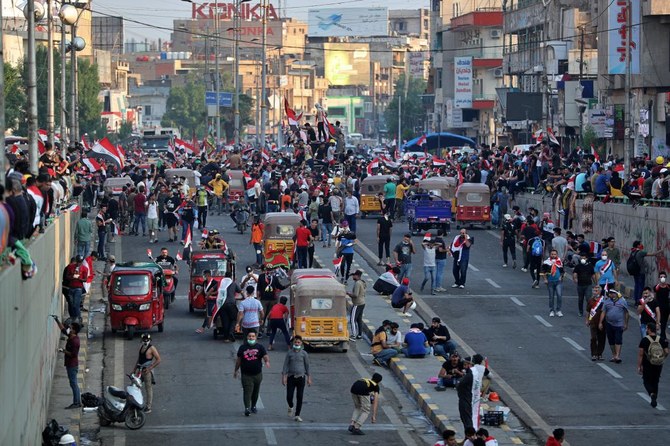
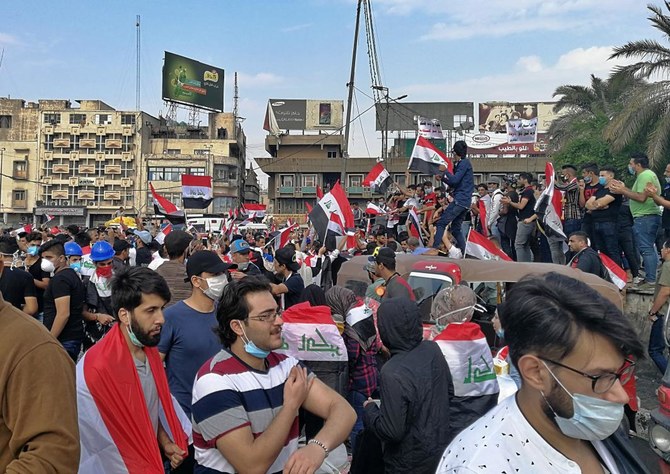
After four weeks of protests in which more than 250 people have been killed, the past 24 hours saw the demonstrations swell to a previously unseen scale in the capital.
Middle class families with small children joined self-proclaimed “revolutionary” youths from poor neighborhoods to brave tear gas and barricades in Baghdad’s Tahrir Square.
“No Moqtada, no Hadi,” protesters chanted, denouncing what they saw as an effort by the leaders of parliament’s two largest blocs — populist cleric Moqtada Al-Sadr and militia leader Hadi Al-Amiri — to cling to power behind the scenes with or without the prime minister they installed a year ago.
Sadr has demanded Abdul Mahdi call an early election. When the premier refused, Sadr called on Amiri, his main political rival, to help oust him.
Amiri issued a statement overnight that was initially seen as accepting Sadr’s call to ditch Abdul Mahdi. But a day of silence followed, leaving the prime minister’s fate in limbo.
“We will work together to secure the interests of the Iraqi people and save the nation in accordance with the public good,” Amiri had said in the overnight statement.
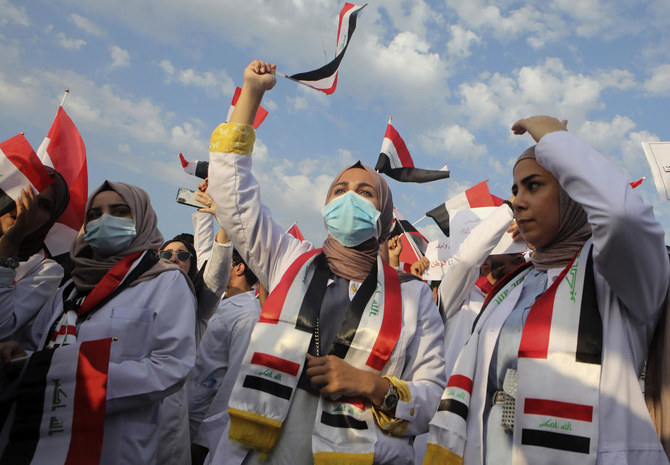
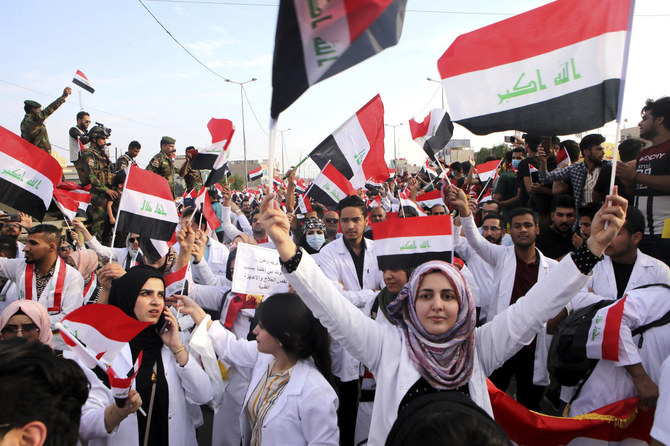
Many young women and older people joined the protests as they gained momentum and appeared safer. The mood was jubilant yet defiant, with many singing and dancing and a group of young men even playing dominos, in contrast with the tense situation earlier this week when scores were killed nationwide.
One wheelchair-bound man said he came with his two young granddaughters to support the protesters.
The protesters have drawn inspiration from a similar uprising in Lebanon, where pan-sectarian anti-government protests forced Prime Minister Saad Harari to step down.
“We are staying and holding our ground. Our demand is not only to replace Adel Abdul Mahdi: we want the whole government uprooted,” said Karar Saad, 20. “All of them are thieves.”
Despite promising reforms and ordering a broad reshuffle of the cabinet, Abdul Mahdi has done little to address the demonstrators’ complaints. Parliament passed measures on Monday including reduced salaries for officials, but protesters derided this as too little too late.
The security forces responded to the initial unrest in early October with a brutal crackdown, firing with live ammunition from rooftops into crowds. But if they hoped to intimidate the demonstrators, the tactic has backfired, inflaming passions.
Despite OPEC member Iraq’s vast oil wealth, many Iraqis live in poverty or have limited access to clean water, electricity, basic health care and education. Most of the protesters are young people who above all want jobs.
While the demonstrations were initially mostly made up of young men, they have become more diverse as the crowds have swelled, with more families, women and older people braving streets strewn with tear gas canisters and debris.
“We are a people who love life, we are a country of riches that you steal. We are staying here, women and men, we will not retreat!” said Safaa, a female student. “Leave! Enough! You haven’t had enough stealing?“
She called for dismantling the entire system of power sharing among sectarian political parties, put in place after the 2003 US-led invasion that toppled Saddam.
The entrance to Tahrir Square was littered with makeshift tents on Wednesday with many protesters camping out there overnight. Young men formed human chains to keep roads clear for a flurry of tuk-tuks, which have been used to ferry the wounded through crowds from the battle lines of clashes with police.
Security forces continued to lob tear gas at protesters on a nearby bridge who sought to break into the heavily fortified Green Zone which houses government buildings. There appeared to be less tear gas than on previous days. At least 26 people were injured, medical sources said.
Protests took place in five other provinces, mostly in the southern Shiite heartland. Around 800 people gathered in the Shiite holy city of Najaf, 500 in Diwaniya, and over 1,500 in Nassiriya, where at least 51 people were wounded overnight when security forces opened fire to disperse protests.
Over 2,000 people gathered in oil-rich Basra, where operations came to a complete standstill at the Umm Qasr commodities port after protesters blocked its entrance in the previous day, port officials said.


![]()
![]()
![]()
![]()

Iraq prime minister’s fate in limbo as crowds of demonstrators swell
Iraq prime minister’s fate in limbo as crowds of demonstrators swell
- Sadr has demanded Abdul Mahdi call an early election
- When the premier refused, Sadr called on Amiri, his main political rival, to help oust him


Latest updates


© 2026 SAUDI RESEARCH & PUBLISHING COMPANY, All Rights Reserved And subject to Terms of Use Agreement.