

Pakistan premier lays foundation stone for first Sikh university

1 / 2
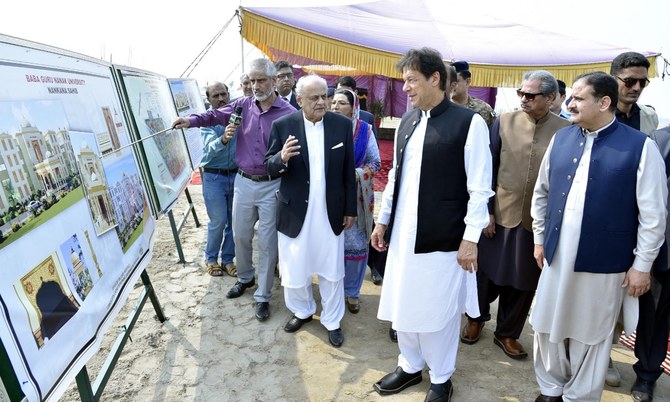
Prime Minister Imran Khan being briefed about Baba Guru Nanak University project in Nankana Sahib on October 28, 2019. (PID)
2 / 2
Pakistan Prime Minister Imran Khan laid foundation-stone of Baba Gurru Nanak University at Nanka Sahib on October 28, 2019. (PID)
Updated 29 October 2019
Follow

Pakistan premier lays foundation stone for first Sikh university

  • With an estimated cost of Rs5bn, project is aimed at facilitating Sikh pilgrims
  • Follows Pakistan's announcement to inaugurate visa free corridor for Sikh pilgrims on November 9

ISLAMABAD: Pakistan’s Prime Minister Imran Khan laid the foundation stone for the Baba Guru Nanak University on Monday, weeks ahead of the launch of the Kartarpur Corridor on November 9.
The ceremony in Nankana Sahib, a district in the Punjab province, was attended by Interior Minister Aijaz Ahmed Shah and a coterie of other officials.
Speaking on the occasion, PM Khan said that both Kartapur and Nankana Sahib were important places of worship for Sikhs, adding that irrespective of the relations between Pakistan and India, “we should never stop those who love Guru Nanak, rather we need to facilitate them.”
“This university will be completed with the cost of PKR5 billion. Punjab government has also launched several projects to uplift religious tourism and development of Nankana Sahib at a cost of PKR7 billion,” Chief Minister Usman Buzdar said.
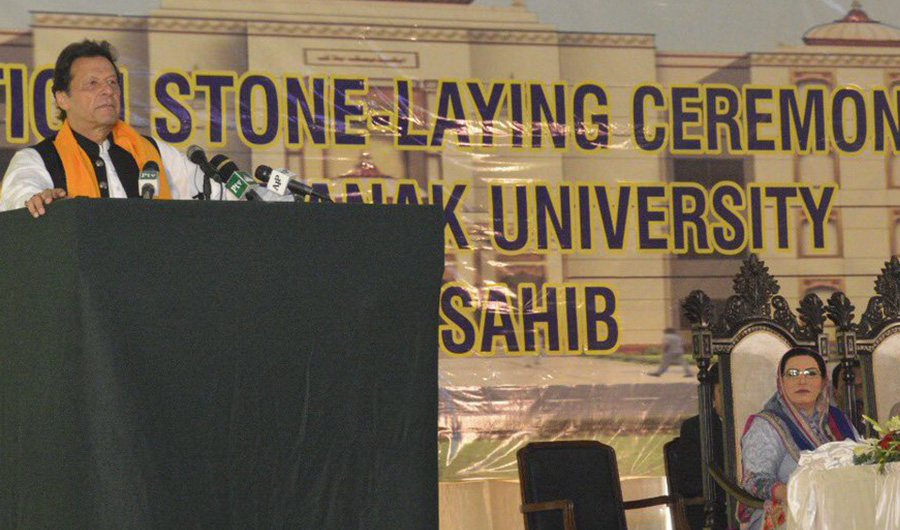


Prime Minister Imran Khan addressing at the foundation stone laying ceremony of Baba Guru Nanak University at Nankana Sahib on October 28,  2019. (PID)

On Thursday, Pakistan and India signed an agreement for opening the Kartarpur Corridor to mark the 550th birth anniversary celebrations of Guru Nanak, the founder of Sikhism.
The Kartarpur Corridor connects the Sikh shrines of Dera Baba Nanak Sahib in India’s Punjab region to the Gurdwara Darbar Sahib in Kartarpur, Pakistan.
PM Khan is scheduled to inaugurate the corridor on November 9. The move is expected to facilitate visa-free travel for 5,000 pilgrims on a daily basis “in groups or individually, on foot or by bus to visit Gurdwara Kartarpur Sahib in Narowal, Pakistan...throughout the year, except on public holidays or for exigencies/emergencies, which will be notified to India in advance,” excerpts from a statement released by Pakistan’s Foreign Office read last week.
“The signing of the agreement, despite the challenging environment is unprecedented and reflective of Prime Minister Imran Khan’s commitment toward facilitating Nanak Naamlevas to visit their most reverential place of worship in line with Pakistan’s Kartarpur initiative and groundbreaking ceremony last year,” it added.
According to the agreement, India will share the list of pilgrims ten days in advance while Pakistan will do so four days ahead of schedule.


Pakistan to begin first phase of Hajj 2026 trainings from today

Updated 31 December 2025
Follow

Pakistan to begin first phase of Hajj 2026 trainings from today

  • Training programs to be held in phases across Pakistan till February, says religion ministry
  • Saudi Arabia allocated Pakistan a total quota of 179,210 pilgrims for Hajj 2026

ISLAMABAD: Pakistan’s religious affairs ministry has said that it will begin the first phase of mandatory Hajj 2026 training for pilgrims intending to perform the pilgrimage from today, Thursday.

The one-day Hajj training programs will be held in phases across the country at the tehsil level until February. The ministry directed intending pilgrims to bring their original identity cards and the computerized receipt of their Hajj application to attend the training sessions.

“Pilgrims should attend the one-day training program according to their scheduled date,” Pakistan’s Ministry of Religious Affairs (MoRA) said in a statement.

The ministry said training schedules are being shared through the government’s Pak Hajj 2026 mobile application as well as via SMS. It added that details of the schedule are also available on its website.

According to the ministry, training programs will be held in Abbottabad on Jan. 2; Ghotki, Thatta and Kotli on Jan. 3; and Tando Muhammad Khan and Khairpur on Jan. 4.

Hajj training sessions will be held in Rawalakot, Badin and Naushahro Feroze on Jan. 5, while pilgrims in Fateh Jang, Dadu and Tharparkar will receive the training on Jan. 6.

The ministry said training programs will be conducted in Umerkot and Larkana on Jan. 7, followed by sessions in Mirpurkhas, Shahdadkot and Mansehra on Jan. 8.

Pakistan’s religious affairs ministry has previously said these trainings will be conducted by experienced trainers and scholars using multimedia.

It said the training has been made mandatory to ensure that intending pilgrims are fully aware of Hajj rituals and administrative procedures.

Saudi Arabia has allocated Pakistan a quota of 179,210 pilgrims for Hajj 2026, of which around 118,000 seats have been reserved under the government scheme, while the remainder will be allocated to private tour operators.

Under Pakistan’s Hajj scheme, the estimated cost of the government package ranges from Rs1,150,000 to Rs1,250,000 ($4,049.93 to $4,236), subject to final agreements with service providers.