EL PARDO, Spain: Spain exhumed the embalmed body of Francisco Franco from a grandiose state mausoleum on Thursday, reburying it in more discreet grave in a country still conflicted over the dictator’s decades-long regime.
The carefully-choreographed operation which began inside an imposing basilica in Valley of the Fallen and ended some four hours later at a state cemetery outside of Madrid, was hailed by the government as ending “an insult to Spanish democracy.”
“This decision puts an end to the moral outrage of the glorification of a dictator in a public space,” said Prime Minister Pedro Sanchez.
“It takes us one step closer to reconciliation... and gives prestige to our democracy, not only in our own eyes but in the eyes of the world.”
The delicate procedure drew a line under a somber drama which had threatened to open barely-healed wounds in a nation still divided over Franco’s legacy 44 years after his death.
The diminutive dictator ruled Spain with an iron fist following the end of the 1936-39 civil war and when he died in 1975, his body was laid in a tomb inside the vast basilica at Valley of the Fallen, some 50 kilometers (30 miles) northwest of Madrid.
It was there that 22 of his relatives went on Thursday morning to witness the opening of the grave which has drawn both tourists and right-wing sympathizers.
After removing the heavy flagstone, which reportedly weighed 1,500 kilogrammes (1.5 tons), the dilapidated casket was secured before being extracted and carried out into the light by eight family members.
It was then transferred to a military helicopter for the brief flight to El Pardo where it was reburied alongside that of his wife in Mingorrubio state cemetery.
Also buried there is Rafael Trujillo, the dictator who ruled Dominican Republic until his assassination in 1961.
Gathered outside the cemetery, around 200 supporters, some draped in older Franco-era Spanish flags, others holding Falange banners, shouted “Long live Franco!“
“Franco will never die. For me, today is about loyalty. I had to come to thank him for everything he has done for us,” said Miguel Maria Martinez, a pensioner from the Basque Country.
“We are living in difficult times but if he had been with us, the Catalan issue simply wouldn’t have existed,” said Jose Ramon Gimenez, a 39-year-old delivery man referring to the separatist crisis in northeastern Spain.
Under Franco, Catalan language and culture was severely repressed.
“Everything that’s happening in this country is the fault of these Socialists who have never stopped trying to humiliate us,” he said bitterly.
Since Sanchez came to power in June 2018, he has made moving Franco’s remains a priority, although the plans were delayed by legal challenges posed by the family.
But with the operation taking place before a November 10 election, his rivals have cried foul, with Pablo Iglesias of the radical leftwing Podemos saying Sanchez had unearthed “Franco’s mummy” to win votes.
Spaniards are divided over the exhumation, with 43 percent in favor, 32.5 percent against and the rest undecided, according to an El Mundo poll published earlier this month.
Ordered by Franco in 1940 to celebrate his “glorious (Catholic) crusade” against the “godless” Republicans, the Valley of the Fallen monument was constructed over almost 20 years.
Partly built by the forced labor of political prisoners, the site is one of Europe’s largest mass graves, housing the remains of over 30,000 dead from both sides of a civil war that was triggered by Franco’s rebellion against an elected Republican government.
Most had fought for Franco but the monument also contains the bones of many Republican opponents who were moved there from across the country without their families being informed.
In 2017, the parliament approved a non-binding motion calling for Franco’s remains to be removed from the Valley of the Fallen, but it was ignored by the former conservative government of Mariano Rajoy.
Speaking to reporters, deputy prime minister Carmen Calvo said the removal of Franco’s remains would change the significance of the hillside monument.
“The Valley of the Fallen, in due time, will be a place of memory, of honor for those who are there,” she said.
“There are many things to do but the fundamental goal of removing the dictator from where his victims lay was very important.”

After exhumation, Spain reburies Franco in discreet tomb
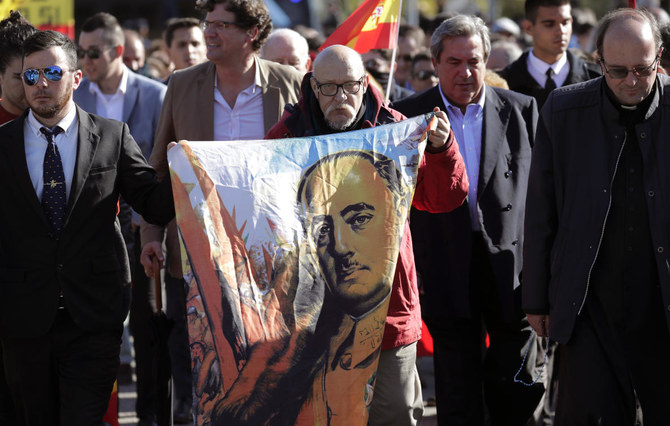
- The carefully-choreographed operation began inside an imposing basilica in the Valley of the Fallen and ended some four hours later at a state cemetery outside of Madrid
- The delicate procedure drew a line under a somber drama which had threatened to open barely-healed wounds in a nation still divided over Franco’s legacy
Deadly militant offensive sweeps northern and eastern Burkina Faso
- Burkina Faso, ruled by a military junta since September 2022, has faced more than 10 years of raids by groups linked to Al-Qaeda and the Daesh
ABIDJAN: Al-Qaeda-affiliated JNIM has in recent days claimed to have inflicted heavy losses in Burkina Faso as a surge in deadly militant attacks sweeps across the Sahelian state.
Burkina Faso, ruled by a military junta since September 2022, has faced more than 10 years of raids by groups linked to Al-Qaeda and the Daesh, including the Group for the Support of Islam and Muslims (JNIM).
A February UN Security Council report noted that the “pace of JNIM attacks” had slowed in September as fighters were diverted to Mali to back an attempted fuel blockade.
“The group’s efforts in Mali have been the primary focus since early September last year,” said Heni Nsaibia, analyst at conflict monitor ACLED.
But attacks never fully stopped, and JNIM has launched a string of large-scale assaults in northern and eastern Burkina Faso since mid-February, killing dozens, including civilians.
“Since February 14, JNIM has claimed responsibility for 10 attacks across different regions of Burkina Faso,” said Hasret Kargin, an Africa studies researcher at intelligence firm Mintel World.
Deadly assaults
The deadliest incidents targeted Titao’s military base on February 15 in the northwest, where the group says it killed dozens of soldiers.
A separate ambush on the same day left around 50 forestry officers dead in Tandjari in the east.
Around 10 civilians were also killed in Titao, including seven Ghanaian traders.
“This latest round demonstrated a high degree of coordination, given the number of large-scale attacks that occurred between 12 and 22 February,” Nsaibia said.
“Over 130 people” — Burkinabe soldiers, civilian auxiliaries and JNIM fighters — “were killed in this series of battles.”
Kargin noted that JNIM has issued no formal statement explaining the recent uptick after several months of reduced activity.
But militant groups often strike “right before and during” the Muslim holy month of Ramadan, he said, adding current dry-season conditions had helped them on the ground.
‘Smuggling zones’
Recent attacks have gripped the country’s north and east, areas seen as financial hubs for Al-Qaeda’s Sahel branch.
“These are zones with numerous gold sites and key routes that fuel the group’s smuggling activities,” a Burkinabe security analyst said, requesting anonymity.
The north “acts as a bridge” to JNIM’s “main central command” in Mali, Kargin said, while he east — home to a vast nature reserve straddling Niger, Benin and Burkina Faso — allows the group to push into neighboring countries.
The forests, he added, both shield fighters from airstrikes and generate income through illegal timber sales and control of artisanal gold mining.
The Tandjari attack near regional capital Fada N’Gourma highlights JNIM’s growing freedom of movement after having “gained a lot of ground in recent years,” Nsaibia said.
“The question is not the frequency of attacks — they never stopped — but how these groups are able to inflict such heavy losses” when the army claims to be better equipped and better organized, said a Burkinabe political scientist.
The army, which rarely comments on attacks, said in mid-February it now controls 74 percent of national territory, with some “600 villages retaken.”
According to the UN report, JNIM recently appointed a senior leader in eastern Burkina Faso tasked with expanding into Benin, Ivory Coast, Ghana, Niger and Togo.
Burkina Faso, ruled by a military junta since September 2022, has faced more than 10 years of raids by groups linked to Al-Qaeda and the Daesh, including the Group for the Support of Islam and Muslims (JNIM).
A February UN Security Council report noted that the “pace of JNIM attacks” had slowed in September as fighters were diverted to Mali to back an attempted fuel blockade.
“The group’s efforts in Mali have been the primary focus since early September last year,” said Heni Nsaibia, analyst at conflict monitor ACLED.
But attacks never fully stopped, and JNIM has launched a string of large-scale assaults in northern and eastern Burkina Faso since mid-February, killing dozens, including civilians.
“Since February 14, JNIM has claimed responsibility for 10 attacks across different regions of Burkina Faso,” said Hasret Kargin, an Africa studies researcher at intelligence firm Mintel World.
Deadly assaults
The deadliest incidents targeted Titao’s military base on February 15 in the northwest, where the group says it killed dozens of soldiers.
A separate ambush on the same day left around 50 forestry officers dead in Tandjari in the east.
Around 10 civilians were also killed in Titao, including seven Ghanaian traders.
“This latest round demonstrated a high degree of coordination, given the number of large-scale attacks that occurred between 12 and 22 February,” Nsaibia said.
“Over 130 people” — Burkinabe soldiers, civilian auxiliaries and JNIM fighters — “were killed in this series of battles.”
Kargin noted that JNIM has issued no formal statement explaining the recent uptick after several months of reduced activity.
But militant groups often strike “right before and during” the Muslim holy month of Ramadan, he said, adding current dry-season conditions had helped them on the ground.
‘Smuggling zones’
Recent attacks have gripped the country’s north and east, areas seen as financial hubs for Al-Qaeda’s Sahel branch.
“These are zones with numerous gold sites and key routes that fuel the group’s smuggling activities,” a Burkinabe security analyst said, requesting anonymity.
The north “acts as a bridge” to JNIM’s “main central command” in Mali, Kargin said, while he east — home to a vast nature reserve straddling Niger, Benin and Burkina Faso — allows the group to push into neighboring countries.
The forests, he added, both shield fighters from airstrikes and generate income through illegal timber sales and control of artisanal gold mining.
The Tandjari attack near regional capital Fada N’Gourma highlights JNIM’s growing freedom of movement after having “gained a lot of ground in recent years,” Nsaibia said.
“The question is not the frequency of attacks — they never stopped — but how these groups are able to inflict such heavy losses” when the army claims to be better equipped and better organized, said a Burkinabe political scientist.
The army, which rarely comments on attacks, said in mid-February it now controls 74 percent of national territory, with some “600 villages retaken.”
According to the UN report, JNIM recently appointed a senior leader in eastern Burkina Faso tasked with expanding into Benin, Ivory Coast, Ghana, Niger and Togo.
© 2026 SAUDI RESEARCH & PUBLISHING COMPANY, All Rights Reserved And subject to Terms of Use Agreement.


