Citizens accuse Lebanon’s Hezbollah of aiding government to ‘rob their livelihoods’

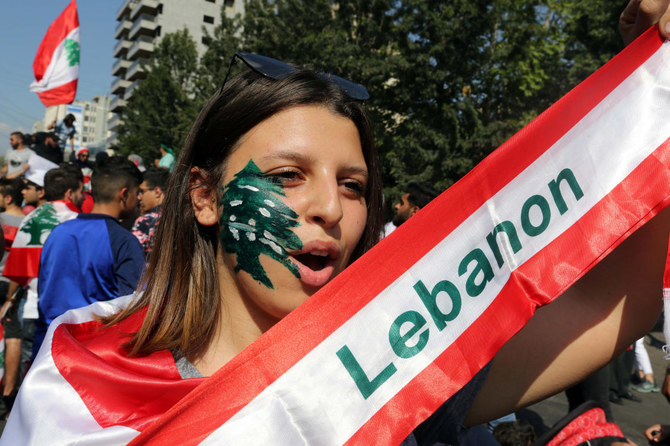
A demonstrator takes part in an anti-government protest in the southern city of Nabatiyeh, Lebanon October 21, 2019. (Reuters)
Updated 03 November 2019
Follow

Citizens accuse Lebanon’s Hezbollah of aiding government to ‘rob their livelihoods’

  • The Hezbollah movement saw demonstrations criticising the party and revered leader Hasan Nasrallah
  • Citizens accused the party of providing political cover for a corrupt government that they say has robbed people of their livelihoods

BEIRUT: When mass anti-government protests engulfed Lebanon, a taboo was broken as strongholds of the Hezbollah movement saw demonstrations criticising the party and revered leader Hasan Nasrallah.
On live TV and in protest sites, citizens accused the party of providing political cover for a corrupt government that they say has robbed people of their livelihoods.
This shattered the myth of absolute acquiesence among Hezbollah's popular base, baffling even those who hail from the movement's strongholds.
"No one ever expected that in any of these areas in south Lebanon we would hear a single word against Nasrallah," or Amal Movement leader Nabih Berri, said Sara, a 32-year-old activist who participated in protests in the southern city of Nabatiyeh.
"It's unbelievable," the activist added, asking to use a pseudonym due to security concerns.
The Iran-backed movement is a major political player that took 13 seats in the country's May 2018 parliamentary elections and secured three cabinet posts.
It helped its Christian ally Michel Aoun assume the presidency in 2016 and has since backed his government despite popular dissatisfaction that peaked last week following protests over taxes, corruption and dire economic conditions.
South Lebanon - a bastion of the powerful Shiite movement  - was not spared.
Protests have been reported in the cities of Nabatiyeh, Bint Jbeil, and Tyre, where Hezbollah and its political affiliate the Amal Movement hold sway.
With the exception of Tyre, they were not as big as other parts of the country.
But "the novelty here is that some of these protesters are party loyalists," said Sara.
"They support Hezbollah, but they are suffocating."
But anti-government protests that started in Beirut on October 17 and quickly spread across the country left no politician unscathed, not even the Hezbollah leader.
"All of them means all of them, Nasrallah is one of them," protesters chanted in Beirut.
Criticism of Nasrallah even aired on the Hezbollah-run Al-Manar TV, in a scene that was previously unfathomable for watchers of the movement's propaganda arm.
In a live interview from central Beirut, one protester urged Nasrallah to "look after his people in Lebanon" instead of focusing on regional enterprises like Syria, where he has deployed fighters to defend President Bashar Al-Assad's regime.
Nasrallah acknowledged the mounting criticism against him in a speech on Saturday: "Curse me, I don't mind."



Aid agencies in South Sudan decry restricted access as government and opposition troops fight

Updated 6 sec ago
Follow

Aid agencies in South Sudan decry restricted access as government and opposition troops fight

  • The World Food Program, a Rome-based UN agency, has warned that escalating violence threatens to cut off food assistance to hundreds of thousands of people

JUBA, South Sudan: Humanitarian organizations in South Sudan said Monday that restricted access to the conflict-hit eastern state of Jonglei has left thousands of people in need of lifesaving medical care and food assistance at risk, as the United Nations raises concern over a growing number of displaced people.
The International Rescue Committee’s country director for South Sudan, Richard Orengo, said that “intensified fighting and the militarization of key areas have forced the suspension of services.”
Medical organization Doctors Without Borders, also known by its French name Médecins Sans Frontières, or MSF, said that the government has suspended all humanitarian flights, cutting off medical supplies, staff movement and emergency evacuations. At least 23 critically ill patients, including children and pregnant women, urgently require evacuation, MSF said.
The World Food Program, a Rome-based UN agency, has warned that escalating violence threatens to cut off food assistance to hundreds of thousands of people, as nearly 60 percent of Jonglei’s population is expected to face crisis-level hunger during the upcoming rainy season. The rains typically cut off access roads, and the violence has prevented the early delivery of aid.
Civilians are bearing the brunt of the escalating fighting in South Sudan’s Jonglei State, which is pushing one of the country’s most fragile regions toward collapse and raising fears of a slide back into full-scale war after an eight-year peace deal, the United Nations and aid groups said.
Homes have been destroyed, civilians killed in the crossfire, and families repeatedly forced to flee as fighting between government forces and opposition fighters loyal to the Sudan People’s Liberation Army–In Opposition, or SPLA-IO, spreads.
Forces loyal to opposition leader Riek Machar, alongside allied “White Army” fighters, have recently made gains against government troops.
The UN and human rights groups have also expressed alarm over inflammatory rhetoric by a senior army commander, who urged troops advancing in Jonglei to “spare no lives.”
The UN Commission on Human Rights in South Sudan expressed “grave alarm” at developments that it said “significantly heighten the risk of mass violence against civilians.”
The opposition said that the commander’s words were an “early indicator of genocidal intent.”
Speaking to The Associated Press, government spokesman Ateny Wek Ateny called the comments “uncalled for” and “a slip of the tongue.”
UN Secretary-General António Guterres has called on all parties to halt the fighting, protect civilians and ensure safe humanitarian access, saying that South Sudan’s crisis requires a political, not military, solution.
The renewed clashes have displaced more than 230,000 people since December, according to the UN Office for the Coordination of Humanitarian Affairs, or OCHA.
The renewed conflict has placed South Sudan’s fragile 2018 peace agreement under severe strain and intensified political tensions before the country’s first general election scheduled for December.