WASHINGTON: Alphabet (Google) subsidiary Wing has become the first company in the United States to deliver packages by drone.
In Christiansburg, the small Virginia town chosen as Wing’s test location, the 22,000 residents can order products normally shipped by FedEx, medicine from Walgreens and a selection of candy from a local business — all of which will arrive via drone.
Wing, which already operates in two Australian cities as well as Helsinki, announced in a statement that the first drone-powered deliveries had taken place Friday afternoon in Christiansburg, “paving the way for the most advanced drone delivery service in the nation.”
One family used the Wing app to order Tylenol, cough drops, Vitamin C tablets, bottled water and tissues, the statement said.
An older resident ordered a birthday present for his wife. Although the majority of the delivery was done by a FedEx truck, the last mile was completed by drone.
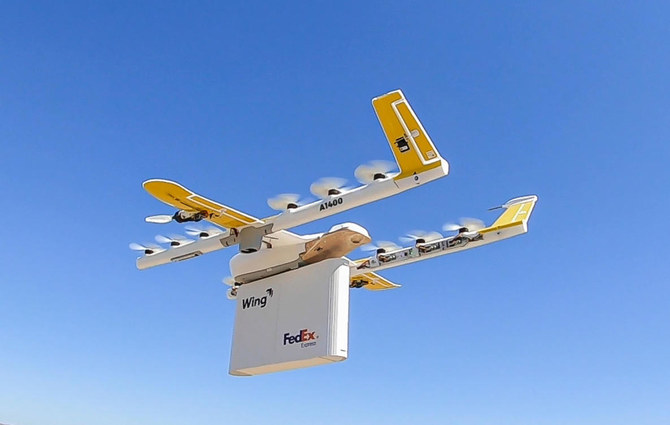
The yellow and white drones are loaded with packages at a local center of operations called the “Nest,” where Wing employees pack them with up to three pounds (1.3 kilograms) of goods, deliverable within a six mile (10 kilometer) radius.
Once they have arrived at their destination, the drones don’t land. Instead, they hover above the house and lower the package with a cable.
Other companies are working to launch similar services, most notably Amazon, UPS and Uber Eats. But Wing was the first to obtain a license from the Federal Aviation Administration (FAA), authorizing company pilots to fly multiple drones at the same time.


Google completes first drone delivery in the US
Google completes first drone delivery in the US

- The yellow and white drones are loaded with packages at a local center of operations called the “Nest”
- Other companies are working to launch similar services, most notably Amazon, UPS and Uber Eats


Amazon’s AWS reports outage after UAE datacenter struck by ‘objects’
- AWS confirmed sparks and fire after objects hit UAE data center causing disruptions to Emirate and Bahrain regions
- Full recovery expected to “be many hours away”
LONDON: Amazon’s cloud-computing facilities in the Middle East faced power and connectivity issues on Monday after unidentified “objects” struck its data center in the United Arab Emirates.
The objects had triggered a fire on Sunday that forced authorities to eventually cut power to two clusters of Amazon data centers in the UAE, with restoration expected to take several more hours, according to Amazon Web Services’ (AWS) status page.
Localized power issues impacted AWS services in both the UAE and neighboring Bahrain, according to the page. Abu Dhabi Commercial Bank said its platforms and mobile app were unavailable due to a region-wide IT disruption, although it did not directly link the outage to the AWS incident.
While Amazon did not identify the objects, the incident happened on the same day Iran fired a barrage of drones and missiles at Gulf States in retaliation for US and Israeli strikes that killed Supreme Leader Ayatollah Ali Khamenei.
A strike, if confirmed, on the AWS facility in the UAE will mark the first time a major US tech company’s data center has been knocked offline by military action. It could also raise questions around Big Tech’s pace of expansion in the region.
US tech giants have been positioning the UAE as a regional hub for artificial intelligence computing needed to power services such as ChatGPT. Microsoft said in November it plans to bring its total investment in the UAE to $15 billion by the end of 2029 and will use Nvidia chips for its data centers there.
“In previous conflicts, regional adversaries such as Iran and its proxies targeted pipelines, refineries, and oil fields in Gulf partner states. In the compute era, these actors could also target data centers, energy infrastructure supporting compute, and fiber chokepoints,” Washington-based think tank Center for Strategic and International Studies said last week.
Microsoft as well as Google and Oracle — both of which also operate facilities in the UAE — did not immediately respond to Reuters requests for comment.
AWS said a full recovery from the issues was expected to “be many hours away” for both UAE and Bahrain.
The outage had disrupted a dozen core cloud services and the company advised customers to back up critical data and shift operations to servers in unaffected AWS regions.