ISLAMABAD: Saudi Arabia and the United Arab Emirates (UAE) have offered to open up their digital labor databases to Pakistan to boost the export of labor from Pakistan to both Gulf countries, Syed Zulifqar Abbas Bukhari, Special Assistant to the Prime Minister on Overseas Pakistan and Human Resource Development, told Arab News from Dubai.
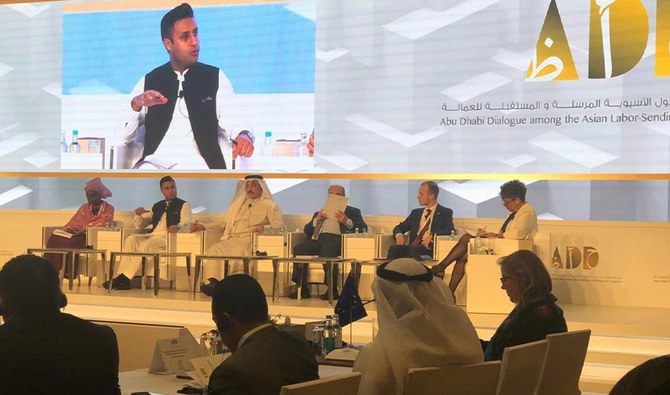
The offer was extended by UAE Minister of Human Resources and Emiratization (MOHRE), Nasser Bin Thani Al Hameli, during a meeting with Bukhari on the sidelines of the 5th ministerial session of Abu Dubai Dialogue held in Dubai last week.
“UAE offered linkage to its ‘virtual labor market database’, and Saudi Arabia has also extended an offer to Pakistan to send domestic workers to the Kingdom through new identity of the electronic home labor program, ‘Musaned,’” Bukhari said and added that the process would be complete in the next three months.
“Pakistan welcomed this, as this would help us in reducing unemployed Pakistanis in both the countries,” he said.
The initiative looks to provide Pakistan with up-to-date information about job opportunities in the labor market in Saudi Arabia and the UAE, and gives valuable information regarding demand for different skills overseas.
Bukhari said the Saudi database also included new and other services developed to preserve the rights of the employer and the worker.
“Pakistan has agreed to connect this with its own digital portal,” he added.
Over 2.7 million Pakistanis live in Saudi Arabia and remit nearly $6 billion home every year. Additionally,1.6 million Pakistanis live in the UAE and are the second largest national group there, constituting 12.5% of the country’s total population.
“Pakistan wants to integrate its digital platform with UAE MOHRE to minimize the cost of recruitment and to make it fair, efficient, transparent, as Pakistan is digitally ready for this collaboration,” Bukhari said.
General Secretary of Pakistan Workers Foundation, Zahoor Awan, welcomed the move, saying it would result in “direct access” between workers and employers.
“Digitalization will help workers find jobs as employers will have direct access to them,” Awan told Arab News, and said the database would reduce the exploitation of workers by middle-men.
“The agents used to loot workers through tall claims about jobs in UAE but this step will lessen their troubles. The technology will provide digital information to employers about their availability and skills. They will contact them directly which will reduce fraud and exploitation,” he said.


Saudi, UAE offer Pakistan access to their labor market databases
Saudi, UAE offer Pakistan access to their labor market databases

- The move is aimed to boost the export of the Pakistani workforce to the two Gulf countries
- The initiative will reduce fraud and exploitation of workers by middle-men

Pakistan says defense pact with Saudi Arabia elevated brotherly ties to ‘new heights’
- Pakistan, Saudi Arabia signed strategic defense pact last year pledging aggression against one will be treated as attack on both
- Deputy PM Ishaq Dar says enduring bonds with Islamic and Arab nations form vital pillar of Pakistan’s foreign policy
ISLAMABAD: Deputy Prime Minister Ishaq Dar said on Wednesday that Pakistan’s defense pact with Saudi Arabia elevated its brotherly ties with the Kingdom to “new heights,” stressing that close ties with Arab and Islamic nations form a key pillar of Islamabad’s foreign policy.
Pakistan and Saudi Arabia signed a Strategic Mutual Defense Agreement on Sept. 17 last year, pledging that aggression against one country would be treated as an attack on both, enhancing joint deterrence and formalizing decades of military and security cooperation.
Both nations agreed in October 2025 to launch an economic cooperation framework to strengthen trade and investment ties.
“In the Middle East, our landmark Strategic Mutual Defense Agreement with Saudi Arabia has elevated our brotherly ties to new heights,” Dar said while speaking at the Pakistan Governance Forum 2026 event in Islamabad.
The Pakistani deputy prime minister was speaking on the topic “Navigating International Relations Amidst Changing Geo-Politics.”
Dar noted that Pakistan has reinforced partnerships with other Middle Eastern nations such as the UAE, Qatar, Jordan, Oman, Egypt and Bahrain. He said these partnerships have yielded “concrete agreements” in investment, agriculture, infrastructure, and energy sectors.
“Our enduring bonds with Islamic and Arab nations form a vital pillar of our foreign policy, and we will continue to expand our partnerships across Asia, Latin America, and Africa,” he said.
Dar pointed out that the presidents of Kazakhstan, Uzbekistan and Kyrgyzstan have undertaken visits to Pakistan in recent months, reflecting Central Asian nations’ desire to boost cooperation with Islamabad.
On South Asia, the Pakistani deputy PM said Pakistan has successfully transformed its fraternal ties with Bangladesh into “a substantive partnership.”
“Similarly, the trilateral mechanism involving China, Pakistan, and Bangladesh has been launched with a view to expanding and deepening regional cooperation and synergy,” the Pakistani minister said.
He said Islamabad has strengthened its “all-weather” partnership with China via the second phase of the multi-billion-dollar China-Pakistan Economic Corridor agreement and “unwavering support” from both sides for each other’s core interests.
Dar said Pakistan had also reinvigorated its partnership with the US, advancing cooperation in trade, technology, investment, and regional stability.
“This calibrated approach has enhanced our ability to navigate complexity with skill and confidence, ensuring that our national interests are served without compromising our core foreign policy principles,” he said.


