


ANKARA: US Vice President Mike Pence and Secretary of State Mike Pompeo arrived in Ankara on Thursday to pressure Turkey into a cease-fire in northeastern Syria.
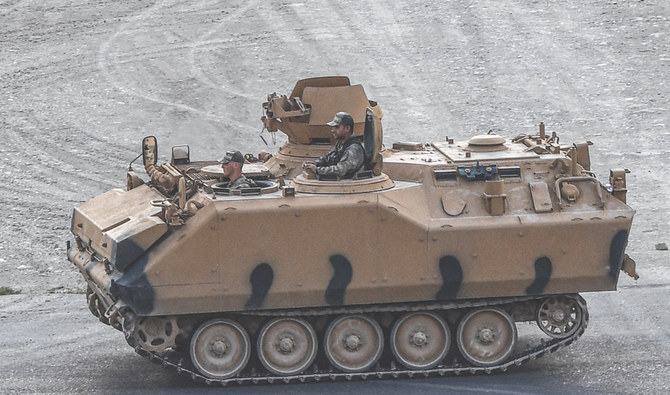
Their visit follows US President Donald Trump’s abrupt decision to withdraw troops from Syria, and Turkey’s launch of a military operation in the country’s northeast.
The assault has sparked a humanitarian crisis as civilians flee the violence. There are security fears over jailbreaks by Daesh group fighters, and there have been howls of condemnation from an international community livid with Trump and Turkish President Recep Tayyip Erdogan.
A meeting between Erdogan and Pence lasted an hour and 40 minutes and it was followed by a meeting between both sides, featuring Pompeo and Washington’s National Security Adviser Robert O’Brien.
The dramatic and fast-moving events have also thrown up a bizarre letter from Trump to his Turkish counterpart, with media reports saying Erdogan binned the correspondence in which he was urged to act in the “right and humane way” in Syria.
In the brash note Trump suggested they “work out a good deal” but then warned about serious economic sanctions to destroy the Turkish economy.
“You don’t want to be responsible for slaughtering thousands of people, and I don’t want to be responsible for destroying the Turkish economy – and I will,” Trump wrote.
“History will look upon you favorably if you get this done the right and humane way. It will look upon you forever as the devil if good things don’t happen. Don’t be a tough guy. Don’t be a fool! I will call you later.”
The US delegation were in Ankara as a “last-ditch” effort to stop the incursion, Max Hoffman from the Center for American Progress said, but the leaking of Trump’s “juvenile” letter right before the US meeting with Erdogan meant it would be hard for him to agree publicly to a cease-fire.
“That will, in turn, possibly prompt Trump to slap harmful sanctions on Turkey for an invasion he essentially greenlit — with Turkish fury the likely outcome,” Hoffman told Arab News.
“And all of this is largely irrelevant, as the incursion is quickly coming up against the reality of stiff SDF (Syrian Democratic Forces) resistance and the political tripwire that the presence of Syrian President Bashar Assad and Russian forces present.”
The SDF, spearheaded by the Kurdish People’s Protection Units (YPG), has helped the US in its fight against Daesh.
Ankara says its military operation is against the YPG which it views as a terrorist group. The Kurdistan Workers’ Party (PKK) has waged an insurgency inside Turkey, and Ankara regards the YPG as an extension of the PKK.
Turkish Foreign Minister Mevlut Cavusoglu told the BBC that Moscow had promised Ankara that the PKK and the YPG would not be in Syrian territories across the border.
“If Russia, accompanied by the Syrian army, removes YPG elements from the region, we will not oppose this,” he added.
Soner Cagaptay, director of the Turkish program at the Washington Institute, said Erdogan would finalize cease-fire details after his meeting with Russian President Vladimir Putin on Oct. 22.
“After the US withdrawal, Russia now controls the ground in Syria and Erdogan will not ink, seal or sign any cease-fire deal with the US before getting a green light from Putin,” he told Arab News.
In the meantime, he added, Turkey would want to maximize its territorial gains.
“The larger Turkey’s space is in Syria, the bigger Turkey’s say is at the peace table when there is a global peace conference to end the conflict in Syria. The larger Turkey’s space, the more bargaining power Turkey has vis-à-vis the Assad regime for a handshake between Erdogan and Assad that will include Turkey potentially returning those territories to Assad and Assad shutting down the YPG and agreeing the return of some refugees to Syria.
Assad said Thursday his forces would confront Turkey’s invasion by “all legitimate means” at their disposal.
Damascus on Sunday reached a deal with Kurdish forces, while Syrian troops deployed in key areas such as Kobani and Manbij.


