Prince William and wife Kate see impact of climate change at Pakistan glacier

1 / 4
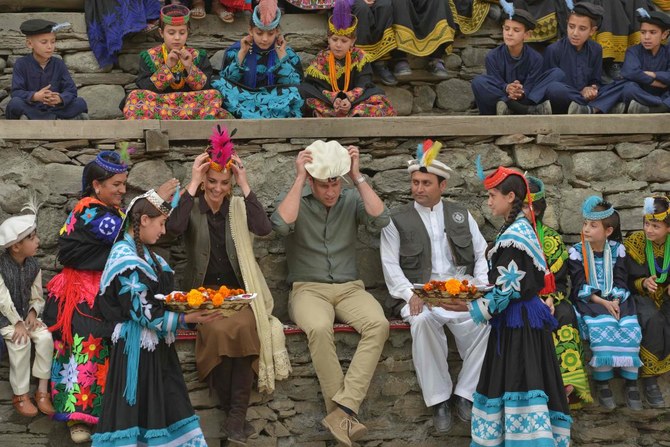
Britain's Prince William and his wife chat with members of the Kalash tribe during their visit to the Bumburate Valley in Pakistan. (Reuters)
2 / 4
Kalash girls presents traditional hats to Britain's Prince William and his wife Britain's Catherine during their visit to the Bumburate Valley in Pakistan northern Chitral District on October 16, 2019. (Reuters)
3 / 4
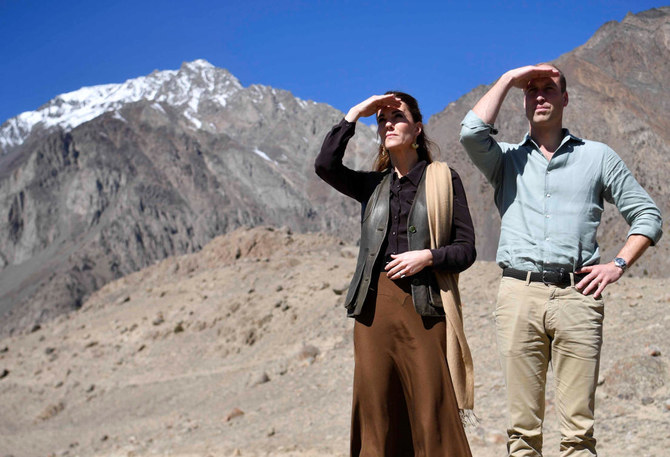
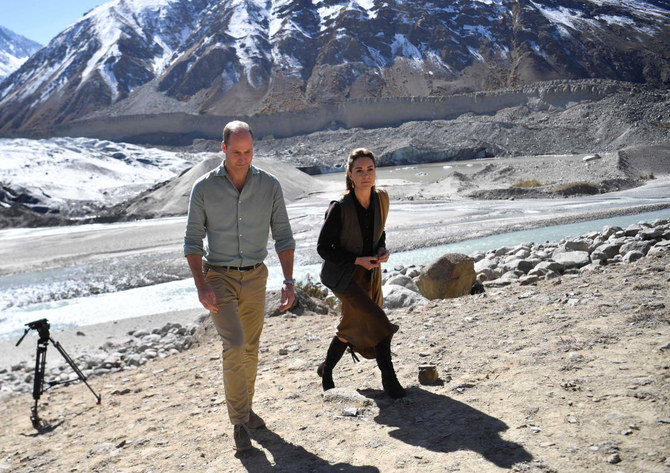
Britain's Prince William and Catherine, Duchess of Cambridge visit the Chiatibo glacier in the Hindu Kush mountain range in the Chitral District of Khyber-Pakhtunkhwa Province in Pakistan. (Reuters)
4 / 4
Britain's Prince William and Catherine, Duchess of Cambridge visit the Chiatibo glacier in the Hindu Kush mountain range in the Chitral District of Khyber-Pakhtunkhwa Province in Pakistan. (Reuters)
Updated 17 October 2019
Follow

Prince William and wife Kate see impact of climate change at Pakistan glacier

  • Britain's Prince William and Kate heard how the Chiatibo glacier was retreating by climate change expert
  • It is one of Pakistan's 7,200 glaciers that meteorological officials say show signs of melting

ISLAMABAD: Britain's Prince William and his wife Kate on Wednesday visited a melting glacier in the Hindu Kush mountain range not far from Pakistan's border with Afghanistan, witnessing first hand the impact of climate change their trip is seeking to highlight.
They flew by helicopter to the northern tip of the Chiatibo glacier, where a climate change expert explained how it was retreating.
It is one of the around 7,000 of Pakistan's 7,200 glaciers that meteorological officials say show signs of melting, citing data gathered over the last 50 years.
Earlier, the Duke and Duchess of Cambridge had stopped at an airport in Chitral and been given a traditional feathered mountain hat, similar to one gifted to William's mother Princess Diana during her visit to the area in 1991. They were also given an album of photos of Diana during her visit.
William highlighted the visit to the glacier and the challenge of climate change, a major theme of their five-day trip, in a speech the previous evening at a reception hosted by the British High Commission at Pakistan's national monument in the capital, Islamabad.
Pakistan's northern glaciers and those throughout the Hindu Kush and Himalaya region, are an important water store for 250 million people, and another 1.6 billion rely on rivers originating in the mountains, putting many communities at risk as global temperatures rise.
"This could lead to a loss of over a third of these vital glaciers in less than a century, with enormous impacts not only on the availability of water, but on agriculture and hydropower generation," William said in his speech.
He said he hoped Wednesday's visit to Chitral would help the couple better understand the challenges residents were facing first hand. "I hope to learn what more we all can do to help prevent and mitigate this impending global catastrophe."
Kate and William later observed damage and emergency response drills in a village in Chitral that had been hit by floods due to glaciers melting.
They also vistaed a settlement of the Kalash people, a small indigenous group living in the Chitral region where they met with young people and wore colourful local scarves and headwear while being treated to song and dance.


Indonesia sets rules limiting use of AI for schoolchildren

Updated 4 sec ago
Follow

Indonesia sets rules limiting use of AI for schoolchildren

  • Indonesian children spend about 7.5 hours daily on tablets, smartphones
  • Gen Zs make up the majority of AI users in the country of 280m people

JAKARTA: The Indonesian government introduced on Thursday a new policy regulating the use of digital technology in education, limiting access to artificial intelligence for students.

Generation Alphas and Gen Zs make up almost half of Indonesia’s online population, which reached nearly 230 million people in 2025, according to a survey conducted by the Association of Indonesian Internet Service Providers.

As Indonesian children clock around 7.5 hours of daily screen time, the joint ministerial decree seeks to boost the benefits of digital technology and AI in formal and informal educational institutions, while also protecting the youth from risks in digital spaces.

“There are a lot of factors but the number of teenagers with mental health issues are high and continue to increase, and one of the suspected triggers — that have been proven academically — is the uncontrolled, unmitigated use of digital technology,” said Pratikno, Indonesia’s Coordinating Minister for Human Development and Cultural Affairs.

“The effects on education are also concerning, such as how it weakens brain activity due to dependence on digital technology tools and reduces critical thinking and cognitive and reflective abilities. This is what we have to regulate.”

Among Indonesia’s 280 million population, around a quarter of internet users are already using AI, with Gen Zs making up about 43 percent of that segment.

The joint decree, which Pratikno described as “comprehensive” and encompasses early childhood education to higher education, was signed in Jakarta by seven ministers, including Higher Education, Science and Technology Minister Brian Yuliarto and Primary and Secondary Education Minister Abdul Mu’ti.

“This decree seeks to ensure that our children are not controlled by technology but become the masters of technology for good, that is our goal. (It prioritizes) digital wellness, (for tech to be used) wisely and intelligently,” Pratikno said.

The policy is important to support young Indonesians, many of whom are internet users from adolescence, said Communication and Digital Affairs Minister Meutya Hafid, who also signed the ministerial decree.

“Indonesia has a significant number of children using the internet. Therefore, we must ensure that they are not only a target market for the technology industry, but also able to utilize technology according to their readiness,” she said.

“Every kind of technological advance has to consider the readiness of its users, especially children.”