

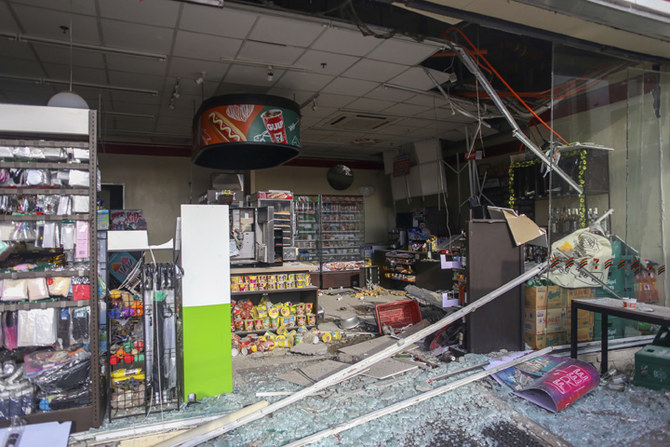


DAVAO, Philippines: A strong and shallow 6.4-magnitude quake hit the southern Philippines on Wednesday, the United States Geological Survey (USGS) said, sending hundreds rushing out of a shopping mall where local television said killing at least one child and injuring more than two dozen other people
An elderly man received treatment after being struck by a falling object during the early evening quake, ABS-CBN television reported from the scene.
The USGS said the quake, which was 14 kilometers (8.6 miles), struck 69 km (43 miles) north-northwest of the city of General Santos, Mindanao at 7:39 p.m. (1137 GMT). The epicenter was about 80 km southwest of central Davao
The Philippines is part of the Pacific "Ring of Fire", an arc of intense seismic activity that stretches from Japan through Southeast Asia and across the Pacific basin.
"We felt a very strong jolt and there was a blackout. I saw people rushing down. We were panicking, heading to the exit," said Naru Guarda Cabaddu, a hotel consultant visiting Kidapawan City, between the epicenter of the quake and Davao.
Renato Solidum, head of the Philippine Institute of Volcanology and Seismology, told the ANC news channel there was a chance of aftershocks, which could be strong and capable of causing severe damage.
"Aftershocks can happen. Some can be felt most likely in low intensities. But we cannot remove the possibility of similar intensities that can be felt in the epicentral area," he said.
Government authorities were starting to receive reports from field officials on the island of Mindanao where the earthquake struck, opening cracks in buildings and homes, sending residents running from shops and offices and knocking power out.
"Our hospital chief reported that a child died because of the earthquake," Reuel Limbungan, mayor of Tulunan town in North Cotabato province, told the DZMM radio station. Two more people were injured, he added.
The earthquake also shook Davao City, the hometown of President Rodrigo Duterte and among the most populous cities in the country.
In Magsaysay town, in the nearby province of Davao del Sur, 20 people were injured by falling debris and home furniture, Anthony Allada, the municipality's information officer, told DZMM.
"Many houses were totally damaged... Another person is in a critical condition," Allada said.
The municipality of M'lang, in Cotabato province, reported three injuries, Vice Mayor Joselito Pinol told DZMM radio.
"I was driving back home when I felt a very powerful shake. I stopped and saw people and patients running out of the hospital," Raprap Rafael, a resident of Kidapawan City, told Reuters. "I'm not sleeping at my home tonight."
Schools in quake-hit areas, including the president’s hometown of Davao city, suspended classes on Thursday so buildings can be inspected for damage. President Rodrigo Duterte was in the capital, Manila, when the quake struck.
Leslie Francisco, a local disaster response officer, said a small college in Digos city in Davao del Sur province had extensive damage.
The Philippines is one of the world’s most disaster-prone countries, with frequent typhoons, earthquakes and volcanic activity. It lies on the Pacific “Ring of Fire,” the arc of faults around the Pacific Ocean where most of the world’s seismic activity occurs.
A magnitude 7.7 quake killed nearly 2,000 people in the northern Philippines in 1990.




