



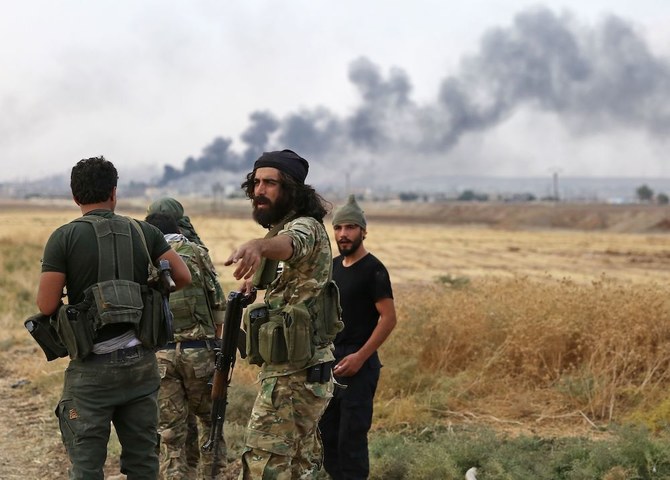

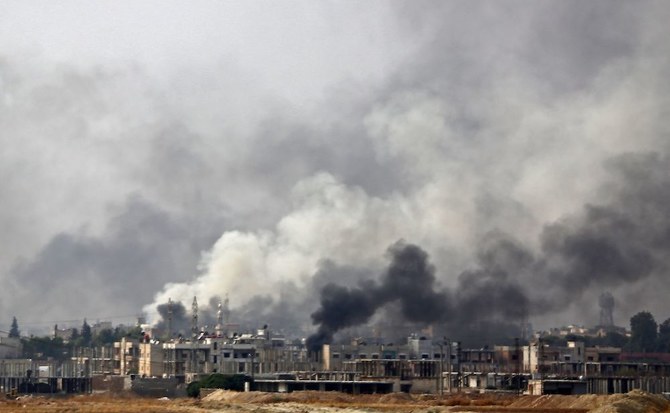
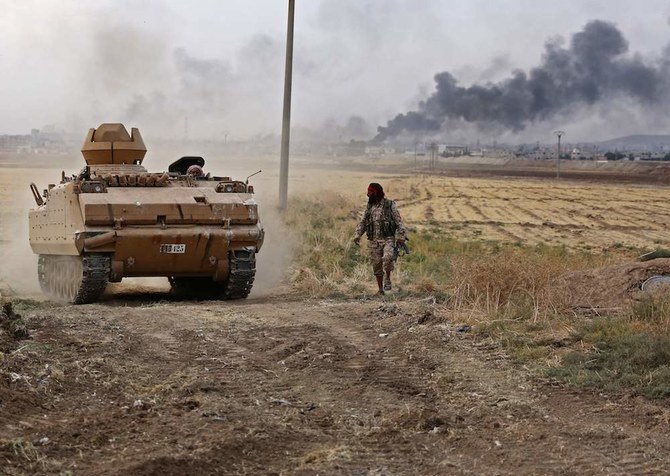

WASHINGTON/ANKARA: US President Donald Trump said on Wednesday he did not mind Russia helping Syria in a conflict with NATO ally Turkey and rejected criticism of his withdrawal of US troops from Syria that exposed Kurdish allies, calling it “strategically brilliant.”
In a day of fast-moving events, Trump endured harsh criticism for the withdrawal and lashed out at US House of Representatives Speaker Nancy Pelosi, calling her a “third-rate” politician during a tense White House meeting after which she accused him of having a “meltdown.”
Trump’s decision to withdraw US forces before a Turkish offensive into northern Syria last week has shattered the relative calm there and he has been accused of abandoning Kurdish militia who helped the United States fight Daesh militants in the region.
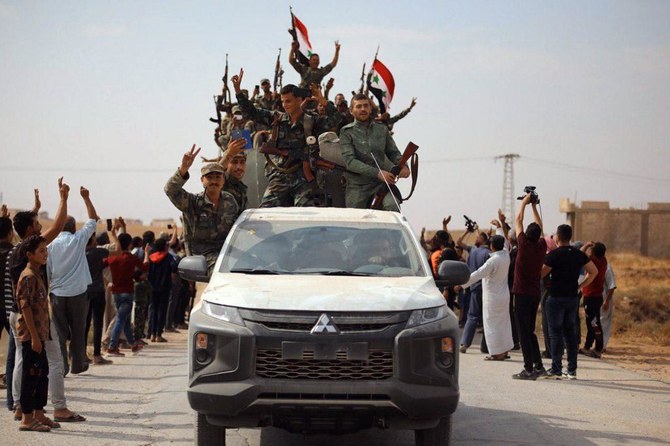
The hasty troop exit has created a land rush between Turkey and Russia — now the undisputed foreign powers in the area — to partition the formerly US-protected Kurdish area. It has allowed Syrian President Bashar Assad to redeploy his forces to an area that had been beyond his control for years in the more than eight-year Syrian war.
Syrian troops accompanied by Russian forces entered the city of Kobani, a strategically important border city and a potential flashpoint for a wider conflict, the UK-based Syrian Observatory for Human Rights, which monitors the Syrian war, reported.
Speaking to reporters as he met Italian President Sergio Mattarella and then at a joint news conference, Trump said the Kurds were “not angels” and that it might be necessary for Russian-backed Syria and Turkey to “fight it out.”
“Our soldiers are not in harm’s way — as they shouldn’t be, as two countries fight over land that has nothing to do with us,” Trump said during Oval Office talks with Mattarella where he sounded as if he were washing his hands of the conflict.
He also defended his move to get US troops out as part of his wider effort to bring Americans home from “endless wars,” despite being excoriated by members of his own Republican Party. USofficials say, however, that those troops were expected to be repositioned in the region. Some of them could go to Iraq.
“I viewed the situation on the Turkish border with Syria to be for the United States strategically brilliant,” Trump said.
“Syria may have some help with Russia, and that’s fine. It’s a lot of sand,” he later said. “So you have Syria and you have Turkey. They’re going to argue it out, maybe they’re going to fight it out. But our men aren’t going to get killed over it.”
Acting last week after a phone call on Oct. 6 with Turkish President Tayyip Erdogan, Trump abruptly upended five years of US policy with his decision to withhold protection from Syria’s Kurds and to withdraw first about 50 special operations forces and then the roughly 1,000 US troops in northern Syria.
“This is a mistake worse than what (Barack) Obama did” when the former president withdrew US troops from Iraq in 2011, Republican US Senator Lindsay Graham, usually among Trump’s strongest supporters, told reporters.
The White House, fighting the domestic political damage and perhaps trying to demonstrate the president’s efforts to stop Turkey’s onslaught, released an Oct. 9 Trump letter to Erdogan that said: “Don’t be a tough guy” and “Don’t be a fool!“
SANCTIONS
Washington announced sanctions on Monday to punish Turkey, but Trump’s critics said the steps, mainly a steel tariffs hike and a pause in trade talks, were too feeble to have an impact.
On Wednesday, US Treasury Secretary Steven Mnuchin said sanctions included the entire ministries of energy and defense and could be broadened to others. Republicans in the US House of Representatives also plan to introduce sanctions legislation.
Trump dispatched some of his top aides, including Vice President Mike Pence and Secretary of State Mike Pompeo to Turkey for emergency talks to try to persuade Ankara to halt its assault. Trump said he thought Pence and Erdogan would have a “successful meeting” with Erdogan, saying if they did not, US sanctions and tariffs “will be devastating to Turkey’s economy.”
Erdogan’s spokesman said Turkey’s Foreign Ministry was preparing retaliation for US sanctions.
A White House meeting between Trump, Republican and Democratic lawmakers on US policy in Syria was cut short. Pelosi, the top Democrat in Congress, said Trump was upset by a 354-60 House vote condemning his Syria withdrawal. Republicans said Pelosi “stormed out.”
“What we witnessed on the part of the president was a meltdown. Sad to say,” Pelosi, whose fellow Democrats are investigating whether to impeach Trump because of his actions toward Ukraine, said upon leaving.
Trump shot back via Twitter on Wednesday night, posting — “Nervous Nancy’s unhinged meltdown!” with a photo of Pelosi standing up and pointing at him during the meeting.
Dozens of Republicans joined the majority Democrats in the House vote. The split underscored deep unhappiness in Congress over Trump’s action, which many lawmakers view as abandoning Kurdish fighters who had been loyally fighting alongside Americans to defeat Islamic State.
Trump has denied giving a green light to Turkey to attack the Syrian Kurds.
Erdogan has insisted there will be no cease-fire, and said he might call off a visit to the United States in November because of the “very big disrespect” shown by US politicians.
He also denounced Washington for taking the “unlawful, ugly step” of imposing criminal charges against a Turkish state bank Halkbank over allegations it broke sanctions on Iran. Washington says the case is unrelated to politics. Halkbank denies wrongdoing.
Turkey’s assault has spawned a humanitarian crisis, with 160,000 civilians taking flight, a security alert over thousands of Islamic State fighters abandoned in Kurdish jails, and a political maelstrom at home for Trump.
Senior Republicans voiced dismay.
“I’m sorry that we are where we are,” the characteristically understated Senate Majority Leader Mitch McConnell said, telling reporters he hoped Pence and Pompeo “can somehow repair the damage” during their trip to Ankara.
Syrian army forces, backed by Washington’s adversaries Russia and Iran, have exploited the power vacuum left by US troops to advance.
Turkey’s cross-border offensive and the US pullout have brought the two biggest militaries in NATO close to confrontation on the battlefield. The United States has complained about Turkish artillery fire near its troops.
The Syrian Observatory said Russian troops had crossed the Euphrates River to advance to Kobani’s outskirts.
Lebanon’s Al-Mayadeen TV reported that Russian-backed Syrian forces had also set up outposts in Raqqa, the one-time capital of Islamic State’s caliphate, which the Kurds captured in 2017 at the peak of their campaign with US support.
Trump did not object to an agreement cut between Kurdish-led forces and the Syrian government to protect Syria from a Turkish offensive, said Commander Mazloum Kobani of the Syrian Democratic Forces (SDF), of which the Kurdish YPG is the main fighting element.
Opinion
This section contains relevant reference points, placed in (Opinion field)


