


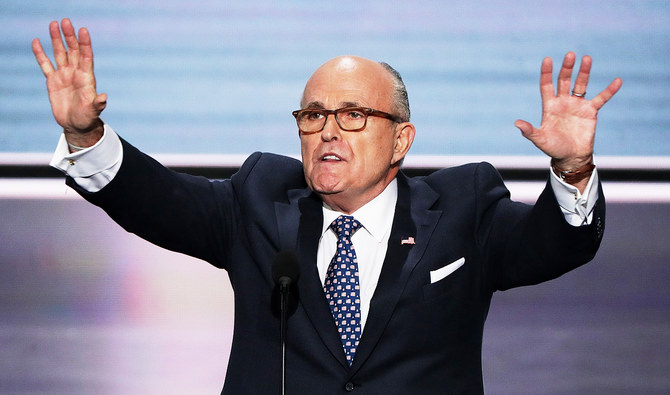

WASHINGTON: National security adviser John Bolton was so alarmed by Rudy Giuliani’s back-channel activities in Ukraine that he described President Donald Trump’s personal lawyer as a “hand grenade who is going to blow everybody up,” according to a former White House aide.
The testimony from Fiona Hill in the impeachment inquiry is among what could eventually become dozens of closed-door depositions as House Democrats work methodically to pin down the details in Trump’s pressure campaign on Ukraine.
Investigators heard Tuesday from Deputy Assistant Secretary of State George Kent, who was among those officials concerned about the “fake news smear” against the US ambassador to Ukraine, Marie Yovanovitch, whom Trump recalled in May, according to emails obtained by The Associated Press.
Hill testified for more than 10 hours on Monday as part of the Democrats’ impeachment probe into Trump’s dealings with Ukraine.
The former White House aide detailed Bolton’s concerns to lawmakers and told them that she had at least two meetings with National Security Council lawyer John Eisenberg about the matter at Bolton’s request, according to a person familiar with the testimony who requested anonymity to discuss the confidential interview.
Those meetings took place in early July, weeks before a July 25 phone call between Trump and Ukrainian President Volodymyr Zelenskiy, in which Trump urged that Zelenskiy investigate political rival Joe Biden’s family and Ukraine’s own involvement in the 2016 presidential election.
A whistleblower complaint about that call, later made public, prompted House Speaker Nancy Pelosi to launch the impeachment inquiry.
Giuliani, who is Trump’s personal lawyer, was heavily involved in the effort to pressure Ukraine on the investigations.
He said Tuesday he was “very disappointed” in Bolton’s comment. Bolton, Giuliani said, “has been called much worse.”
Giuliani also acknowledged he had received payments totaling $500,000 related to the work for a company operated by Lev Parnas who, along with associate Igor Fruman, played a key role in Giuliani’s efforts to launch a Ukrainian corruption investigation against Biden and his son, Hunter. The two men were arrested last week on campaign finance charges as they tried to board an international flight.
Hill’s interview, like the others conducted by House impeachment investigators, took place behind closed doors.
Hill also told the investigators that she had strongly and repeatedly objected to Yovanovitch’s ouster, according to the person familiar with the testimony. Yovanovitch testified to the impeachment investigators Friday that Trump pressured the State Department to fire her.
Opinion
This section contains relevant reference points, placed in (Opinion field)
Hill, a top adviser on Russia, also discussed US ambassador Gordon Sondland and acting White House chief of staff Mick Mulvaney, the person said, telling the three committees leading the investigation that Bolton also told her he was not part of “whatever drug deal Sondland and Mulvaney are cooking up,” an apparent reference to talks over Ukraine.
She quoted Bolton, whom Trump forced out last month, as saying in one conversation that Giuliani was “a hand grenade who’s going to blow everybody up.”
Five more officials are scheduled this week, mostly from the State Department, though it is unclear if they will all appear after Trump declared he wouldn’t cooperate with the probe. Sondland is expected to appear for a deposition under subpoena Thursday and will certainly be asked about those talks.
Sondland, who is the US ambassador to the European Union, is expected to tell Congress that a text message released earlier this month reassuring another envoy that there was no quid pro quo in their interactions with Ukraine was based solely on what Trump told him, according to a person familiar with his coming testimony.
The cache of text messages was provided by one of the inquiry’s first witnesses, former Ukrainian envoy Kurt Volker, and detailed attempts by the diplomats to serve as intermediaries around the time Trump urged Zelenskiy to start the investigations into a company linked to Biden’s son.
In the emails from March, Kent shares with other State Department officials a “daily update of the fake news driven smear out of Ukraine.” The emails include news reports and other commentary, some from US journalists, that “goes after Masha,” as Yovanovitch was known.
Five more officials are scheduled this week, mostly from the State Department, though it is unclear if they will all appear after Trump declared he wouldn’t cooperate with the probe.
Michael McKinley, a former top aide to Secretary of State Mike Pompeo who resigned last week, is scheduled to testify Wednesday. McKinley, a career foreign service officer and Pompeo’s de facto chief of staff, resigned Friday, ending a 37-year career.
While interviews have focused on the interactions with Ukraine, the probe could broaden as soon as next week to include interviews with White House budget officials who may be able to shed light on whether military aid was withheld from Ukraine as Trump and Giuliani pushed for the investigations.
The three committees leading the probe are seeking interviews next week with Russell Vought, acting director of the Office of Management and Budget, and Michael Duffey, another OMB official who leads national security programs, according to a person familiar with those requests. That person wasn’t authorized to discuss the invitations and requested anonymity.
Once Democrats have completed the probe and followed any other threads it produces, they will use their findings to help determine whether to vote on articles of impeachment.
Because of the Trump administration’s edict, the Democrats have been subpoenaing witnesses as they arrived for their interviews — a move sometimes known as a “friendly” subpoena that could give the witnesses additional legal protection as they testify. Both Yovanovitch and Hill received subpoenas the mornings of their testimony, and Kent was subpoenaed for Tuesday’s interview, officials said.
One witness who may not be called before Congress is the still-anonymous government whistleblower who touched off the impeachment inquiry.
Republicans complained Tuesday that the whistleblower’s identity should be made available.
“The question I keep coming back to is why don’t we know who this individual is?” Rep. Jim Jordan, R-Ohio said Tuesday. “I mean they’re basing an impeachment process, trying to remove the president of the United States based on some anonymous whistleblower again with no firsthand knowledge.”
Top Democrats say testimony and evidence coming in from other witnesses, and even the Republican president himself, are backing up the whistleblower’s account of Trump’s July 25 phone with Zelenskiy.


