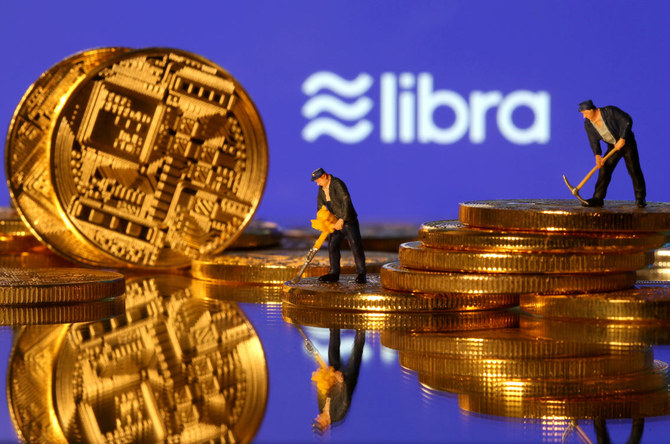
Group behind Facebook’s Libra coin announces 21 founding members

Facebook executives have claimed the new digital coin could help lower costs for global money transfers and help those without access to the banking system. (Reuters)
Updated 15 October 2019
Follow

Group behind Facebook’s Libra coin announces 21 founding members

  • Planned Libra global currency faces swelling criticism from regulators
  • Group of Seven warned it poses a threat to the global financial system

GENEVA: The Libra Association, created by Facebook to launch its new cryptocurrency, has announced its 21 founding members after defections by previous supporters including Visa and Mastercard.
The announcement on Monday came as the planned Libra global currency faces swelling criticism from regulators, and reported warnings from the Group of Seven that it poses a threat to the global financial system.
The group kicked off its first council meeting in Geneva and founding members including Uber, Spotify and Vodafone formally signed onto the Libra Charter, director general Bertrand Perez said.
“We now have a total guarantee of their involvement, so we have confidence in the project,” he said.
Last month, the non-profit association voiced hope that the number of companies backing it when it opened for business would swell from an initial 28 to “well over 100.”
But instead the list has shrunk, after more of its initial backers walked away amid swelling criticism from regulators around the world.
Credit card giants Visa and Mastercard, online marketplace eBay and digital payments firm Stripe each announced Friday they had changed their minds about being founding members of the association, following a similar recent announcement by digital payments firm PayPal.
The Libra Association confirmed Friday that the companies would no longer be founding members, but said it would continue building an alliance of businesses, social-good organizations, and others to implement the cryptocurrency.
Its launch was originally planned for mid-2020, but Perez said he had not ruled out a later start date.
“What we want is to build a platform that is solid, that is there to last and that will survive in the long term,” he said, adding he was still “optimistic” about reaching around 100 members as planned.
The membership departures came after US senators sent letters to several financial firms noting that they could face “a high level of scrutiny from regulators” if they participated in the new currency plan.
French economy and finance minister Bruno Le Maire had warned that under current circumstances, Libra posed a threat to the “monetary sovereignty” of governments and could not be authorized in Europe.
Facebook executives have, however, claimed the new digital coin could help lower costs for global money transfers and help those without access to the banking system.
Facebook chief Mark Zuckerberg is set to testify at an October 23 hearing in the US House of Representatives on the Libra plan.
But in a fresh blow, a draft G7 report has outlined nine major risks posed by such digital currencies, according to the BBC.
The report, due to be presented to finance ministers at International Monetary Fund’s annual meeting this week, did not single out Libra but referred to “global stablecoins” with the potential to “scale rapidly” as posing a range of potential problems.
Stablecoins are seen as more steady than cryptocurrencies like Bitcoin, since they are pegged to traditional currencies such as the US dollar or the euro.
But the G7 draft report reportedly cautioned that such currencies could pose problems for policymakers setting interest rates, and could threaten financial stability if users suddenly suffer “loss of confidence” in the digital unit.
Randal Quarles, the head of the Financial Stability Board (FSB), which oversees regulation among G20 economies, also sent a letter to G20 finance ministers Sunday warning that “global stablecoins could pose a host of challenges to the regulatory community.”
This, he wrote, was “not least because they have the potential to become systemically important, including through the substitution of domestic currencies.”
“Stablecoin projects of potentially global reach and magnitude must meet the highest regulatory standards and be subject to prudential supervision and oversight,” he insisted.


Global markets slide as US-Israel strikes on Iran rattle investors 

Updated 5 sec ago
Follow

Global markets slide as US-Israel strikes on Iran rattle investors 

RIYADH: Global markets plunged on March 2 after US and Israeli strikes on Iran triggered Gulf-wide retaliation, disrupting energy and financial hubs and rattling investors worldwide. 

Equities across Asia fell in early Monday trading as investors moved into safe-haven assets amid fears of prolonged conflict and supply disruptions in the energy-rich Middle East.

Oil prices surged sharply while global stock markets came under pressure, reflecting concerns that escalating tensions could fuel inflation and slow economic growth. 

Asian markets tumbled in early trade, with Japan’s Nikkei 225 and South Korea’s Kospi declining by 2.7 percent and 4.3 percent, respectively. 

Indian benchmark indices extended losses, with the BSE Sensex falling 1.90 percent and the NSE Nifty 50 dropping 1.88 percent as of 11:30 a.m. Saudi time. 

Pakistan’s stock market was also hit by geopolitical tensions, plunging as much as 9.6 percent at the open on Monday — the worst fall of its kind on record — according to Reuters. 

Commenting on the latest developments, Charu Chanana, chief investment strategist at Saxo Bank, said in a statement that Asian markets opened Monday trading in a risk-off mood, with pressure most visible in airline, cyclical and trade-exposed sectors. 

She added that energy, mining and defense stocks — including companies involved in drone technology, which has been widely deployed in the conflict — could show relative resilience during periods of geopolitical tension. 

“Traditional defensives such as utilities, consumer staples and healthcare may hold up better than the broader market, but they are not immune if the selloff is driven by higher oil prices and inflation concerns,” said Chanana.  

She added: “Asia and EM (emerging markets) also face a dual shock of higher oil prices, which tend to be an inflation/tax effect and a broader pullback in risk appetite.”  

Tony Hallside, CEO of STP Partners, told Arab News that the immediate impact of the ongoing war is a geopolitical risk premium in crude, driven by tanker disruptions and the threat of a Strait of Hormuz choke point. 

“The macro takeaway is simple: higher energy feeds inflation expectations, squeezes consumer demand in importing economies, and complicates the path for interest rates,” said Hallside.  

He added: “The early pattern is 'risk off': investors rotate into safe havens — gold, the US dollar, Swiss franc — and trim equities, especially in energy-importing regions. You can see it in the tape: oil and gold up, major equity futures and indices weaker, and FX rewarding perceived safety and energy self-sufficiency.” 

Echoing similar views, Chanana said higher oil prices raise the risk of stickier headline inflation and could slow the pace at which inflation readings improve. 

“That does not automatically mean policy tightening, but it can make the Fed more cautious about cutting quickly, because energy-driven inflation can spill into expectations and broader pricing behavior over time,” she said.  

Chanana added that gold tends to perform well when investors seek assets less dependent on earnings visibility, supply chains or any single region’s political risk. 

Investment in gold can also serve as a policy-plus-inflation hedge in an environment where energy risks complicate the macro outlook — creating “double support” for gold and, to a degree, other precious metals. 

“Silver can see bigger upside in a risk-off bid because it typically carries more beta than gold: it can rally harder when safe-haven demand and inflation hedging rise, but it also tends to be more volatile on the way there,” said Chanana.  

She added that equities could stabilize and retrace if tensions in the region de-escalate, although oil may remain above pre-event levels as insurance and security costs take time to normalize. 

Subramanian Sharma, director of Greenback Advisory Services, told Arab News that the Iran-US conflict is likely to have a significant impact on oil prices, as a potential closure of the Strait of Hormuz could sharply raise the landing cost of crude for major importing countries, leading to higher freight and insurance expenses. 

According to Sharma, this would push up inflation in oil-importing nations and could weigh on their economic growth. 

“If the war continues for some more days, we can see a ripple effect on these economies, and it will weaken their currencies,” said Sharma. 

He cautioned that investors have grown increasingly jittery since the onset of the conflict, a trend already reflected in global equity market movements. 

“Share markets in major countries are down, and people may resort to panic selling, which will add more pressure to the dice,” said Sharma.  

He added: “Overall, the sentiment will remain bearish, and if the war prolongs, we can see more pain across the globe.”