

The storied history of an Iron Age dagger found in Dubai

A rare bronze dagger has gone on show at the Louvre Abu Dhabi . (Supplied)
Updated 15 October 2019
Follow

The storied history of an Iron Age dagger found in Dubai

DUBAI: A rare bronze dagger dating back almost 3,000 years has gone on show at the Louvre Abu Dhabi as part of the museum’s “Rulers and Warriors: The Age of Heroes” exhibit.

The sophisticated, slightly curved dagger is on loan from Dubai Municipality and was excavated from Saruq Al-Hadid in southern Dubai, widely viewed as one of the Arab world’s most significant Iron Age archaeological sites following its discovery in 2002.


The rare bronze dagger dates back almost 3,000 years. (Supplied) 

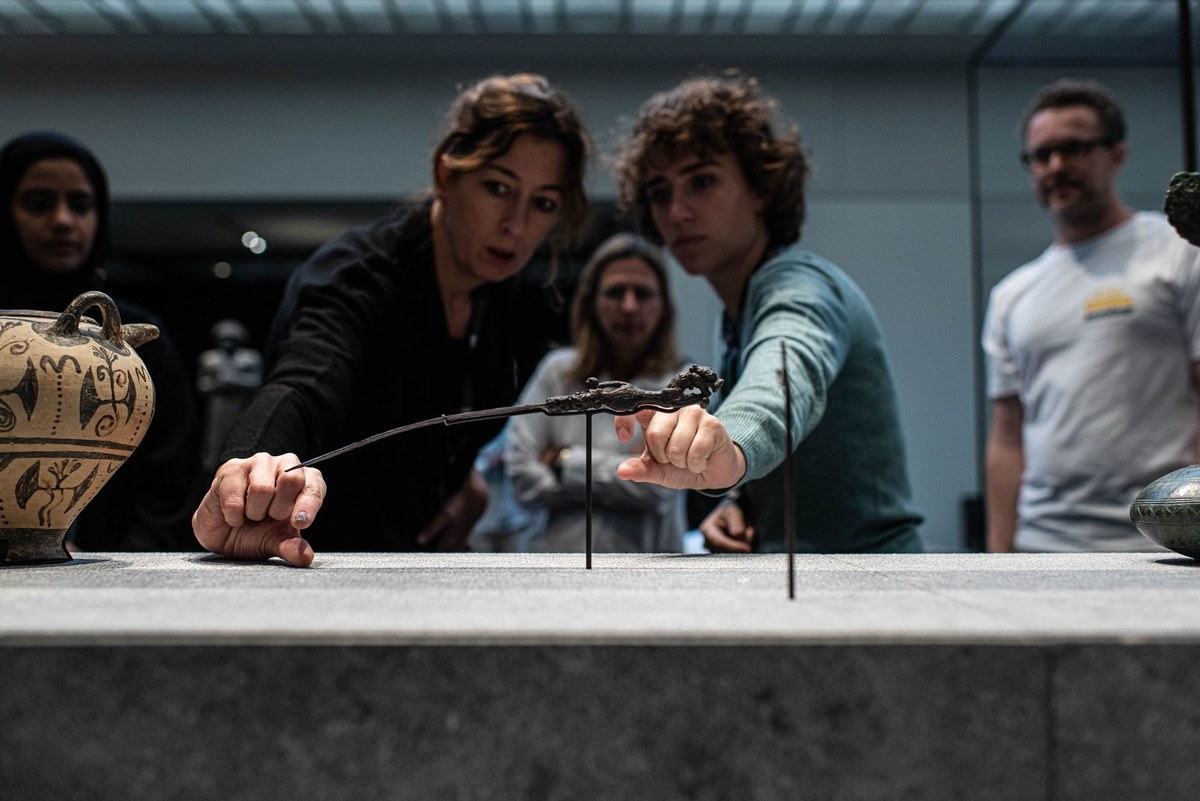
Archaeologists believe the dagger was an “object of prestige,” Noemi Dauce, the museum’s chief curator of archaeology, told Arab News.

“What we are trying to highlight is how weapons become attributes of power. Instead of creating a simple shape for the weapons — just a blade that would be enough to harm anybody — some of these weapons, like this dagger, would actually have rich decoration,” she said.
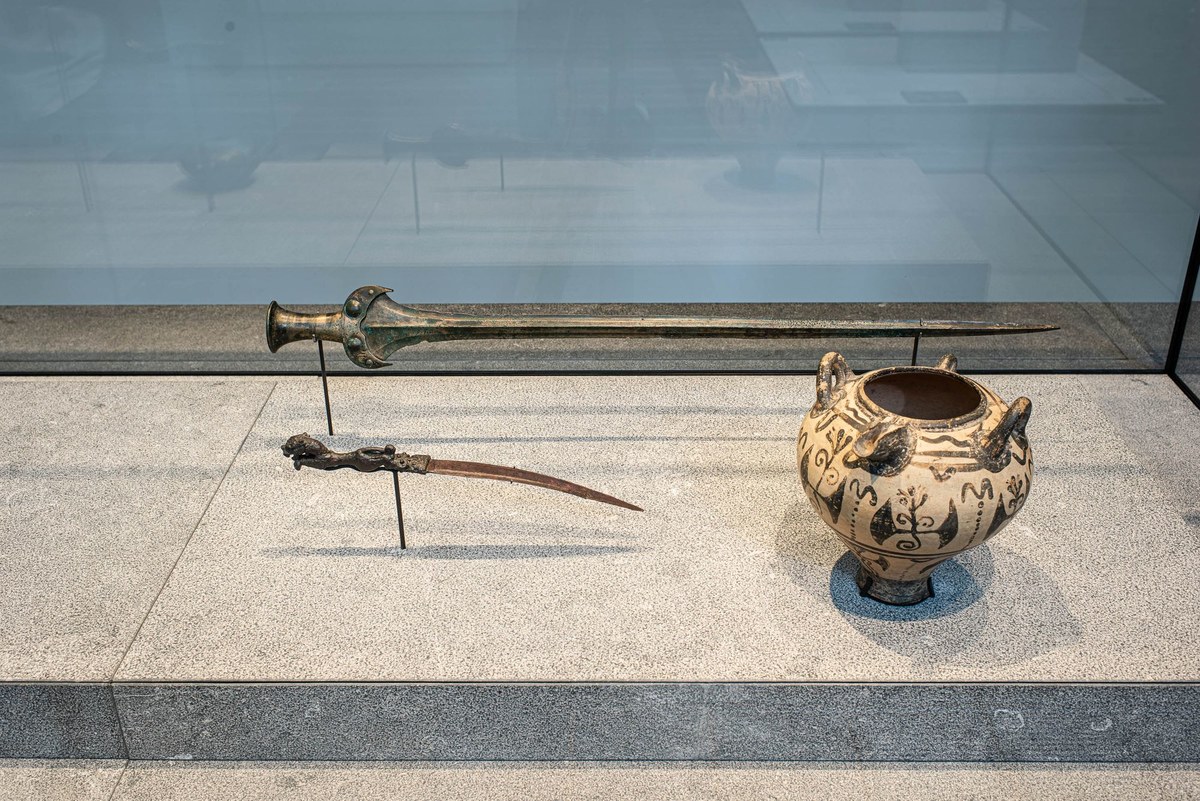


The Iron Age dagger shows at the Louvre Abu Dhabi as part of the museum’s “Rulers and Warriors: The Age of Heroes” exhibit.

Dauce points to the dagger’s remarkable handle, which is topped off with a design featuring an attacking lion — a telling detail that may indicate that the weapon’s owner was a ruler or military leader.

“In a lot of cultures and civilizations, the lion is, of course, a wild and ferocious animal and is very commonly associated with power.” she said.

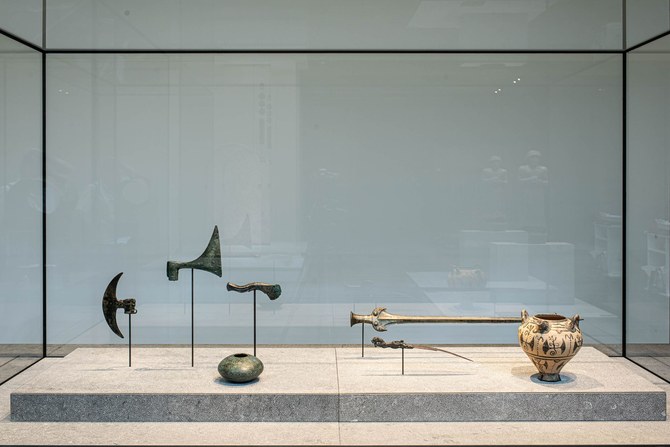
The dagger is displayed in a glass case alongside ancient military artefacts from Iran, Greece and the Caucasus — an approach that aims to foster cross-cultural narratives in the museum.


Archaeologists believe the dagger was an “object of prestige.” (Supplied)

An axe blade from the mountains of Lorestan in Iran and a bronze sword with a decorated hilt that was found in France form part of the exhibition.

“The ambition of the Louvre Abu Dhabi is to be a universal museum,” Dauce said. “We try to highlight the long history of the UAE, but also the way it fits into the larger picture of humanity.”


Riyadh to install 25 new public artworks after conclusion of Tuwaiq Sculpture symposium

Updated 09 March 2026
Follow

Riyadh to install 25 new public artworks after conclusion of Tuwaiq Sculpture symposium

  • Move will extend the impact of the annual art event beyond its conclusion, bringing large-scale contemporary artworks into the city’s streets and parks
  • Artworks produced during the symposium will now become part of Riyadh Art’s permanent collection

RIYADH: Some 25 sculptures created during the seventh edition of the Tuwaiq Sculpture symposium and exhibition will soon be installed across public spaces in Riyadh.

The move will extend the impact of the annual art event beyond its conclusion, organizers said, bringing large-scale contemporary artworks into the city’s streets and parks.

Organized by the Royal Commission for Riyadh City through the Riyadh Art Program, the 2026 edition has ended after nearly two months of live sculpting, exhibitions and public programming.

The artworks produced during the symposium will now become part of Riyadh Art’s permanent collection and will appear across the capital as part of a broader effort to integrate art into everyday urban life.

This year’s symposium began in January and took place along Prince Mohammed bin Abdulaziz Road, widely known as Tahlia Street.

The site was transformed into an open-air studio in which visitors could observe artists carving, welding and assembling sculptures.

The live sculpting phase, which was held between Jan. 10 and Feb. 5, brought together leading Saudi and international artists to produce 25 large-scale works.

The sculptures were created using locally sourced granite and reclaimed metal, highlighting both the region’s natural materials and the creative reuse of industrial elements.

Visitors were able to follow the process of each artwork’s development, from raw materials to finished sculptures, while also interacting with the artists and learning about their techniques and concepts.

The event also featured a wide-ranging community engagement program designed to deepen public understanding of contemporary art.

The program included 10 panel discussions, 105 training workshops and 15 masterclasses exploring sculptural techniques, materials and the role of public art in cities.

Educational outreach formed another key component of the symposium. Organizers hosted 25 educational visits for more than 600 students, while daily guided tours enabled visitors to explore the artworks and gain insight into the creative processes behind them.

After the live sculpting phase, the completed sculptures remained on-site until March 8, giving visitors the opportunity to experience the works in their original setting before their distribution across Riyadh.

The symposium was curated by Lulwah Al-Homoud, Sarah Staton, and Rut Blees Luxemburg, who guided the artistic direction around the theme “Traces of What Will Be,” exploring how sculpture can reflect future possibilities while responding to the city’s evolving identity.