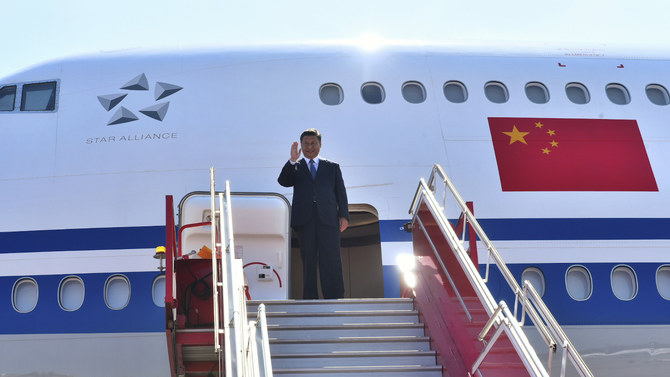
MAMALLAPURAM: Chinese President Xi Jinping arrived in India on Friday for meetings with Prime Minister Narendra Modi at a time of tensions over Beijing’s support for Pakistan in opposing India’s downgrading of Kashmir’s semi-autonomy and continuing restrictions on the disputed region.
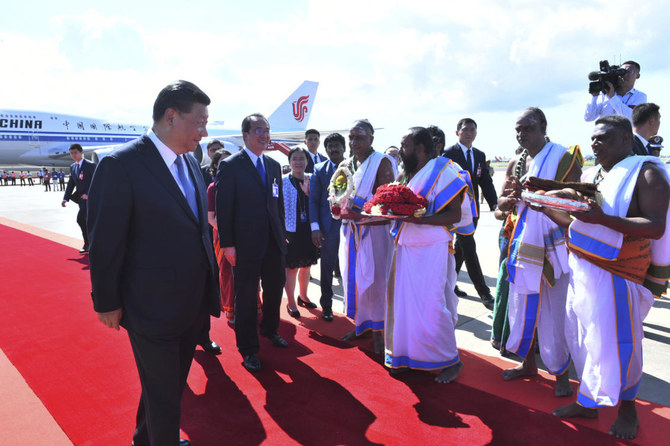
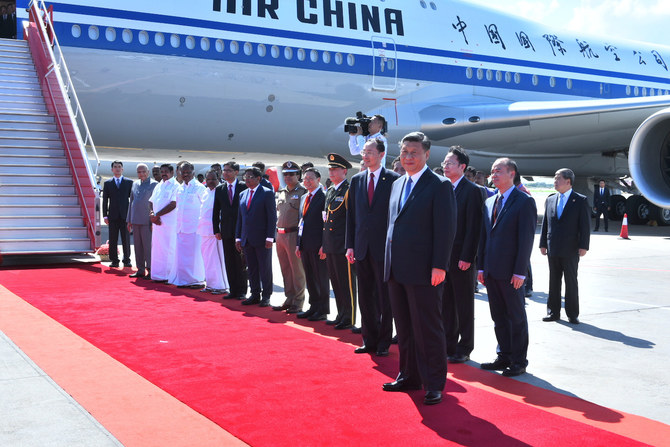
Xi was greeted at the Chennai airport by Tamil Nadu state Gov. Patwarilal Purohit as a cultural group beat drums and blew horns.
India’s foreign ministry said Xi and Modi will meet in the seaside temple town of Mamallapuram later Friday and Saturday.
Their one-to-one meeting in Wuhan in China in April last year also was preceded by tensions caused by a 10-week standoff between their armed forces on the Bhutan border.
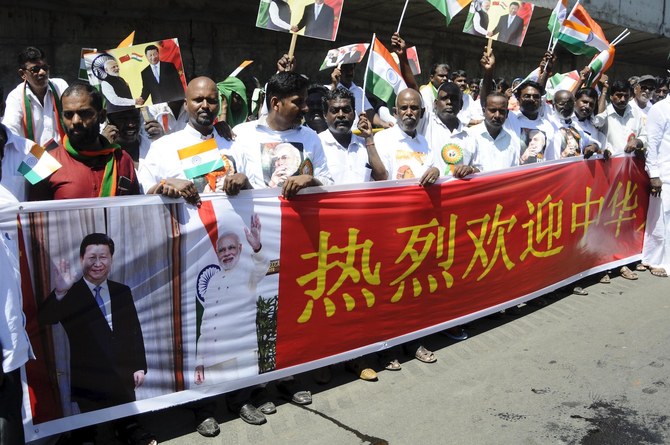
Mamallapuram is decorated with arches studded with fruits and green vegetables. Hundreds of young children in traditional dress carrying posters with photographs of Xi and Modi waited for hours to greet the Chinese leader.
The town was under tight surveillance, with thousands of security personnel. Mamallapuram is 55 kilometers (35 miles) south of Chennai, the capital of Tamil Nadu state.
China claims some 90,000 square kilometers (35,000 square miles) of territory in India’s northeast, while India says China occupies 38,000 square kilometers (15,000 square miles) of its territory on the Aksai Chin Plateau in the western Himalayas. Officials have met at least 20 times to discuss the competing border claims without making significant progress.
The two countries fought a border war in 1962.
India also is concerned about China’s moves to build strategic and economic ties with its neighbors, Sri Lanka, Nepal, Bangladesh and the Maldives.
Tensions in Kashmir, which is divided between Pakistan and India but claimed by both, have escalated since August, when India downgraded the semi-autonomy of Indian-administered Kashmir and imposed a security and communications lockdown.
China supported Pakistan in raising India’s actions at the UN General Assembly meeting in New York. China said India should not act unilaterally in Kashmir, a portion of which China also controls.
Xi arrived two days after hosting Pakistan Prime Minister Imran Khan in Beijing.
India says Jammu and Kashmir is an integral part of India. “China is well aware of our position. It is not for other countries to comment on the internal affairs of India,” India’s External Affairs Ministry said in a statement Wednesday.
Lalit Mansingh, a former Indian ambassador to the United States, said he expected an overview of relations by the two leaders and “instructions on how the relationship should proceed.”
He said the diplomatic damage the Chinese inflicted over India’s action in Kashmir has been done. “This is not going to be undone. India has stuck to its position and received international support,” he said.
China for its part resents India’s hosting of the exiled Tibetan spiritual leader the Dalai Lama, who fled Tibet in 1959 and took refuge in India.
The Tibetan Youth Congress in a statement on Friday urged Prime Minister Modi to take up the Tibetan issue with Xi during the summit. “TYC condemns the Communist government of China and its president as long as the Communist Party continues to suppress the struggle of the Tibetan people,” it said.
China says Tibet has been part of its territory for centuries, although many Tibetans say they were essentially independent for most of that time. Communist troops took control of the region in 1950 after a brief military struggle.
Referring to India’s support for China’s position on Tibet, Mansingh said that India backs China’s territorial integrity. “China will not keep on challenging our territorial integrity. Otherwise we will have to have to take a different view on the issue,” he said.


![]()
![]()
![]()
![]()

China’s president in India for summit amid Kashmir tensions
China’s president in India for summit amid Kashmir tensions
- Xi was greeted at the Chennai airport by Tamil Nadu state Gov. as a cultural group beat drums and blew horns
- India’s foreign ministry said Xi and Modi will meet in the seaside temple town of Mamallapuram later Friday and Saturday


Latest updates


Recommended



© 2026 SAUDI RESEARCH & PUBLISHING COMPANY, All Rights Reserved And subject to Terms of Use Agreement.