

Conjoined twins from Libya arrive in Saudi Arabia

1 / 5
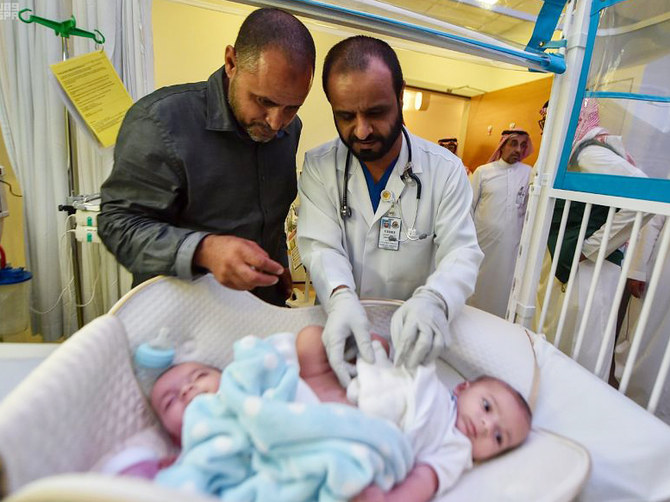
The children were transferred to the King Abdullah Children Specialist Hospital in Riyadh. (SPA)
2 / 5
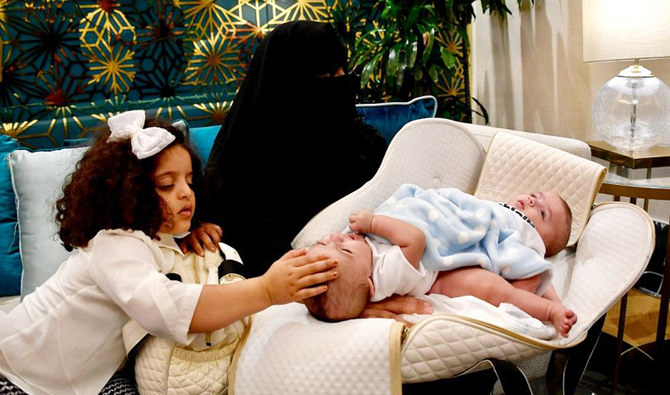
The children were transferred to the King Abdullah Children Specialist Hospital in Riyadh. (SPA)
3 / 5
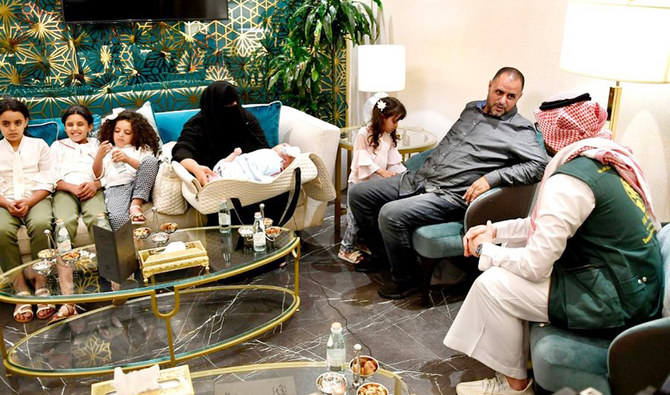
The children were transferred to the King Abdullah Children Specialist Hospital in Riyadh. (SPA)
4 / 5
The children were transferred to the King Abdullah Children Specialist Hospital in Riyadh. (SPA)
5 / 5
The children were transferred to the King Abdullah Children Specialist Hospital in Riyadh. (SPA)
Updated 09 October 2019
Follow

Conjoined twins from Libya arrive in Saudi Arabia

  • The case of Ahmed and Mohammed is being studied as part of the Saudi National Siamese Twins Separation Program

RIYADH: Libyan conjoined twins have arrived in the Kingdom following directives from King Salman and Crown Prince Mohammed bin Salman to study their case and the possibility of separating them, the Saudi Press Agency reported.
The children, Ahmed and Mohammed, were transferred to the King Abdullah Children Specialist Hospital in Riyadh. Their parents, who accompanied the boys, thanked the Saudi leadership for its warm welcome, hospitality and interest.
The supervisor general of the King Salman Humanitarian Aid and Relief Center and renowned pediatric surgeon, Dr. Abdullah Al-Rabeeah, said the Kingdom’s initiative was in recognition of the difficult circumstances facing Libya.
He added that the initiative also reflected the humanitarian role played by the Kingdom’s leadership in dozens of countries that needed help and assistance with such cases.
The case of Ahmed and Mohammed is being studied as part of the Saudi National Siamese Twins Separation Program.


Northern Borders rock art reveals ancient life

Updated 6 sec ago
Follow

Northern Borders rock art reveals ancient life

  • Among the most notable remains are stone structures scattered northwest of Arar
  • Evidence ranges from the Neolithic era to Islamic times, forming a chronological record

JEDDAH: Saudi Arabia’s Northern Borders region contains numerous archaeological sites, reflecting a long history of human settlement dating back to early periods, the Saudi Press Agency reported.
Among the most notable remains are stone structures scattered northwest of Arar.
Varying in shape, size and design, specialists believe these structures date to the end of the Neolithic period and the beginning of subsequent eras. They are thought to have been used as stone tombs to preserve the remains of the dead.
Evidence ranges from the Neolithic era to Islamic times, forming a chronological record that highlights the diversity of communities that once lived in the region and how they interacted with their natural environment over centuries.
Ajab Al-Otaibi, director general of antiquities at the Heritage Commission, said the stone structures and rock art sites in the Northern Borders region represent an integral part of Saudi Arabia’s national cultural heritage and serve as an important resource for archaeological studies and scientific research.
He highlighted the importance of surveys, documentation and protection efforts to preserve these cultural landmarks as a historical legacy for future generations.
The region is also home to several important rock art sites, such as Shu’ayb Hamer, which features a wide and diverse collection of drawings carved on natural rock surfaces, marking it as a key site that documented early human activity in the area.
The artworks depict scenes of hunting, horsemanship, dancing, daily life and social rituals. They were created using a variety of artistic styles, most notably framed and abstract forms, and produced through different techniques including incizing and pecking, both direct and indirect.
The carvings portray human figures and a range of animals, including camels, horses and gazelles, as well as some wild and predatory species that have long since disappeared.
These images provide insight into the richness of the natural environment in earlier periods and help researchers understand the evolving relationship between humans and their surroundings.