ISLAMABAD: Prime Minister Imran Khan arrived in China on Monday for a two-day official visit, PM Office said.
Khan is visiting Beijing upon the invitation of Prime Minister Li Keqiang and will discuss issues of regional and bilateral significance, including projects under the multi-billion-dollar China-Pakistan Economic Corridor (CPEC) with the top Chinese leadership, according to the official handout released by the country’s foreign office earlier in the day.
The premier will hold separate meetings with Chinese President Xi Jinping and PM Keqiang.
He is accompanied by a high-powered delegation comprising top government officials, including Foreign Minister Shah Mahmood Qureshi, Minister for Planning, and Adviser on Commerce and Chairman BOI. Army Chief General Qamar Javed Bajwa is also joining Khan’s meetings with the Chinese leadership, according to the statement.
“The Prime Minister will exchange views on regional developments including the state of peace and security in South Asia arising from the situation in occupied Jammu & Kashmir since 5 August 2019,” the statement added.
The foreign office said that the visit will be instrumental in further cementing Pakistan’s strategic ties with China along with “deepening bilateral trade, a commercial investment partnership.”
During the visit, Khan will interact with senior representatives of the Chinese business and corporate sector.
“Among other things, the Prime Minister will apprise the Chinese leadership of the government’s recent landmark decisions to speed-up implementation of ongoing CPEC projects as well as efforts to project CPEC as a High-Quality Demonstration Project of BRI,” the statement read.
Khan will discuss the expansion of projects under the CPEC framework besides cooperation in agriculture, industrial and socio-economic sectors.
Khusro Bakhtiar, Pakistan’s minister for planning who also oversees CPEC projects, dispelled the impression of a “slowdown” in CPEC.
Bakhtiar said that PM Khan will address during his visit the China-Pakistan Business Forum to further cement economic and trade exchanges between the two countries. He will also meet with Chinese entrepreneurs and heads of different companies during his visit, the minister added.
“Prime Minister’s visit to China is extremely important particularly coming at a point when the two countries have recently signed the second phase of free trade agreement which allows both the countries increased market access and reduced custom duties for their commodities,” Dr. Vaqar Ahmed, senior economist and joint executive director of Sustainable Development Policy Institute (SDPI), told Arab News.
“The visit will also pave way for a clearer understanding and way forward for the joint coordination committee of CPEC which will meet soon,” Ahmed said.
Political analyst Rasul Bakhsh Rais said that “China has emerged as the largest investor in strategic sectors of energy, communications, and industrial infrastructure. After stabilizing the economy, Pakistan wants to engage China on joint business ventures, science, and technology, agriculture and railways, also it desires to expedite the ongoing CPEC projects.”
Khan may also seek China’s help in getting relief for the people of Kashmir by lifting of the two-month-long curfew imposed by India on the part of the disputed valley under its administrative control, Rais said.


Pakistan prime minister arrives in China for two-day visit
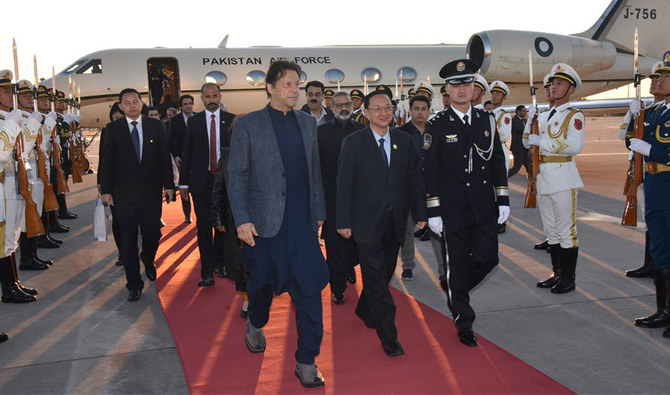

Pakistan prime minister arrives in China for two-day visit

- PM Khan will discuss regional developments including the situation in Kashmir
- Will apprise the Chinese leadership of efforts to speed-up implementation of ongoing CPEC projects

Pakistan and Kazakhstan sign 37 MoUs to deepen cooperation, set $1 billion trade target
- Both sides agree to form strategic partnership and discuss enhanced physical connectivity
- PM Sharif says the two sides should turn these MoUs into implementable agreements
ISLAMABAD: Pakistan and Kazakhstan on Wednesday agreed to establish a strategic partnership, signed 37 memoranda of understanding (MoUs) and set a target of raising bilateral trade to $1 billion within a year, as the two sides agreed to strengthen bilateral cooperation and physical connectivity amid a push for greater regional integration.
The MoUs were signed in the presence of Prime Minister Shehbaz Sharif and President Kassym-Jomart Tokayev, who arrived in Islamabad a day earlier on an official visit.
Landlocked Kazakhstan is seeking access to global maritime trade through Pakistan’s ports on the Arabian Sea, while Islamabad has been positioning itself as a regional transit hub linking Central Asia with South Asia, the Middle East and beyond.
“We had very useful and productive meetings since morning, and just now we have had this signing ceremony of 37 MOUs,” Sharif said while addressing the gathering at the PM House, expressing hope that the understandings would soon be converted into binding agreements and implemented.
The two countries agreed to expand cooperation across transport and logistics, including rail, road and multimodal corridors, with Sharif offering Kazakhstan access to Pakistan’s transit infrastructure and seaports as part of broader efforts to enhance regional connectivity through Central Asia and Afghanistan.
Sharif acknowledged that current bilateral trade levels remained well below potential.
“Unfortunately, our trade volume is just meager $250 million during the last year,” he said. “This does not reflect not only the strength of our friendship, but also the potential of the two countries ... Let us make a commitment that we will take up our trade volume to $1 billion in the next one year.”
Speaking at the ceremony, Tokayev described Pakistan as a key partner for Kazakhstan.
“Pakistan is a reliable and important partner of Kazakhstan in South Asia and beyond,” he said. “Our peoples are united by centuries-old ties rooted in the legacy of the Great Silk Road, as well as by deep cultural and spiritual affinity.”
Beyond connectivity, the MOUs cover cooperation in energy, agriculture, mining and minerals, pharmaceuticals, defense production, digital technologies and artificial intelligence.
The two sides also agreed to promote joint ventures, particularly in food processing, agriculture value chains and industrial production.
Investment cooperation featured prominently, including the launch of a joint investment platform involving Kazakhstan’s sovereign wealth entities and Pakistani partners to identify bankable projects in mining, energy and infrastructure.
The talks also addressed collaboration in education, science and culture, with both sides agreeing to expand academic exchanges, institutional linkages between universities and people-to-people contacts through cultural and sporting initiatives.
This is the first visit of a Kazakhstan president to Pakistan in 23 years.
The two countries are also scheduled to hold the joint business forum in which more than 250 companies from both sides will come together and are expected to sign commercial agreements.


