SRINAGAR, India: The coffee machines have been cold, computer screens blank and work stations empty for two months in Kashmir’s Silicon Valley as an Indian communications blockade on the troubled region takes a growing toll on business.
The dozen software development companies in the Rangreth industrial estate on the edge of Srinagar bring tens of millions of dollars of crucial revenue into the region each year.
But the cutting of Internet and mobile phone links on August 5, when the New Delhi government ended Kashmir’s semi-autonomous status, has crippled business.
Rangreth has become a ghost town, a symbol of suffering across the region.
The government said the crackdown, backed by the presence of hundreds of thousands of security forces, was needed to head off trouble by Pakistan-backed militants in the Muslim-majority territory.
Pakistan also claims Kashmir which the two neighbors divided when they became independent in 1947 and have squabbled over ever since.
Markets, banks, schools, clothes stores and the fledgling hi-tech industry have all been closed. Many locals say the shutdown is in protest at the government action. Authorities blame militant threats.
Rangreth’s warehouse-style halls, normally packed with young T-shirted programmers, are empty.
“It’s a devastating blow to the software business in Kashmir. Internet is like oxygen to our business and it has been taken away,” the owner of one company with clients all over the world said on condition of anonymity.
The businessman said clients’ patience was running out. “We’re likely to lose them.”
Jahangir Rasool, chief executive of Internet provider STC, said he was detained by police for six days for keeping lines open for a few hours to help another company in his building that has clients in the United States.
Rasool said his firm and others have the firewalls and protocols to block social media or “political propaganda” on the Internet. But he said Indian authorities would not listen.
“They sent police and intelligence agencies to inspect our systems. We told them that the IT sector will collapse (without the Internet). They said: ‘Let it. We are not taking any risks’,” declared the director of another company with clients in the Middle East.
Authorities have unblocked most landlines. But apart from 6,000 mobiles used by police and government officials, most of Kashmir’s 880,000 mobile connections and Internet services remain suspended.
State governor Satya Pal Malik in August said the lines were mainly useful as a “weapon” for “terrorists and Pakistanis for mobilization and indoctrination.”
Some IT companies have already laid off workers, many are preparing to move their business away from Kashmir.
Rasool at STC said his company had lost more than $2.8 million in business since August 5 and has laid off two thirds of its 370 employees.
“We can’t function in a total blackout,” said STC’s finance chief Abid Bhat who compared the shutdown to being “blind.”
High-tech is not alone in its suffering.
Not a single car or truck has been sold in two months by dealers across the Kashmir Valley, said Aawan Ahmad Narwaroo, head of one Srinagar car dealership.
He reckoned about 5,000 vehicles and motorbikes were sold in the same two months last year.
Official records show no new vehicles have been registered with the authorities since August 5.
“It’s a collapse of Kashmir’s economy. It’s not possible to calculate the snowballing losses,” Kashmir Chamber of Commerce and Industry vice president Nasir Hamid Khan said.
“About 1,200 trucks carrying Kashmiri produce used to ply daily on the main highway out. Today we hear not even 100 do,” Khan said.
At least three top business leaders were among thousands arrested after the August 5 clampdown. The executives are still in detention.
Speaking on condition of anonymity, a top police officer said the decision to reopen mobile and Internet services would be taken by India’s powerful Home Minister Amit Shah.
“He (Shah) is asking for guarantees that no large-scale protests will happen if the services are resumed. And there is no official here today confident enough to put his neck on the block,” the police official said.

India clampdown hits Kashmir’s Silicon Valley
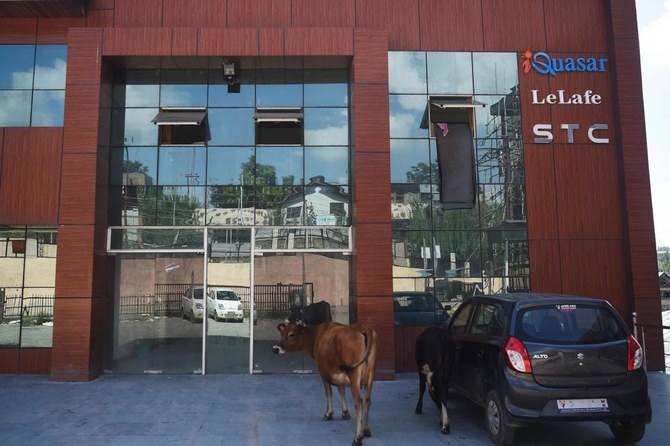
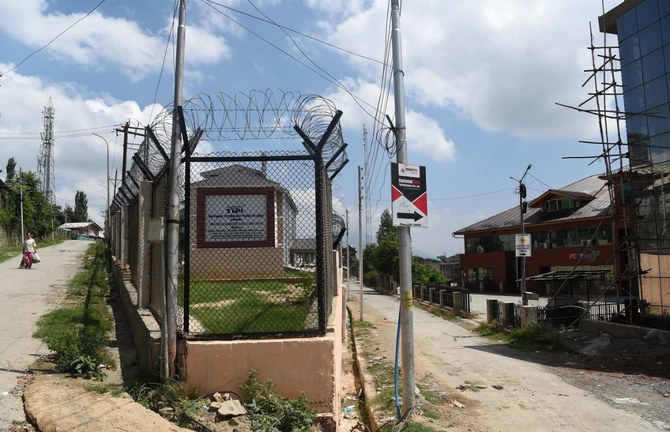
- An Indian communications blockade on the troubled region taking a growing toll on business
- Some IT companies have already laid off workers, many are preparing to move their business away from Kashmir
Hegseth says US ‘can’t stop everything’ that Iran fires even as he asserts air dominance
WASHINGTON (AP): Defense Secretary Pete Hegseth acknowledged Wednesday that some Iranian air attacks may still hit their targets even as he asserted that US military superiority is quickly giving it control of the Islamic Republic’s airspace.
The US has spared “no expense or capability” to enhance air defense systems to protect American forces and allies in the Middle East, Hegseth told reporters at the Pentagon days after the US and Israel attacked Iran in a war that has widened throughout the region.
“This does not mean we can stop everything, but we ensured that the maximum possible defense and maximum possible force protection was set up before we went on offense,” he said.
The acknowledgement that additional drone or missile strikes in the region could cause damage and harm to troops comes as President Donald Trump and top defense leaders have warned that additional American casualties were expected in a conflict that could last months.
US service members “remain in harm’s way, and we must be clear-eyed that the risk is still high,” Gen. Dan Caine, chairman of the Joint Chiefs of Staff, said at the same press conference.
Six soldiers were killed when an Iranian drone strike hit an operations center Sunday in the heart of a civilian port in Kuwait, miles away from the main Army base. The husband of one of the slain soldiers, who was part of a supply and logistics unit based in Iowa, says the center was a shipping container-style building and had no defenses.
Hegseth also signaled a possible longer time frame for the conflict than has previously been floated by the Trump administration, saying it could last eight weeks but that the US has the munitions and the equipment to beat Iran in a war of attrition. He declined to set a specific time range, saying the specific duration of the war would depend on how it unfolds.
“You can say four weeks, but it could be six, it could be eight, it could be three,” he said. “Ultimately, we set the pace and the tempo. The enemy is off balance, and we’re going to keep them off balance.”
More forces continue to arrive in the region, including jet fighters and bombers, Hegseth said, and the US “will take all the time we need to make sure that we succeed.”
Tehran has vowed to completely destroy the Middle East’s military and economic infrastructure — signaling the war was nowhere near over and could expand further.
President Donald Trump said this week the campaign are likely to last four to five weeks but that he was prepared “to go far longer than that.”
The US has spared “no expense or capability” to enhance air defense systems to protect American forces and allies in the Middle East, Hegseth told reporters at the Pentagon days after the US and Israel attacked Iran in a war that has widened throughout the region.
“This does not mean we can stop everything, but we ensured that the maximum possible defense and maximum possible force protection was set up before we went on offense,” he said.
The acknowledgement that additional drone or missile strikes in the region could cause damage and harm to troops comes as President Donald Trump and top defense leaders have warned that additional American casualties were expected in a conflict that could last months.
US service members “remain in harm’s way, and we must be clear-eyed that the risk is still high,” Gen. Dan Caine, chairman of the Joint Chiefs of Staff, said at the same press conference.
Six soldiers were killed when an Iranian drone strike hit an operations center Sunday in the heart of a civilian port in Kuwait, miles away from the main Army base. The husband of one of the slain soldiers, who was part of a supply and logistics unit based in Iowa, says the center was a shipping container-style building and had no defenses.
Hegseth also signaled a possible longer time frame for the conflict than has previously been floated by the Trump administration, saying it could last eight weeks but that the US has the munitions and the equipment to beat Iran in a war of attrition. He declined to set a specific time range, saying the specific duration of the war would depend on how it unfolds.
“You can say four weeks, but it could be six, it could be eight, it could be three,” he said. “Ultimately, we set the pace and the tempo. The enemy is off balance, and we’re going to keep them off balance.”
More forces continue to arrive in the region, including jet fighters and bombers, Hegseth said, and the US “will take all the time we need to make sure that we succeed.”
Tehran has vowed to completely destroy the Middle East’s military and economic infrastructure — signaling the war was nowhere near over and could expand further.
President Donald Trump said this week the campaign are likely to last four to five weeks but that he was prepared “to go far longer than that.”
© 2026 SAUDI RESEARCH & PUBLISHING COMPANY, All Rights Reserved And subject to Terms of Use Agreement.


