Saudi Arabia pledges commitment to protecting global shipping

1 / 7
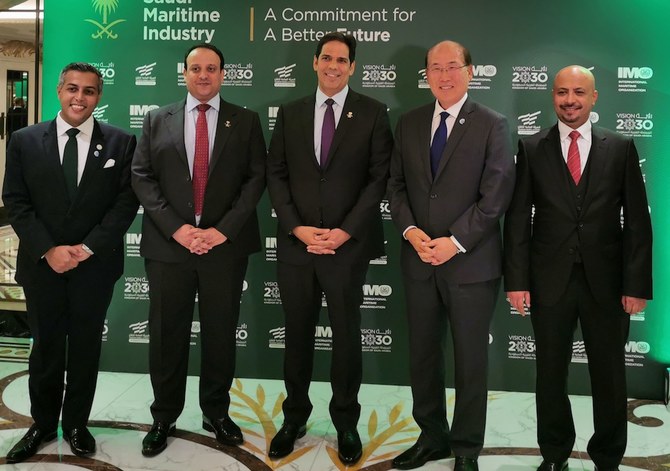
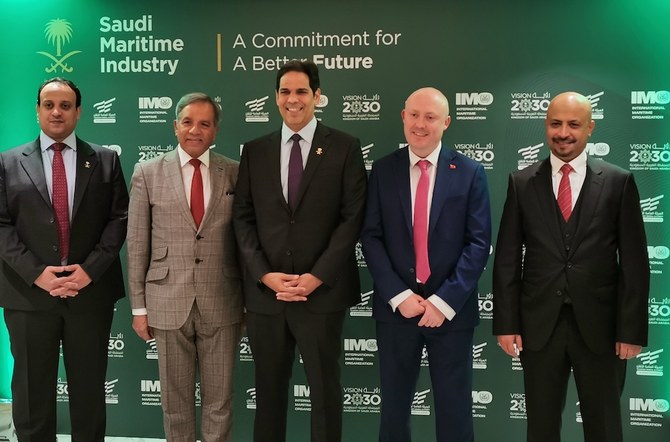
Saudi Arabia’s newly-appointed permanent representative to the IMO Essam Al-Ammari (L), Saudi Transport Minister Nabeel Al-Amoudi (C) and International Maritime Organization (IMO) Secretary-General Kitack Lim (C-R) at the reception to promote the Kingdom’s membership to the IMO Council. (AN Photo/Sarah Glubb)
2 / 7
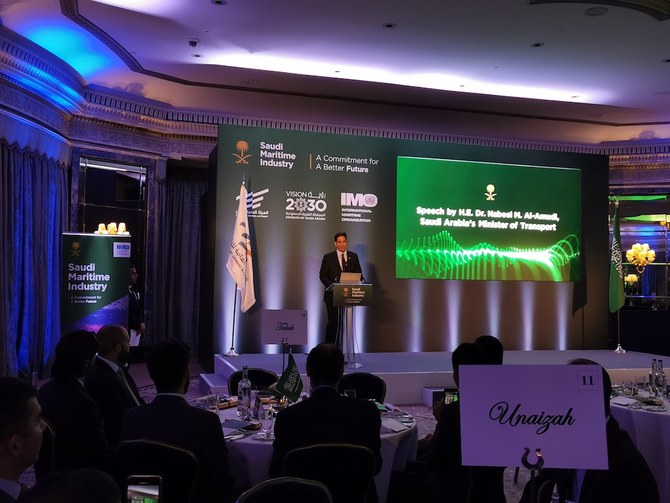
Saudi Arabia’s Transport Minister Nabeel Al-Amoudi speaking during a reception in London to promote the Kingdom’s membership to the International Maritime Organization’s (IMO) Council. (AN Photo/Sarah Glubb)
3 / 7
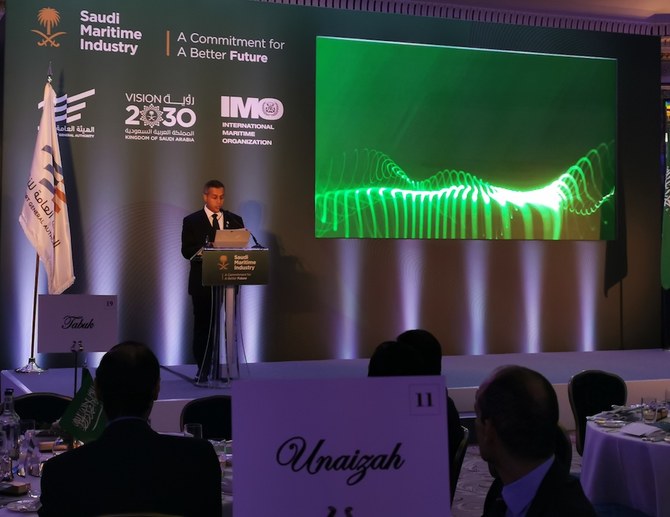
Saudi Arabia’s newly-appointed permanent representative to the International Maritime Organization (IMO), Essam Al-Ammari, speaking during a reception in London to promote the Kingdom’s membership to the IMO’s Council. (AN Photo/Sarah Glubb)
4 / 7
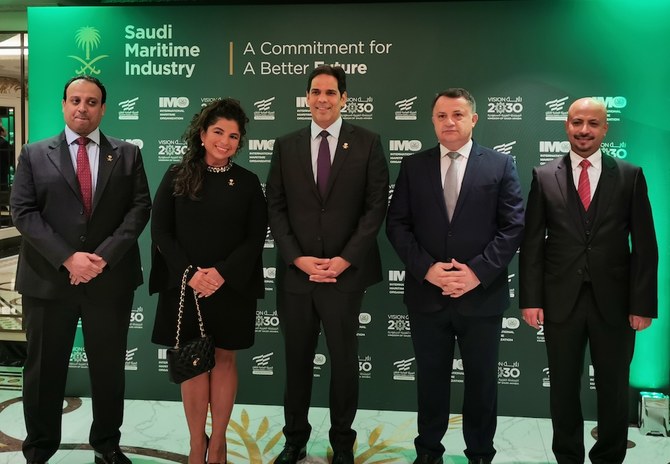
Saudi Arabia’s Transport General Authority hosted a reception in London to promote the Kingdom’s membership to the International Maritime Organization’s (IMO) Council in the upcoming annual elections. (AN Photo/Sarah Glubb)
5 / 7
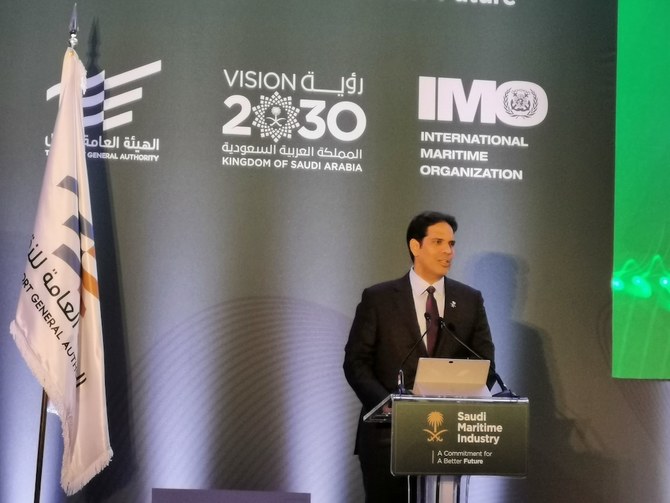
Saudi Arabia’s Transport Minister Nabeel Al-Amoudi speaking during a reception in London to promote the Kingdom’s membership to the International Maritime Organization’s (IMO) Council. (AN Photo/Sarah Glubb)
6 / 7
Saudi Transport Minister Nabeel Al-Amoudi co-hosted the event with the International Maritime Organization (IMO) in London. (AN Photo/Sarah Glubb)
7 / 7
Saudi Transport Minister Nabeel Al-Amoudi co-hosted the event with the International Maritime Organization (IMO) in London. (AN Photo/Sarah Glubb)
Updated 06 October 2019
Follow

Saudi Arabia pledges commitment to protecting global shipping

  • Transport minister says maritime security was a key issue for many countries, especially Saudi Arabia 
  • Kingdom is aiming to be elected to the International Maritime Organization’s Council 

LONDON: Protecting global shipping and developing international maritime trade growth was a key priority for Saudi Arabia, the Kingdom’s transport minister has pledged.
Speaking in London to promote Saudi membership of the International Maritime Organization’s (IMO) Council at upcoming annual elections, Dr. Nabeel Al-Amoudi said: “The Kingdom is strategically located between the east and west, overlooking two of the world’s most important marine waters.”
The minister added that since the Kingdom’s accession to the UN agency in 1969, it had “consistently played a vital and effective role in the growth and development of the international maritime transport sector by preserving the marine environment and promoting the safety and security of the maritime transport industry.
“The Kingdom views that we have under-represented our achievements in the maritime sector and we hope, through our election, that we can reassert our presence to the IMO Council,” Al-Amoudi told delegates to the event, hosted by the Transport General Authority.

The IMO Council election comes at a time when freedom of navigation for international shipping in the waters in and around the Arabian Gulf has been the focus of heightened tensions with Iran.
Saudi Arabia, the US and other nations have accused Tehran of attacking shipping in the Gulf and the Strait of Hormuz while supporting Yemeni militias in disrupting navigation in the Red Sea and Bab Al-Mandab Strait.
Al-Amoudi said maritime security was a key issue for many countries, especially Saudi Arabia.
The gathering heard how Saudi Arabia held a leading global maritime role, with nine commercial and industrial ports along its 2,500-kilometer coastline linking Asia, Africa and Europe. The Red Sea to the west was a vital passage for about 13 percent of world trade, and the Arabian Gulf to the east, accounted for about 30 percent of international energy flow.
IMO Secretary-General Kitack Lim told Arab News: “Saudi Arabia is one of the most important member states and has been working very hard and actively participating in all IMO meetings, so we are very satisfied. Also, the Kingdom is an important maritime shipping nation, both importing and exporting.
“There’s a lot of potential to develop collaboration between the IMO and Saudi Arabia, so we are working to enhance and collaborate more than before.”

On the Kingdom’s maritime role amid the current tensions with Iran, the newly-appointed Saudi permanent representative to the IMO, Essam Al-Ammari, told Arab News that the UN-based organization did not “deal with politics” and “these issues are discussed at a higher level in the UN or Security Council.”
However, Kitack said: “We are expecting that tensions should be eased as soon as possible, based on collaboration and dialogue among the stakeholders.”
Al-Ammari added that winning a seat on the IMO Council would be “something special; to have decisions and to work with other countries in developing the (maritime) laws for a safe and clean environment.”
In recent years, Saudi Arabia has significantly developed its maritime regulatory framework as part of its sweeping Vision 2030 reform program.

The Kingdom established the King Abdullah Port in King Abdullah Economic City and the King Salman International Complex for Maritime Industries and Services in Ras Al-Khair port that includes shipbuilding yards and a maritime academy. It has also built two maritime radio navigation satellite service stations to enhance nautical communication.
The country’s fleet has increased from 284 to 368 ships that carry the Saudi flag and its tonnage had more than doubled from 3.2 to 7.9 million tons by 2018, ranking it 23rd globally.
“Our capacity is over 600 million tons per annum,” Al-Amoudi said. “We look to increase that through private-sector investment in the coming years and you’ll hear some announcements soon. We are also looking to expand into the maritime building and shipbuilding sectors.”
The IMO has 172 member states, 40 of which serve in the council.



Saudi Arabia, UN-Habitat unveil Quality of Life Index at WEF

Updated 7 sec ago
Follow

Saudi Arabia, UN-Habitat unveil Quality of Life Index at WEF

  • Index is global public resource designed to help people, cities, governments better understand what makes urban life thrive
  • ‘Human-centric is the goal. Technology is simply the tool’: Princess Reema

DAVOS: Saudi Arabia is to launch a new Quality of Life Index — developed in partnership with UN-Habitat — the Kingdom’s Tourism Minister Ahmed Al-Khateeb announced on Tuesday, with Saudi Ambassador to the US Princess Reema bint Bandar calling it a Saudi “gift to the world.”

Speaking on a panel at the World Economic Forum in Davos, Al-Khateeb said the index was positioned as a global public resource designed to help people, cities and governments better understand what makes urban life thrive.

Princess Reema described the index as a reflection of the Kingdom’s broader Vision 2030 reforms and a tool intended to benefit people far beyond Saudi Arabia.

She said: “The Quality of Life Index is not just a Saudi initiative, it’s a UN initiative. The ownership of the data and the content lives there. We’re populating it and we are gifting it to the world — and that’s one of the things that’s most exciting for me.”

The index, which has been under development for three years as part of a wider Quality of Life Program in the Kingdom, aims to provide a comprehensive, human-centered assessment of how cities perform across a wide range of factors that shape everyday life, from healthcare, education and mobility to safety, culture, entertainment and green spaces.

According to Al-Khateeb, the initiative was born out of a simple and yet complex question: What is the city people actually want to live in?

“When we started the Quality of Life Program back in 2017, we began by asking ourselves what kind of city we want to live in,” the minister said.

“That question is complicated because younger generations have different needs to the older generations, and cities today must serve both residents and visitors.”

Al-Khateeb explained that the framework behind the index separated the fundamentals of urban living, what he described as “livability,” from the experiences on top of that foundation.

“No city in the world today can tick all the boxes,” he said. “That’s why we worked with UN-Habitat to define what the best quality of life should look like, identify the gaps, and then measure them.”

The index will allow cities around the world to voluntarily register, submit data and be assessed against those criteria. According to Al-Khateeb, more than 120 cities have already registered, with over 20 vetted and qualified at the time of the announcement.

The goal, he said, was to give individuals and families practical information to help guide life decisions, whether choosing where to live, work, retire or visit, while also giving city leaders a clearer picture of where investment and reform were needed.

“Any global resident can go to the website, look at the cities and decide where they want to live or retire, or where they want to visit,” he said. “This is about experience, not just retail or hospitality or education on their own, but all of it together.”

Princess Reema linked the index directly to the social transformation underway in Saudi Arabia, particularly around participation, opportunity and equity for women.

Reflecting on her experience working on the program with Al-Khateeb, she said the reforms succeeded because they were built around people, not metrics alone.

“For quality of life to be real, a woman could no longer have to ask for permission to participate or to get herself where she needed to be,” she said, describing a pivotal moment early in the program’s development. “That’s when I knew the change we were hoping for was real.”

She pointed to visible outcomes, particularly among young people, as the true measure of success, arguing that quality of life was ultimately reflected in the choices people were able to make.

“You cannot be what you cannot see,” she said. “What I see in the opportunities people now have, whether they’re artists, athletes, filmmakers or musicians, that is the true measurement of quality of life.”

While Saudi Arabia expects its own cities to feature in the rankings, Princess Reema stressed that the index was not designed as a competition.

She added: “We’re competing to make ourselves better — for who we serve, for where we are. If that makes us No. 1, great. But the goal is improvement.”

Both speakers emphasized that the index is intended to evolve over time, reflecting changing expectations and generational needs.

Technology, Princess Reema added, should be viewed as a tool to support human well-being, not the objective itself.

“Human-centric is the goal,” she said. “Technology is simply the tool.”

Speaking to Arab News after the panel, Norah Al-Yousef, a senior adviser at the Quality of Life Program, said the development of the index was a four-year, globally consultative effort to create something of value to people and governments alike.

“So many cities and governments that we consulted with, verbatim, said, ‘If you create another index to rank me, I’m not interested. Help me solve problems, help enable me’,” she said.

“It’s a narrative shift. We’re kick-starting it with this, and we really hope that, globally, people adopt it, people support it. You know, it’s like a snowball effect.”