Facebook’s Zuckerberg defends encryption, despite child safety concerns

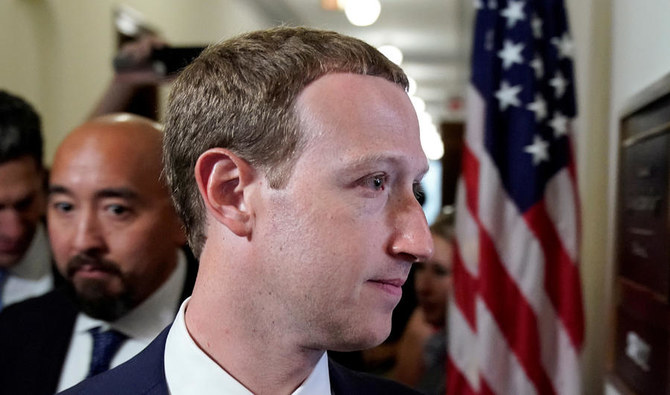
Facebook Chief Executive Mark Zuckerberg on his way to meet with lawmakers to discuss "future internet regulation on Capitol Hill in Washington on September 19, 2019. (REUTERS/Joshua Roberts/File Photo)
Updated 04 October 2019
Follow

Facebook’s Zuckerberg defends encryption, despite child safety concerns

SAN FRANCISCO: Facebook Inc. Chief Executive Officer Mark Zuckerberg defended on Thursday his decision to encrypt the company’s messaging services, despite concerns about its impact on child exploitation and other criminal activity.
The United States, Britain and Australia signed an open letter earlier in the day calling for Facebook to suspend its encryption plan, saying it would hinder the fight against child abuse and terrorism.
Zuckerberg, speaking in a livestream of the company’s weekly internal Q&A session, said he had been aware of child exploitation risks before announcing his encryption plan and acknowledged that it would reduce tools to fight the problem.
“When we were deciding whether to go to end-to-end encryption across the different apps, this was one of the things that just weighed the most heavily on me,” he said.
Addressing an employee question about online child abuse, Zuckerberg acknowledged that losing access to the content of messages would mean “you’re fighting that battle with at least a hand tied behind your back.”
But he said he was “optimistic” that Facebook would be able to identify predators even in encrypted systems using the same tools it used to fight election interference, like patterns of activity and links between accounts on different platforms.
He also suggested the company might further limit the ways adults can interact with minors on Facebook’s platforms.
Zuckerberg announced his plan to pivot the company toward more private forms of communication in March, capping months of internal debate over the merits of encryption, three sources familiar with the discussions told Reuters.
Inside the company, privacy engineers and others eager to shed the legacy of the Cambridge Analytica scandal saw the move as a win, as did product managers watching the steady uptick of growth at Facebook’s encrypted messaging service WhatsApp.
But members of Facebook’s safety team familiar with the child exploitation risks argued against the plan, raising deep concerns through the group’s leaders and in large company meetings with senior executives, the sources said.
The United States, Britain and Australia said in their joint letter that they had engaged with Facebook on the issue, but that the company had not committed to addressing their “serious concerns” about the impact of its proposals.
The National Center for Missing and Exploited Children also met with Zuckerberg and other senior leaders of Facebook, who offered assurances that child safety was important to them.


Western media refute Trump’s claims Iran possesses Tomahawk missiles

Updated 6 sec ago
Follow

Western media refute Trump’s claims Iran possesses Tomahawk missiles

  • Speaking to journalists, Trump suggested Tehran used US-made cruise missile in school attack that killed over 170, calling the weapon ‘very generic’
  • CNN, Sky News and analysts said that ‘neither Israel nor Iran use Tomahawk missiles,’ urged accurate identification to ensure credibility in public discourse

LONDON: Western media outlets and defense analysts have pushed back against claims by US President Donald Trump that Iran possesses Tomahawk cruise missiles, after he raised the possibility while discussing a recent strike on an Iranian school that has drawn international scrutiny.

Speaking to reporters on Monday, Trump suggested Iran may have used Tomahawks in the attack, calling the weapon “very generic” and implying that multiple countries, including Iran, could have access to the system.

However, journalists and weapons experts swiftly disputed that assertion. They noted that Tomahawk missiles are US-manufactured cruise missile systems that Washington supplies only to a small number of close allies, primarily the UK and Australia. There is no credible evidence that Iran has ever obtained the weapon.

CNN anchor Erin Burnett referenced an investigation by correspondent Isobel Yeong that concluded “neither Israel nor Iran use Tomahawk missiles, according to experts.” Sky News and other Western outlets also challenged Trump’s remarks.

Analysts pointed out that Iran has developed its own domestic cruise missile systems, such as the Soumar and Hoveyzeh, which are believed to be based partly on older Soviet-era designs.

While these systems resemble cruise missiles in concept, experts say they differ significantly from the Tomahawk in design, propulsion configuration and operational characteristics.

While Iran has made substantial advances in ballistic and domestically produced cruise missiles over the past two decades, defense analysts said there is no verified evidence that Tehran holds the American-made system.

The episode reflects a broader pattern in which statements about military technology are rapidly scrutinized by open-source investigators and defense experts.

Experts say the distinction is important: accurately identifying the type of missile used in a strike can provide clues about the likely actor responsible, the launch platform involved and the broader geopolitical consequences of a strike.

Analysts also say that accurate identification of military systems remains essential for avoiding misinformation and for maintaining credibility in public discourse surrounding regional security.

Despite the growing body of evidence, the precise circumstances of the school attack nonetheless remain unclear, with investigators hampered by a lack of weapons fragments and limited access to the site.

Norway-based rights group Hengaw said the school was holding its morning session at the time of the reported attack and had at least 168 children and 14 teachers.

Trump said the US was continuing to investigate the incident. “Whatever the report shows, I’m willing to live with that report,” he said.