CAIRO: Egypt’s government said Thursday it would decrease fuel prices for the first time in decades and after a series of hikes in recent years after embarking on an ambitious reform program aimed at overhauling the country’s ailing economy.
The statement by the Petroleum Ministry said the new prices go into effect Friday, and will be reviewed after three months, partly based on international oil prices.
The decrease comes following rare anti-government protests believed to have been partly driven by economic hardship.
Austerity measures linked to the reform program have taken a heavy toll on poor and middle-class Egyptians.
The prices decreased by 0.25 Egyptian pounds ($0.015). The price of 92 octane gasoline decreased from 8 to 7.75 Egyptian pounds per liter. Eighty octane gas slashed from 6.75 to 6.5 Egyptian pounds per liter.

Egypt decreases fuel prices for the first time in decades
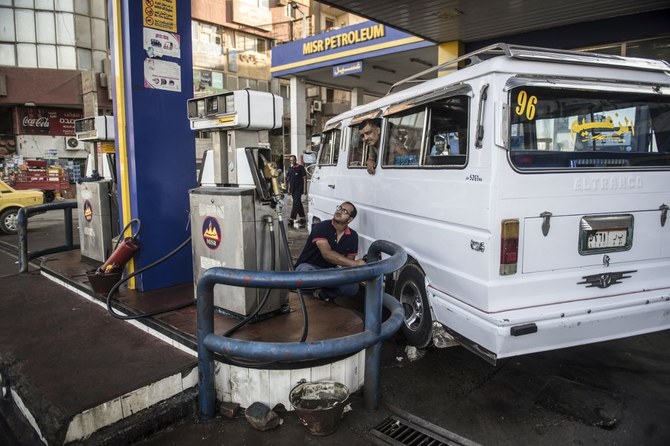
- The decrease comes following rare anti-government protests believed to have been partly driven by economic hardship
- the Petroleum Ministry said the new prices go into effect Friday, and will be reviewed after three months,
BYD Americas CEO hails Middle East as ‘homeland for innovation’
- In an interview on the sidelines of Davos, Stella Li highlighted the region’s openness to new technologies and opportunities for growth
DAVOS: BYD Americas CEO Stella Li described the Middle East as a “homeland for innovation” during an interview with Arab News on the sidelines of the World Economic Forum.
The executive of the Chinese electric vehicle giant highlighted the region’s openness to new technologies and opportunities for growth.
“The people (are) very open. And then from the government, from everybody there, they are open to enjoy the technology,” she said.
BYD has accelerated its expansion of battery electric vehicles and plug-in hybrids across the Middle East and North Africa region, with a strong focus on Gulf Cooperation Council countries like the UAE and Saudi Arabia.
GCC EV markets, led by the UAE and Saudi Arabia, rank among the world’s fastest-growing. Saudi Arabia’s Public Investment Fund has been aggressively investing in the EV sector, backing Lucid Motors, launching its brand Ceer, and supporting charging infrastructure development.
However, EVs still account for just over 1 percent of total car sales, as high costs, limited charging infrastructure, and extreme weather remain challenges.
In summer 2025, BYD announced it was aiming to triple its Saudi footprint following Tesla’s entry, targeting 5,000 EV sales and 10 showrooms by late 2026.
“We commit a lot of investment there (in the region),” Li noted, adding that the company is building a robust dealer network and introducing cutting-edge technology.
Discussing growth plans, she envisioned Saudi Arabia and the wider Middle East as a potential “dreamland” for innovation — what she described as a regional “Silicon Valley.”
Talking about the EV ambitions of the Saudi government, she said: “If they set up (a) target, they will make (it) happen. Then they need a technology company like us to support their … 2030 Vision.”


