

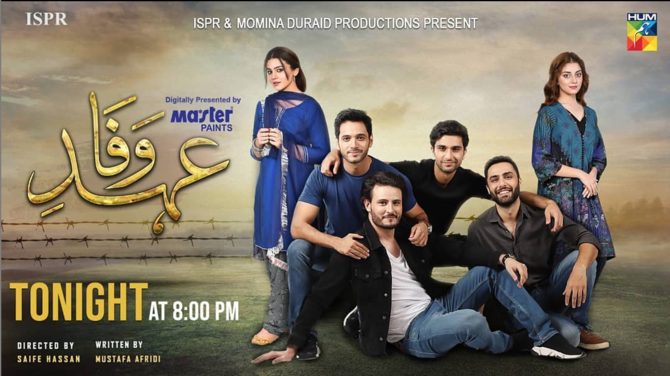
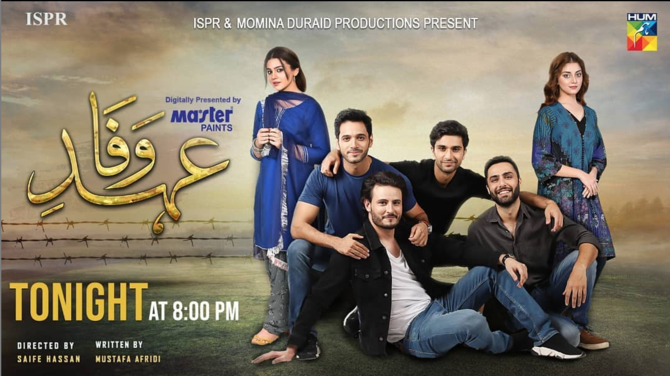
ISLAMABAD: This past Sunday the second episode of “Ahd-e-Wafa,” a joint production by the Inter-Services Public Relations (ISPR) and Momina Duraid, played on HUM TV. The story of the drama focuses on students at an army college in Murree, thus delivering something different to the viewer from the usual storylines of Pakistani plays.
Ahd-e-Wafa follows the story of four schoolmates: Saad, Shariq, Shahryar and Shah Zain, or, as they refer to themselves, the “S Gang,” played by Ahad Raza Mir, Wahaj Ali, Ahmed Ali Akbar and Osman Khalid Butt, respectively. There are also two school age female students: Rani played by Zara Noor Abbas; and Dua played by Alizeh Shah.
A mischievous group, the boys attend Lawrence College where they are caught in episode 1 while attempting to sneak out from their boarding school, and in the second episode they manage to catch the culprit who ratted on them (a brown nosing son of the school Warden) and set him up to be caught sneaking out himself.
The play written by Mustafa Afridi and directed by Saife Hasan has so far bucked what goes for entertainment in drama serials. We have yet to see a crying woman, talk of divorce or even shaadi, usually the top 3 ingredients in local drama recipes. It’s refreshing to have a story about school, parental expectations, youthful jubilance and even a glimpse into the lives of those serving or planning to serve our armed forces. Tension has yet to be introduced, and though mishaps (mostly comical) have occurred, it is nice to sit down for television with more options than clueless and easy-to-manipulate men and weary women anxiously twisting dupattas into knots.
The filming is quite beautiful with spanning shots of Islamabad’s neighboring hillsides, where much of the story has taken place so far.
Ahd-e-Wafa has introduced us to a handful of family dynamics and friendships in the first two episodes, all of which have playful banter, quick wit responses and (mostly) believable teasing happening between the focal relationships.
The onscreen chemistry is fantastic between the group of “boys,” boys in quotes because it is hard to overlook the fact that these school aged characters are being played by men nearing if not firmly footed in their 30’s.
The acting prowess and talent is not in question here, the actors are decorated (just a few days ago Akbar’s “Laal Kabootar” performance bagged him an award at DC’s South Asian Film Festival for Best Actor), but in terms of removing oneself from reality it’s hard to accept actors as children who are blatantly not. Veteran may be too old of a tag to throw on them but seasoned actors? Absolutely.
Similarly, Zara Noor Abbas, another major talent from Pakistan’s drama industry, is meant to play a school girl. But when shot among the girls’ school setting, it’s a bit cringeworthy.
And though they all step up to the plate with comedic timing and line delivery – Abbas particularly has brilliant scenes in both episodes where her character’s rambunctious side is celebrated – it seems like a truly missed opportunity to inject some new blood onto our screens.
It’s possible that the drama will incorporate time jumps and that they wanted these (reiterating again: talented) actors to play these roles, but why not have younger actors step in for when they are meant to be younger?
Episode 3’s trailer shows the boys delivering on the chuckles and seems to still be avoiding the storyboards that dominate our screens, here’s hoping that Ahd-e-Wafa stays the course.


