ISLAMABAD: The ruling Pakistan Tehreek-e-Insaf (PTI) party on Wednesday downplayed the threat of a mass movement against it, saying that the opposition’s effort to launch such a protest would not pose an existential threat to the government.
“The opposition doesn’t have any moral or legal justification to march against our government,” Malik Amir Dogar, a PTI lawmaker, told Arab News on Wednesday. “These parties remained in power for decades and left state institutions in a difficult situation which we are now trying to rectify.”
Dogar, however, said that it was the opposition’s democratic right to protest against the government’s policies, adding that “we will facilitate them if they exercise their democratic right within the limits of the constitution.”
Jamiat-e-Ulama-e-Islam (JUI-F), a prominent religious party, said earlier in the day it would decide when to commence anti-government agitation in its Central Executive Committee (CEC) meeting on Thursday.
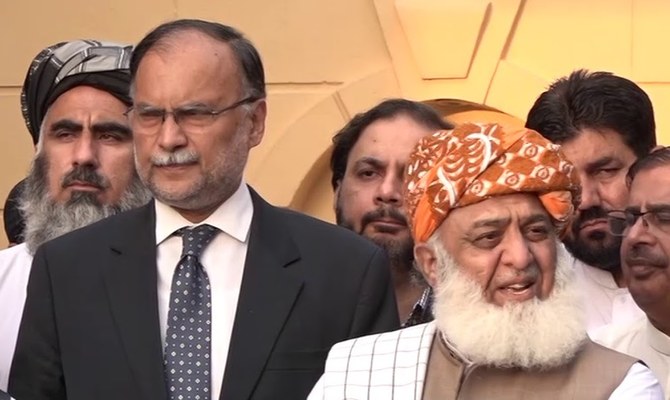
“We will decide tomorrow if we will delay our million march for a month or proceed with it as planned,” JUI-F chief Maulana Fazlur Rehman said on Wednesday while addressing a joint news conference with Pakistan Muslim League-Nawaz (PML-N) leader, Ahsan Iqbal.
The JUI-F announced in June that it would launch a mass protest against the government in October along with other opposition parties.
However, leaders of the Pakistan Muslim League-Nawaz and Pakistan Peoples Party (PPP) want to delay the protest for at least a month and chalk out a comprehensive strategy before hitting the road.
“We have listened to reservations and suggestions of the PML-N and PPP,” JUI-F Senator Hafiz Hamdullah told Arab News. “We will decide the final timeline for the protest tomorrow.”
He added that his party wanted to initiate a “long march” against the government even if other opposition factions were reluctant to join it due to their political compulsions.
“People want to get rid of this inefficient and incompetent government,” he added, “and we are sure that tens of thousands of them will join our march.”
The JUI-F party has a large network of religious seminaries across the country and its students constitute its power base.
“We are fully prepared to participate in the agitation against the government,” said PML-N Chairman Raja Zafarul Haq. “However, we want Maulana Fazlur Rahman to delay it for at least a month to ensure better preparations,” Haq told Arab News.
He added that his party had conveyed its “reservations” to the JUI-F chief and shared with him its own protest plan.
Haq continued that his party was also in touch with the PPP leadership to formulate a joint strategy for the protest, but “things have yet to be worked out.”
Meanwhile, PPP leaders have conveyed to the JUI-F chief it would not become part of any “undemocratic” drive, though the party was willing to participate in the march if a “smooth plan” for the anti-government protest was chalked out beforehand.
“We don’t want to become part of any move that intends to incite religious hatred against the government or may provoke interference from undemocratic forces,” former PPP Senator Sehar Kamran told Arab News.
She said that her party had conveyed its “reservations” to the JUI-F chief and asked him to chalk out a “well thought out strategy” before marching toward Islamabad.
“This government has failed to improve the economic condition [of the country] despite levying hefty taxes on businesses and common men,” she added. “This is resulting in rising inflation, unemployment and unrest among general public.”
Kamran said that her party was “ready” to participate in the agitation against the “selected government,” but its time and venue was yet to be decided.


![]()

Opposition’s million march has no moral, legal ground – Pakistan’s ruling party
Opposition’s million march has no moral, legal ground – Pakistan’s ruling party
- JUI-F, a prominent religious party, wants to launch a mass movement against the government
- PML-N, PPP want to delay the agitation at least for a month
Latest updates


Recommended


© 2026 SAUDI RESEARCH & PUBLISHING COMPANY, All Rights Reserved And subject to Terms of Use Agreement.