

Britain acknowledges pain of explorer Cook’s deadly encounter with Māoris

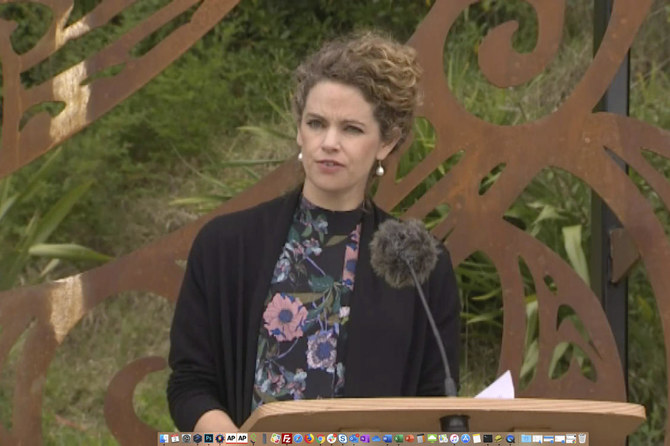
British High Commissioner Laura Clarke delivers a speech in Gisborne, New Zealand, Wednesday, Oct. 2, 2019. (AP)
Updated 03 October 2019
Follow

Britain acknowledges pain of explorer Cook’s deadly encounter with Māoris

  • New Zealand is due to mark the anniversary of Cook’s arrival with events that will feature a replica of the Endeavour
  • Cook’s ship, the Endeavour, landed on the east side of the Turanganui River, near present-day Gisborne, on Oct. 8, 1769

SYDNEY: Britain’s envoy told New Zealand’s indigenous Māoris on Wednesday that Britain regretted the killings of nine of their number immediately after explorer James Cook landed in the territory 250 years ago.

At a ceremony marking the delivery in person of a “statement of regret” to local Māori tribal leaders ahead of the anniversary of Cook’s arrival, High Commissioner Laura Clarke said Britain understood that the pain of that arrival had not gone away, but did not offer a formal apology.

“Here on behalf of the four countries of the United Kingdom, on behalf of the people of those four countries ... I acknowledge the pain of those first encounters,” she told reporters in Gisborne, on the eastern coast of New Zealand’s North Island. She was expected to present a formal statement to local tribes privately.

Cook’s ship, the Endeavour, landed on the east side of the Turanganui River, near present-day Gisborne, on Oct. 8, 1769. The expedition got off to a disastrous start when a tribal leader, Te Maro, was shot and killed by one of Cook’s men. Historians say the Māoris may have been performing a ceremonial challenge that the Europeans took to be an attack.

“I acknowledge the deaths of nine of your ancestors including Te Maro who were killed by the crew of the Endeavour,” Clarke said, in remarks shown on New Zealand television.

“That was greatly regretted by the crew of the Endeavour at the time ... and it is regretted here today. It is deeply sad that the first encounter happened in the way that it did and to you as the descendants of those killed, I offer my every sympathy, for I understand that pain does not diminish with time.”

New Zealand is due to mark the anniversary of Cook’s arrival with events that will feature a replica of the Endeavour.


Zuckerberg says Meta no longer designs apps to maximize screentime

Updated 51 min 35 sec ago
Follow

Zuckerberg says Meta no longer designs apps to maximize screentime

  • Meta Platforms CEO faces questioned at a landmark trial over youth social media addiction
  • It was the billionaire Facebook founder’s first time testifying in court on Instagram’s effect on the mental health of young users

LOS ANGELES: Meta Platforms CEO Mark Zuckerberg pushed back in court on Wednesday against a lawyer’s suggestion that ​he had misled Congress about the design of its social media platforms, as a landmark trial over youth social media addiction continues.
Zuckerberg was questioned on his statements to Congress in 2024, at a hearing where he said the company did not give its teams the goal of maximizing time spent on its apps.
Mark Lanier, a lawyer for a woman who accuses Meta of harming her mental health when she was a child, showed jurors emails from 2014 and 2015 in which Zuckerberg laid out aims to increase time spent on the app by double-digit percentage points. Zuckerberg said that while Meta previously had goals related to ‌the amount of ‌time users spent on the app, it has since changed its ​approach.
“If ‌you ⁠are trying ​to ⁠say my testimony was not accurate, I strongly disagree with that,” Zuckerberg said.
The appearance was the billionaire Facebook founder’s first time testifying in court on Instagram’s effect on the mental health of young users.
While Zuckerberg has previously testified on the subject before Congress, the stakes are higher at the jury trial in Los Angeles, California. Meta may have to pay damages if it loses the case, and the verdict could erode Big Tech’s longstanding legal defense against claims of user harm.
The lawsuit and others like it are part of a ⁠global backlash against social media platforms over children’s mental health.
Australia has prohibited access ‌to social media platforms for users under age 16, and ‌other countries including Spain are considering similar curbs. In the US, ​Florida has prohibited companies from allowing users under age ‌14. Tech industry trade groups are challenging the law in court.
The case involves a California woman ‌who started using Meta’s Instagram and Google’s YouTube as a child. She alleges the companies sought to profit by hooking kids on their services despite knowing social media could harm their mental health. She alleges the apps fueled her depression and suicidal thoughts and is seeking to hold the companies liable.
Meta and Google have denied the allegations, and ‌pointed to their work to add features that keep users safe. Meta has often pointed to a National Academies of Sciences finding that research does not ⁠show social media changes ⁠kids’ mental health.
The lawsuit serves as a test case for similar claims in a larger group of cases against Meta, Alphabet’s Google, Snap and TikTok. Families, school districts and states have filed thousands of lawsuits in the US accusing the companies of fueling a youth mental health crisis. Over the years, investigative reporting has unearthed internal Meta documents showing the company was aware of potential harm.
Meta researchers found that teens who report that Instagram regularly made them feel bad about their bodies saw significantly more “eating disorder adjacent content” than those who did not, Reuters reported in October.
Adam Mosseri, head of Instagram, testified last week that he was unaware of a recent Meta study showing no link between parental supervision and teens’ attentiveness to their own social media use. Teens with difficult life circumstances more often said they used Instagram habitually ​or unintentionally, according to the document shown at ​trial.
Meta’s lawyer told jurors at the trial that the woman’s health records show her issues stem from a troubled childhood, and that social media was a creative outlet for her.