

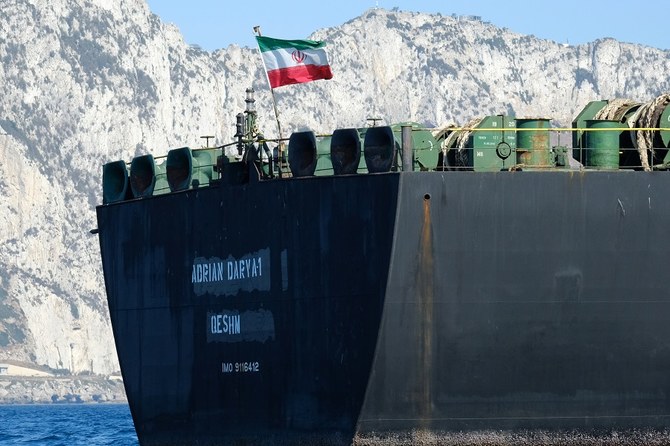
Iranian tanker delivers oil to Syria despite Zarif’s assurances: Mike Pompeo

The tanker was seen near the Syrian coast. (File/AFP)
Updated 03 October 2019
Follow

Iranian tanker delivers oil to Syria despite Zarif’s assurances: Mike Pompeo

  • Pompeo shared a satellite image of the tanker near the Syrian coast, accusing Iran of breaking its assurances not to sell crude oil to Syria
  • The tanker was previously detained on July 4 by British forces for breaching European Sanctions

DUBAI: The Iranian tanker Adrian Darya 1 is still delivering oil to Syria, despite Iran’s Foreign Minister Javad Zarif’s promises to Britain, US Secretary of State Mike Pompeo said on Wednesday.

In a tweet, Pompeo shared a satellite image of the tanker near the Syrian coast, accusing Iran of breaking its assurances not to sell crude oil to the country, after it was previously detained on July 4 by British forces for breaching European Sanctions.  

Pompeo added in the tweet: “Will the world hold Iran accountable if this oil is delivered to Syria?”

Gibraltar released the tanker, previously named Grace 1, weeks after receiving written assurances from Iran that it would not deliver its 2.1 million-barrel cargo of oil in Syria.

Britain’s Foreign Office said the tanker had sold its crude oil to the Assad regime and that the oil had been transferred to Syria.

Iran’s envoy to Britain has since denied the accusations, saying the tanker’s cargo was sold at sea to a private company. He also said the private buyer of the oil “sets the sale destination.”

Pompeo’s tweet came weeks after the US State Department said it had evidence the ship had offloaded its crude oil to Syria.

“The Iranian regime delivered oil to Syria, and that fuel goes straight into the tanks of troops that are slaughtering innocent Syrians,” US State Department spokeswoman Morgan Ortagus told reporters.

(With Reuters)


Hundreds mourn in Syria’s Homs after deadly mosque bombing

Updated 57 min 48 sec ago
Follow

Hundreds mourn in Syria’s Homs after deadly mosque bombing

  • Officials have said the preliminary investigations indicate explosive devices were planted inside the mosque but have not yet publicly identified a suspect

HOMS: Hundreds of mourners gathered Saturday despite rain and cold outside of a mosque in the Syrian city of Homs where a bombing the day before killed eight people and wounded 18.
The crowd gathered next to the Imam Ali ibn Abi Talib Mosque in the Wadi Al-Dhahab neighborhood, where the population is predominantly from the Alawite minority, before driving in convoys to bury the victims.
Officials have said the preliminary investigations indicate explosive devices were planted inside the mosque but have not yet publicly identified a suspect.
A little-known group calling itself Saraya Ansar Al-Sunna claimed responsibility for the attack in a statement posted on its Telegram channel, in which it indicated that the attack intended to target members of the Alawite sect, an offshoot of Shia Islam whom hard-line Islamists consider to be apostates.
The same group had previously claimed a suicide attack in June in which a gunman opened fire and then detonated an explosive vest inside a Greek Orthodox church in Dweil’a, on the outskirts of Damascus, killing 25 people as worshippers prayed on a Sunday.
A neighbor of the mosque, who asked to be identified only by the honorific Abu Ahmad (“father of Ahmad“) out of security concerns, said he was at home when he heard the sound of a “very very strong explosion.”
He and other neighbors went to the mosque and saw terrified people running out of it, he said. They entered and began trying to help the wounded, amid blood and scattered body parts on the floor.
While the neighborhood is primarily Alawite, he said the mosque had always been open to members of all sects to pray.
“It’s the house of God,” he said. “The mosque’s door is open to everyone. No one ever asked questions. Whoever wants to enter can enter.”
Mourners were unable to enter the mosque to pray Saturday because the crime scene remained cordoned off, so they prayed outside.
Some then marched through the streets chanting “Ya Ali,” in reference to the Prophet Muhammad’s cousin and son-in-law whom Shiite Muslims consider to be his rightful successor.