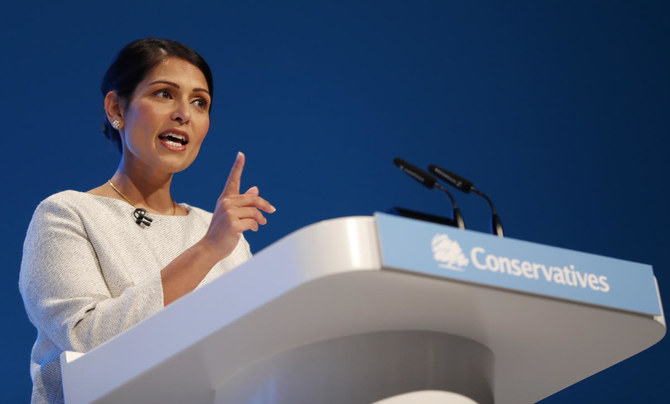
MANCHESTER: British interior minister Priti Patel will say on Tuesday the government will end free movement and introduce an Australian-style points-based immigration system once the country leaves the European Union.
In a speech at the Conservative Party’s annual conference, Patel will say her Brexit mission is “to end the free movement of people once and for all. Instead we will introduce an Australian-style points-based immigration system.”
“One that works in the best interests of Britain. One that attracts and welcomes the brightest and the best. One that supports brilliant scientists, the finest academics and leading people in their fields. And one that is under the control of the British Government,” she will say, according to an advanced copy of her speech.

Britain will introduce points-based immigration system — interior minister
Finland warns end of Ukraine war could bring more Russian spying
- SUPO said that while the Ukraine conflict would probably continue for the “foreseeable future,” its end would free up Russian resources
- “Russian intelligence capacity in Europe has suffered due to the war”
HELSINKI: Finland’s intelligence agency warned Tuesday that Russian spies could boost their efforts to target and destabilize the new NATO member once the Ukraine war ends.
The Finnish Security and Intelligence Service (SUPO) said that while the Ukraine conflict, triggered by Moscow’s full-scale invasion in 2022, would probably continue for the “forseeable future,” its end would free up Russian resources.
Finland, which shares a 1,340-kilometer (830-mile) border with Russia, dropped decades of military non-alignment to join NATO in April 2023 in the wake of the invasion of Ukraine, enraging the Kremlin.
“Russian intelligence capacity in Europe has suffered due to the war, and Russia is preparing to restore this capacity,” SUPO said in a statement.
“Russian intelligence and influencing resources currently tied to Ukraine will become available to be used elsewhere after the war.”
SUPO said Finland would remain of interest to Russia as “a NATO country between the Baltic Sea and the Arctic region.”
If relations between Europe and Russia improve, “the intelligence threat posed by Russia to Finland will become more diverse, with previous operating methods complemented by methods proven effective in the current environment,” Juha Martelius, Director of SUPO, said.
“These include the extensive utilization of proxy actors and intelligence gathering from bases on Russian soil,” he added.
Finland has in the past accused Moscow of “hybrid warfare” in orchestrating a surge of migrants at their shared border — a charge the Kremlin denied.
Last year, western officials accused Russian vessels of sabotaging undersea communications and power cables in several high-profile incidents in the Baltic Sea in recent months.
But SUPO warned about attributing too many incidents to Russia.
“As various events are readily attributed to Russia, Russian influencing against Finland may appear more extensive than it truly is,” it said.