
KARACHI: It took Muhammad Waseem 62 seconds to knock out his opponent in a recent boxing match in Dubai. When he returned to his country, however, he got a cold reception at the airport since only a few people knew about his sensational victory.
Fortunately, his accomplishment did not go completely unnoticed, and he soon started receiving congratulatory messages from high-profile individuals.
Waseem was also overjoyed to see his family’s reaction.
“My father always stopped me from boxing since he thought it had no future. When I was young, he always told me to concentrate on my studies,” Waseem told Arab News in an interview over the phone, adding: “When I breached his instructions, he chucked me out of the house as punishment.”
“When I reached home this time,” he continued, “my father hugged me and said, ‘I am proud of you, my son!’”
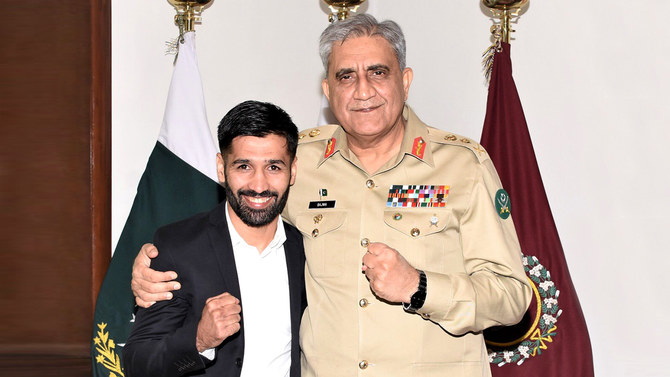
But it was not just his family that lavishly praised him. The country’s army chief, Gen. Qamar Javed Bajwa, also applauded Waseem’s extraordinary performance in the ring. However, the cold reception at the airport continued to hurt him.
“Soldiers fight for their country, and so do boxers. We risk our lives to bring honor to our people. Many boxers have died while fighting. One should not forget that boxers deserve appreciation, much like other people striving for excellence.”

Pakistan’s flyweight boxer Muhammad Waseem poses for a picture with Balochistan’s chief minister, Jam Kamal, at the CM House in Quetta on Sept. 24, 2019. (Photo Courtesy: Muhammad Waseem)
Hailing from the Pashtun Alizai tribe of Mastung, an impoverished town in the country’s southeastern Balochistan province, Waseem said he got a huge welcome when he went to his native land. A caravan took him from the airport to the CM House where the province’s chief minister, Jam Kamal, praised him and gave the cash prize of half a million rupees ($3190).
“I also got a lot of love from the army chief, national heroes like Shoaib Akhter, Shahid Afridi and former squash champion, Jahangir Khan. They all praised me for my fighting skill,” he said.
“Shoaib Akhter invited me to his place several times, Wasim Akram extended congratulations, Shahid Afridi and Jahangir Khan made phone calls to me and praised my performance. The army chief, who has always been appreciative of my work, invited me to the General Headquarters and appreciated my skill,” Waseem said with a hint of satisfaction.
“If I were not a boxer,” he added, “I would have been in the army. But I was destined to be a boxer and I am happy today for what I am.”
However, he said that boxers made a lot of money around the world. “That is not the case with Pakistan, the honor you earn for yourself, your family and, above all, your country is priceless,” he noted.
Waseem, who became a professional boxer in June 2015 after signing a contract with Korean promoter Andy Kim at Ak promotion, earned his country several medals after joining the national team in 2005.
Today, he is associated with MTK Global, a boxing management firm with more than 100 fighters under its umbrella, including Tyson Fury, Billy Joe Saunders, Michael Conlan and Carl Frampton.
“I am not only one of them but also on the list of top ten fighters,” he said. “This is matter of great honor for Pakistan.”
Waseem added that his real task was only beginning now, saying he wanted to take the sport to a new level in Pakistan and make it “as popular as the game of cricket.”
“Our firm will soon start a talent hunt in Pakistan. The youth will be given best training and soon this game will also become popular in the country.”