Prince Harry follows in mother Diana’s footsteps on visit to Angola

1 / 4
Combo picture shows Diana, Princess of Wales walking in one of the safety corridors of the land mine fields of Huambo, Angola January 15, and Britain's Prince Harry, Duke of Sussex, visiting a working de-mining field in Dirico, Angola September 27, 2019. (Reuters)
2 / 4
A crowd gathers on Princess Diana Street ahead of the arrival of Britain's Prince Harry, Duke of Sussex, in Huambo, Angola September 27, 2019. (Reuters)
3 / 4
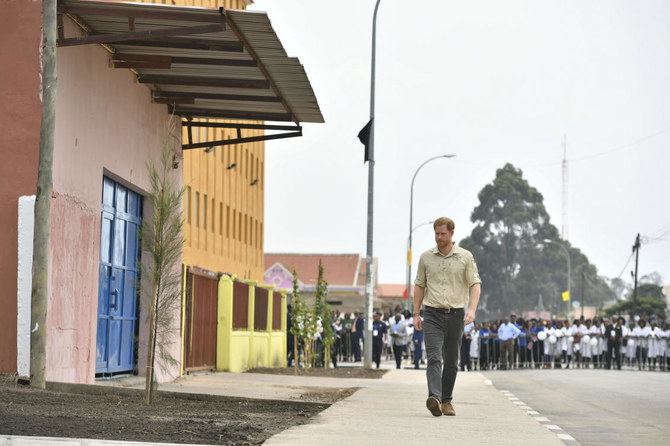
Britain's Prince Harry walks on Princess Diana Street in Huambo, Angola, on day five of the royal tour of Africa, Friday, Sept. 27, 2019. (AP)
4 / 4
Britain's Prince Harry, Duke of Sussex, sits alone beneath the Diana Tree on day five of the royal tour of Africa, in Huambo, Angola September 27, 2019. (Reuters)
Updated 27 September 2019
Follow

Prince Harry follows in mother Diana’s footsteps on visit to Angola

  • Harry visited Huambo, retracing his mother’s steps on a street that was once a path in a dangerous minefield
  • The pictures of Diana wearing protective gear as she walked among red skull-and-crossbone signs in Huambo in January 1997 won publicity for the HALO Trust, which was clearing mines left during Angola’s civil war

JOHANNESBURG: Britain’s Prince Harry followed in his late mother’s footsteps on Friday, wearing a protective vest and visor during a visit to a de-mining project in Angola that echoed a famous series of images taken of Princess Diana more than 20 years ago.
Queen Elizabeth’s grandson and sixth in line to the British throne visited a de-mining field outside Dirico, a town in Angola’s Cuando Cubango province, where, wearing a safety vest, he remotely detonated a mine in a controlled explosion. He also met community members.
Harry then visited Huambo, retracing his mother’s steps on a street that was once a path in a dangerous minefield.
The 35-year-old walked down Princess Diana Street and sat beneath the Diana Tree, the spot where his mother, who campaigned for a global ban on mines, was photographed.
“It has been emotional retracing my mother’s steps along this street 22 years on, and to see the transformation that has taken place, from an unsafe and desolate place into a vibrant community of local businesses and colleges,” Harry said.
“But let us not lose sight of the reality. Twenty two years after my mother visited Angola, there are still more than 1,000 minefields in this beautiful country that remain to be cleared. I wonder if she was still alive whether that would still be the case. I’m pretty sure she would have seen it through.”
The pictures of Diana wearing protective gear as she walked among red skull-and-crossbone signs in Huambo in January 1997 won publicity for the HALO Trust, which was clearing mines left during Angola’s civil war.
They were taken a few months before her death in Paris in a car crash. The international treaty to ban the weapons was signed later the same year.
Harry’s visit to Angola is part of a southern African trip by him, Meghan and their four-month-old son Archie. Their first overseas tour as a family began in South Africa on Monday.
They drew crowds of well-wishers on their first three days in Cape Town, where they visited non-governmental organizations working with vulnerable communities and young people and met Nobel Peace Prize laureate Desmond Tutu.
While Meghan and Archie stayed in South Africa, Harry headed to Botswana on Thursday.
In June, he threw his weight behind mine clearance efforts in Angola, saying land mines were “a humanitarian issue and not a political one.”
The land mines were planted during Angola’s 27-year civil war, which ended in 2002. Many people remain displaced and thousands have been left with disabilities from land mines which continue to maim and kill.
Harry has been visiting southern Africa for two decades for holidays and conservation work.
He ends the solo section of his tour on Tuesday in Malawi, where he will meet President Peter Mutharika and pay tribute at the memorial site for British soldier Guardsman Mathew Talbot, who was killed in May while taking part in counter poaching operations in the country.
Harry will then rejoin Meghan and Archie for a township visit on Wednesday near Johannesburg. They will meet Graca Machel, widow of South African anti-apartheid leader Nelson Mandela, and President Cyril Ramaphosa before departing for London.


Pakistani fighter jet crashes in Jalalabad, pilot captured: Afghan military, police

Updated 42 min 34 sec ago
Follow

Pakistani fighter jet crashes in Jalalabad, pilot captured: Afghan military, police

  • Fighting between Pakistan and Afghanistan’s Taliban military entered its third day on Saturday
  • Pakistan’s strikes on Friday hit Taliban military installations and posts, including in Kabul and Kandahar

JALALABAD: A Pakistani jet has crashed in Jalalabad city and the pilot captured alive, the Afghan military and police said Saturday, with residents telling AFP the man parachuted from the plane before being detained.
"A Pakistani fighter jet was shot down in the sixth district of Jalalabad city, and its pilot was captured alive," police spokesman Tayeb Hammad said.
Wahidullah Mohammadi, spokesman for the military in eastern Afghanistan, confirmed the Pakistani jet was downed by Afghan forces "and the pilot was captured alive".

The AFP journalist heard a jet overhead before blasts from the direction of the airport in Jalalabad, the capital of Nangarhar province, which sits on the road between Kabul and the Pakistani border.

Fighting between Pakistan and Afghanistan’s Taliban military entered its third day on Saturday, following overnight clashes as the international community expressed increasing concern about the conflict and called for urgent talks.

Pakistan’s strikes on Friday hit Taliban military installations and posts, including in Kabul and Kandahar, in one of the deepest Pakistani incursions into its western neighbor in years, officials said.

Islamabad accuses the Taliban of harboring Tehreek-e-Taliban Pakistan (TTP) militants, who it claims are waging an insurgency inside Pakistan, a charge the Taliban denies.

Pakistan described its actions as a response to cross-border assaults, while Kabul denounced them as a breach of its sovereignty, saying it remained open to dialogue but warned any wider conflict would result in serious consequences.

The fighting has raised ‌the risk ‌of a protracted conflict along the rugged 2,600-kilometer frontier.

Diplomatic efforts gathered ‌pace ⁠late on Friday ⁠as Afghanistan said its foreign minister, Amir Khan Muttaqi, spoke by telephone with Saudi Arabia’s Prince Faisal bin Farhan about reducing tensions and keeping diplomatic channels open.

The European Union called for both sides to de-escalate and engage in dialogue, while the United Nations urged an immediate end to hostilities.

Russia urged both sides to halt the clashes and return to talks, while China said it was deeply concerned and ready to help ease tensions.

The United States supports Pakistan’s right to defend itself against attacks by ⁠the Taliban, a State Department spokesperson said.

Border fighting continues

Exchanges of fire continued along ‌the border overnight.

Pakistani security sources said an operation dubbed “Ghazab Lil Haq” was ongoing and that Pakistani forces had destroyed multiple Taliban posts and camps in several sectors. Reuters could not independently verify the claims.

Both sides have reported heavy losses with conflicting tolls that Reuters could not verify. Pakistan said 12 of its ‌soldiers and 274 Taliban were killed while the Taliban said 13 of its fighters and 55 Pakistani soldiers died.

Taliban deputy spokesman Hamdullah Fitrat ⁠said 19 civilians were ⁠killed and 26 wounded in Khost and Paktika. Reuters could not verify the claim.

Pakistan’s Defense Minister Khawaja Muhammad Asif said “our cup of patience has overflowed” and described the fighting as “open war,” warning that Pakistan would respond to further attacks.

Taliban Interior Minister Sirajuddin Haqqani said in a speech in Khost province that the conflict “will be very costly,” and that Afghan forces had not deployed broadly beyond those already engaged.

He said the Taliban had defeated “the world, not through technology, but through unity and solidarity,” and through “great patience and perseverance,” rather than superior military power.

Pakistan’s military capabilities far exceed those of Afghanistan, with a standing army of hundreds of thousands and a modern air force.

In stark contrast, the Taliban lacks a conventional air force and relies largely on light weaponry and ground forces.

However, the Islamist group is battle-hardened after two decades of insurgency against US-led forces before returning to power in 2021.