
JEDDAH: One of the alleged masterminds behind the 2012 kidnapping of veteran journalist Baker Atyani is in custody following his capture inthe Philippines.
Col. Jonnel Estomo, director of the Philippine National Police-Anti Kidnapping Group (AKG), named the suspect as Nasirin Baladji, alias Zaed, a high-ranking member of the militant Abu Sayyaf Group (ASG).
Baladji, who was on the AKG Mindanao most-wanted list, was seized at his house in Zamboanga Sibugay province during a joint military and police operation on Wednesday night. An official announcement was made on Thursday.
Estomo said the suspect’s arrest followed a six-month surveillance operation.
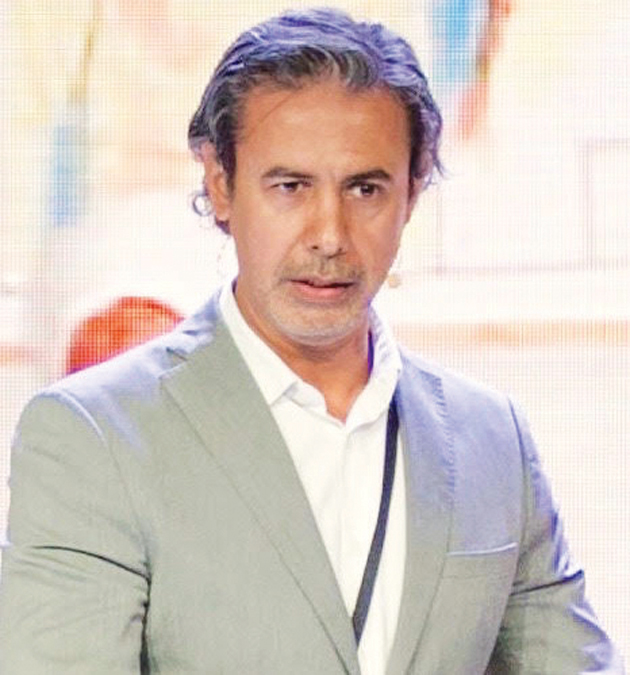
Baker Atyani in a recent photo.
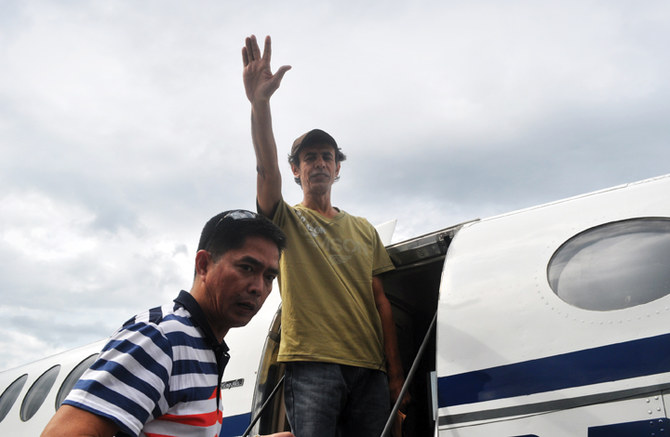
Baladji’s arrest came as a relief to Atyani, who saw 18 months of his life snatched away after he was kidnapped by militants on June 12, 2012, while working on a documentary for Al Arabiya News Channel on Muslims in the southern Philippines.
Atyani, now Arab News Asia Bureau chief, was in Dubai on Thursday when Philippine police phoned to inform him of Baladji’s capture.
The veteran journalist told Arab News that he never met Baladji, but knew from police that he was “one of the key guys behind my abduction.”
Baladji was one of the high-ranking men in the Abu Sayyaf Group.
“When I went to the Philippines in June 2012, I was working on a documentary about Muslims in the southern Philippines, their problems, and the possible signing of the peace agreement between the Philippine government and the Moro Islamic Liberation Front (MILF),” Atyani said.
“Abu Sayyaf Group opposed MILF. The documentary was to include the views of all groups. And so Abu Sayyaf and some members were supposed to be part of the documentary and talk about their views of the situation.
“Back then, the MILF was about to sign an understanding with the government for what became known as the Bangsomoro Peace Agreement.”
He said that a Filipino journalist in Manila at the time had arranged the meeting with an ASG commander.
I spent 18 months in captivity, in the heart of the Sulu jungle, living among ignorant people, to say the least.
“The whole arrangement for the interview was actually setting a trap for my kidnapping.”
Atyani said he has no knowledge what happened to the journalist who claimed that he had arranged the interview.
“I registered an official complaint against him, but to my knowledge no action has so far been taken against him. I have told police to investigate because I believe he has a connection to the group that has kidnapped me
“He is in the Philippines, and everyone knows where he is.”
Atyani said: “With his arrest, I feel that justice would be meted out to the man who stole a year and a half of my life. The Philippine police confirmed that he was the one who delivered me to the kidnappers in the jungle.”

A photo distributed by a US-based intelligence group in September, 2014, appeared to show Abu Sayyaf militants holding hostages at an undisclosed location
“When I heard of his arrest, all the horrors of that time flashed through my mind. It was a terrible time.”
Atyani told Arab News that he believes justice is being done with the arrest.
“The criminal has received what he deserves. My main captor, Kasman Sawadjaan, died three days before I regained my freedom. Then I saw Abu Rami, their spokesman, had been killed along with others.
“They got what they deserved. I want this man to be punished for what he did. This guy was a part of the group holding me. This is what the police told me this morning. The case against him is watertight. He was responsible not only for my kidnapping but for two others as well, including an Italian national.”
After being held for 18 months, Atyani managed to escape his jungle prison on Dec. 4, 2013, with the help of outsiders and Al Arabiya News Channel.
“I was lucky to get my freedom back,” he said.
Atyani said he still dreads visiting the southern Philippines. “I have visited the Philippines five times since then. There is always fear at the back of my mind, which is why I try never to leave Manila when I am in the Philippines.”
Writing about his kidnapping ordeal in this newspaper in 2017, Atyani recalled how he was taken hostage.
“It was about 5.30 a.m. when my cameraman, Ramil, knocked on the door of my room. ‘We have to go now,’ he said. ‘Romeo has arrived and is waiting outside the hostel.’ I was already up and preparing for the meeting with one of the ASG leaders on Sulu island. Romeo was the guide and driver set to take me and my team into the jungle to meet this leader.
“The plan was to return within three hours to Jolo, the island’s main city. I had promised Jolo’s mayor I would attend the Philippine Independence Day ceremony. This was on June 12, 2012.
“My Filipino coordinator said that he was tied up with work in Manila, but had arranged all the interviews and made all the arrangements for my visit to Zamboanga City and Sulu island, including the interview with the ASG leader. He kept saying: ‘My brother, you will be in good hands.’
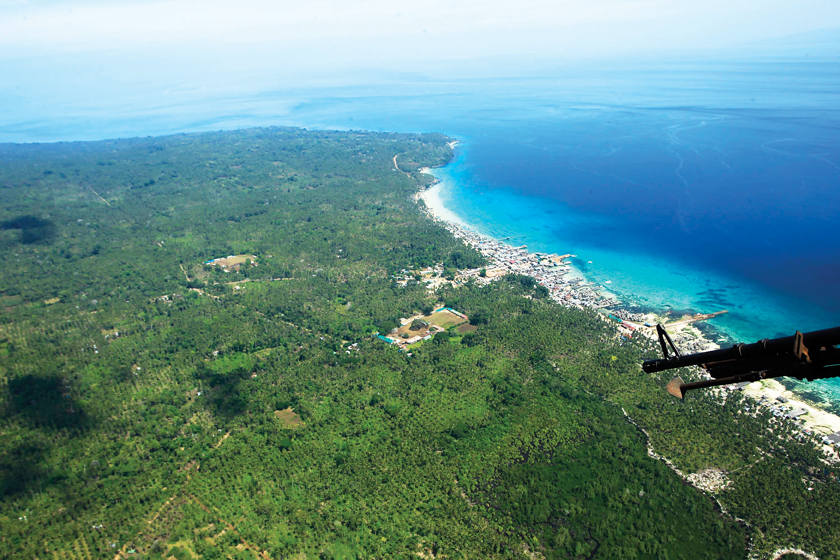
An aerial photo of Jolo, in Mindanao’s Sulu province, where journalist Baker Atyani was found in 2013. (AFP)
“The night before I was kidnapped, he sent me a text saying the same thing. Something inside me warned me of a lurking threat, but I ignored the feeling. My coordinator arranged our accommodation at Sulu Students Hostel and insisted that I refuse to stay with the governor of the island or with the mayor of Jolo. ‘They should not know about our plans to meet with the ASG leader,’ he said.
“As Romeo drove toward the jungle, I had a feeling I would not return soon. The car crashed three times during the journey; the third time, Romeo left the car on the road and told us to continue on foot. This added to my feeling that something was not right; you cannot just leave the car on the road and continue with your journey unless it is serious.
“The journalist in me ignored every sign of threat. ‘You should do this scoop, meet the ASG leader in the jungle, and get a first-hand account of the conflict in Mindanao,’ I thought to myself. I had interviewed all the other parties involved in the conflict of Mindanao by then.
“We were deep inside the Patikol area, the ASG stronghold. Armed men from every side of the jungle appeared with guns and munitions. Abu Rami, an ASG leader who was later ambushed and killed by the Philippine army, gave money to Romeo, who left us with our kidnappers.
“I spent 18 months in captivity, in the heart of the Sulu jungle, living among ignorant people, to say the least.
“When Sheikh Mohammed Hussein, the Grand Mufti of Jerusalem, appealed to my kidnappers to release me, they had hardly heard of Jerusalem. One of them asked me about it, to which I said: ‘Have you heard about Al-Aqsa Mosque?’ He said: ‘Yes, is that in Spain?’”