

Uruguay shock Fiji 30-27 at World Cup

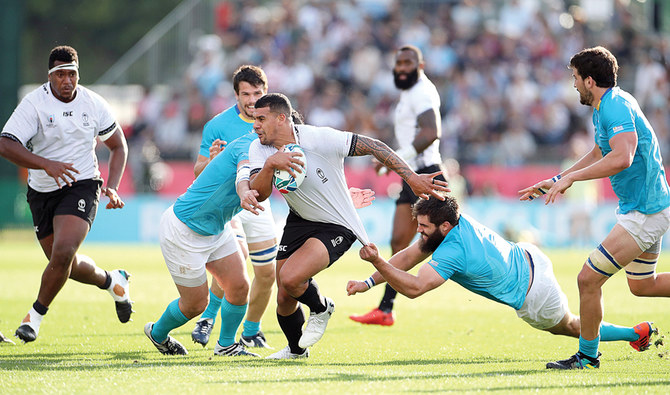
Fiji’s Josh Matavesi is tackled by Uruguay’s Santiago Civetta during their Rugby World Cup match on Wednesday. (Reuters)
Updated 25 September 2019
Follow

Uruguay shock Fiji 30-27 at World Cup

  • The match was one of the most thrilling in World Cup history, full of dramatic twists and turns

KAMAISHI, JAPAN: Uruguay pulled off one of the Rugby World Cup’s largest upsets when they beat Fiji 30-27 in a match laden with significance for the disaster-ravaged town in which it was played on Wednesday.

Only days after coming close to a shock result when they led Australia 14-12 at halftime before losing 39-21, 10th-ranked Fiji found itself on the wrong end of a larger surprise, going down for the first time in four meetings to the 19th-ranked Los Teros.

Fiji scored first but Uruguay scored three first-half tries to lead 24-12 by halftime. Flyhalf Felipe Berchesi kicked two penalties to keep his team in front throughout the second half, finishing with three conversions and three penalties for 15 points.

Fiji threw everything at Uruguay in an effort to wrest back control of the game in the second half but their most ambitious attempts failed through passing and handling errors and paid dearly for poor goalkicking by Josh Matavesi and Ben Volavola.

A try after the fulltime siren to Niko Matawalu — his second of the match, which typically went unconverted — was enough to earn Fiji a losing bonus point. But the result severely jeopardized their hopes of winning a place in the knockout rounds.

The match was one of the most thrilling in World Cup history, full of dramatic twists and turns and brought to life by the indomitable spirit of the Uruguay team which were given little chance of upsetting star-studded Fiji.

Uruguay are the youngest team at the tournament, an assembly of home-based players who are semi-professional at best and can’t match the array of global stars which Fiji has at their disposal.

They played with magnificent professionalism to exploit Fiji’s errors and lead through most of the first half after conceding an opening try after only eight minutes.

They then showed extraordinary spirit to hold out Fiji as they mounted attack after attack in the late stages of the second half. The Uruguay players looked closed to exhaustion and emptied their bench by the end of the third quarter.

But Uruguay continued to defend with unshakeable courage, led by captain Juan Manuel Gaminara who tackled himself to a standstill.

Fiji were denied a try in the 80th minute when replacement flyhalf Volavola lost the ball just short of the line. Matawalu then scored the final try but it came too late to shift the result.

Fiji scored twice early through hooker Mesulame Dolokoto and prop Eroni Mawi and from what appeared to be set moves. But Uruguay produced magnificent responses through scrumhalf Santiago Arana and and back-rower Diana before a try to Juan Manuel Cat ensured they led at halftime.

Fiji cut into the lead with a try to Tevita Ratuva but Berchesi kept his tiring team ahead.

The match brought consolation and new life to a fishing town struck eight years ago by a ruinous earthquake and tsunami.

Prior to kickoff at the Kamaishi Recovery Memorial Stadium both teams observed a minute’s silence for the more than 1,000 people from the town who lost their lives. 

The March 11, 2011 tsunami destroyed 30 percent of homes, 60 percent of businesses, and the stadium is built on the site of two schools destroyed by the wave. The somber note quickly passed, giving way to a celebration of rugby and of the town’s spirit.


Russell, Antonelli lead Mercedes in one-two qualifying positions for F1’s Australian GP

Updated 07 March 2026
Follow

Russell, Antonelli lead Mercedes in one-two qualifying positions for F1’s Australian GP

  • Russell topped all three sessions in F1’s knockout qualifying format, finally casting aside questions of where Mercedes team was in the new-era pecking order

MELBOURNE: Mercedes has revealed its dominant hand during qualifying for Sunday’s Formula 1 Australian Grand Prix.
George Russell earned his ninth-career pole position Saturday ahead of his teammate Kimi Antonelli for the team’s 83rd front-row lockout and its first since the 2024 British Grand Prix.
Russell topped all three sessions in F1’s knockout qualifying format, finally casting aside questions of where Mercedes team was in the new-era pecking order. His pole time, at 1 minute, 18.518 seconds, was almost eight-tenths faster than the nearest non-Mercedes challenger, Red Bull rookie Isack Hadjar, who completed the top three.
“It was a great day, we knew there was a lot of potential in the car, but until we get to this first Saturday of the season, you never know,” Russell said. “But it really came alive this afternoon, especially when the track temperatures cooled, we know we tend to favor those conditions.”
Antonelli was relieved to have made it onto the front row alongside his teammate after a crash in final practice at the exit of turn two meant it was a race in the Mercedes garage to get him out for qualifying.
“It’s been a very stressful day. Unfortunately, I went into the wall (in FP3),” he said. “But the guys (in the garage) were the heroes today to put the car back on track.”
Hadjar was impressive by qualifying third on debut for Red Bull, his highest-ever grid position.
“The only thing I can do is take them at the start, but they’re just too fast at the moment,” Hadjar said of Mercedes. “I want to keep my position and a second podium would be cool.”
Ferrari showed it’s neck-and-neck with McLaren on pace, with just one and a half tenths seconds covering the four drivers just beyond the top-three — with Charles Leclerc qualifying fourth, McLaren’s Oscar Piastri and Lando Norris in fifth and sixth respectively, and Lewis Hamilton in seventh.
Racing Bulls showed they’ve taken a step forward over the winter, with New Zealander Liam Lawson eighth ahead of his highly-rated rookie teammate Arvid Lindblad.
The big surprise of the session came from four-time F1 world champion Max Verstappen, who triggered red flags at Melbourne’s Albert Park after he lost control of his Red Bull car in braking for turn one in the first half of Q1 and ended in the barriers.
The Dutchman, who was unhurt from the crash, though upset that his brakes locked up, will now start from the back of the grid.
F1 heads into a new era this year, with unprecedented changes across the chassis (car) and power unit, which now feature an almost 50:50 output split between the turbo 1.6-liter V6 engine and electrical energy harvested from the brakes, one that requires a new, often counterintuitive driving style from the drivers.