

Saudi oil production surges back to 75 percent of pre-attack level

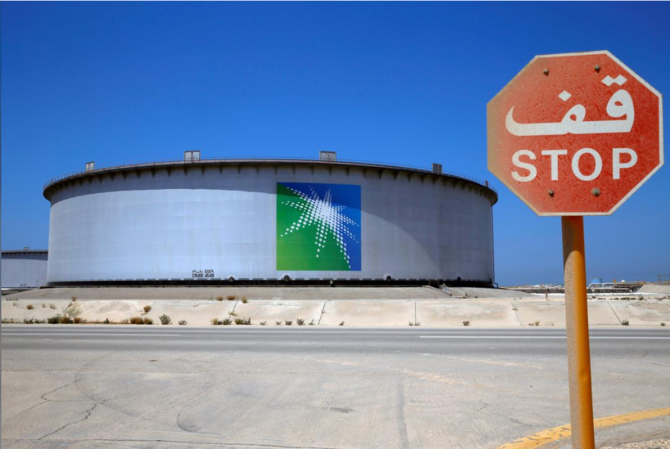
An Aramco tank is seen at Saudi Aramco's Ras Tanura oil refinery and oil terminal in Saudi Arabia May 21, 2018. Picture taken May 21, 2018. (Reuters)
Updated 24 September 2019
Follow

Saudi oil production surges back to 75 percent of pre-attack level

  • We can deal with effects of ‘cowardly sabotage,’ king says of drone and missile attacks
  • Two Aramco plants were hit in drone and missile attacks on Sept. 14 that caused fires and significant damage, halving the country’s oil output

JEDDAH: Saudi Arabia has restored more than 75 percent of the production lost after attacks on two oil processing plants and will return to full capacity next week.

The Khurais facility is now producing more than 1.3 million barrels per day and the Abqaiq plant about 3 million, industry sources said. 

Both Aramco plants were hit in drone and missile attacks on Sept. 14 that caused fires and significant damage, halving the country’s oil output. The Kingdom’s ability to quickly restore production demonstrated an important degree of resilience to potentially damaging shocks, the ratings agency Moody’s said.

King Salman said on Monday that Saudi Arabia was able to deal with the effects of what he described as “this cowardly sabotage, that targeted the Kingdom and the stability of global energy supplies.”

He spoke after talks in Jeddah with King Hamad of Bahrain, who denounced the “serious escalation targeting the security and stability of the region.”

Meanwhile, the diplomatic focus on the fallout from the missile strikes moved to New York, where world leaders are gathering for the UN General Assembly. Saudi Arabia and the US have blamed Iran for the attacks, and they were joined on Monday by Britain.

“The UK is attributing responsibility with a very high degree of probability to Iran for the Aramco attacks. We think it very likely indeed that Iran was responsible,” British Prime Minister Boris Johnson said on his way to the US.

“We will be working with our American friends and our European friends to construct a response that tries to deescalate tensions in the Gulf region,” he said.

However, the UK risks opening a diplomatic rift with other European countries trying to salvage the Joint Comprehensive Plan of Action (JCPOA), the 2015 deal to curb Iran’s nuclear program in return for an easing of economic sanctions. Their efforts have so far failed, with the US withdrawing from the deal and reimposing sanctions.

French President Emmanuel Macron has refused to blame Iran for the Aramco attacks. “One must be very careful in attributing responsibility,” he said on his way to New York.

Macron, Johnson and German Chancellor Angela Merkel held talks on Monday to coordinate their Iran strategy before meetings with US President Donald Trump and Iranian President Hassan Rouhani.

Gulf states, the US, the Europeans and others needed to engage in “collective diplomacy” to defuse tensions, a senior GCC official said.

“The conversation should no longer be about the JCPOA, but Iran’s missile program and its regional misbehavior, which are as important if not more important — they have the potential to hold the region to ransom,” he said.


Pakistan sets expectations for Trump-backed Gaza Board of Peace at UN

Updated 4 sec ago
Follow

Pakistan sets expectations for Trump-backed Gaza Board of Peace at UN

  • The country calls for ceasefire enforcement and reconstruction of the war-ravaged territory
  • Pakistani diplomat warns Gaza recovery must proceed without annexation or forced displacement

ISLAMABAD: Pakistan on Wednesday highlighted its expectations of US President Donald Trump’s Board of Peace (BoP) in Gaza, saying it joined the United Nations-backed body alongside other Muslim nations since it expected concrete steps toward a permanent ceasefire, reconstruction of Gaza and a lasting and just peace grounded in the Palestinian right to statehood.

Prime Minister Shehbaz Sharif signed the Gaza Board of Peace charter earlier this week along with other world leaders on the sidelines of the 56th Annual Meeting of the World Economic Forum in Davos.

Pakistan’s Permanent Representative to the UN, Ambassador Asim Iftikhar Ahmad, told an open Security Council debate on the Middle East that the decision was driven by the need to address the “unresolved Palestinian question,” which he described as “the core of the instability” in the region.

“We hope that the BoP under the framework of resolution 2803 will lead to concrete steps toward the implementation of a permanent ceasefire, further scaling up of humanitarian aid, reconstruction of Gaza, and realization of the right to self-determination of the people of

Palestine through a credible, time-bound political process, consistent with international legitimacy and relevant UN resolutions resulting in an independent, sovereign and contiguous state of Palestine based on pre-1967 borders with Al-Quds Al-Sharif as its capital,” Ahmad said while addressing the council.

“That is the ultimate goal supported by the international community,” he added. “Palestinian-led governance and institutional strengthening, with a central role of the Palestinian Authority, are indispensable in this regard.”

Ahmad maintained Pakistan was deeply concerned about the fragile situation in Gaza, pointing to Israel’s continued ceasefire violations that he said were putting civilian lives at risk. He stressed that the ceasefire must be fully respected with a view to a permanent cessation of hostilities.

The Pakistani diplomat said recovery and reconstruction should begin without delay and must proceed without annexation, forced displacement or any alteration of the territorial unity of the Occupied Palestinian Territory.

“The contiguity of Gaza and the West Bank is indispensable for the viability of the Palestinian state,” he said.

Ahmad also called for a credible, irreversible and time-bound political process culminating in the realization of Palestinian statehood in accordance with international legitimacy.

“The international community, particularly this council, bears the responsibility to translate renewed engagement into measurable change on the ground for the betterment of the Palestinian people,” he said, adding that Pakistan was ready to work with “members of the council, regional and international partners, and the United States to advance a just and lasting solution to the Palestinian question, and comprehensive peace in the Middle East.”