



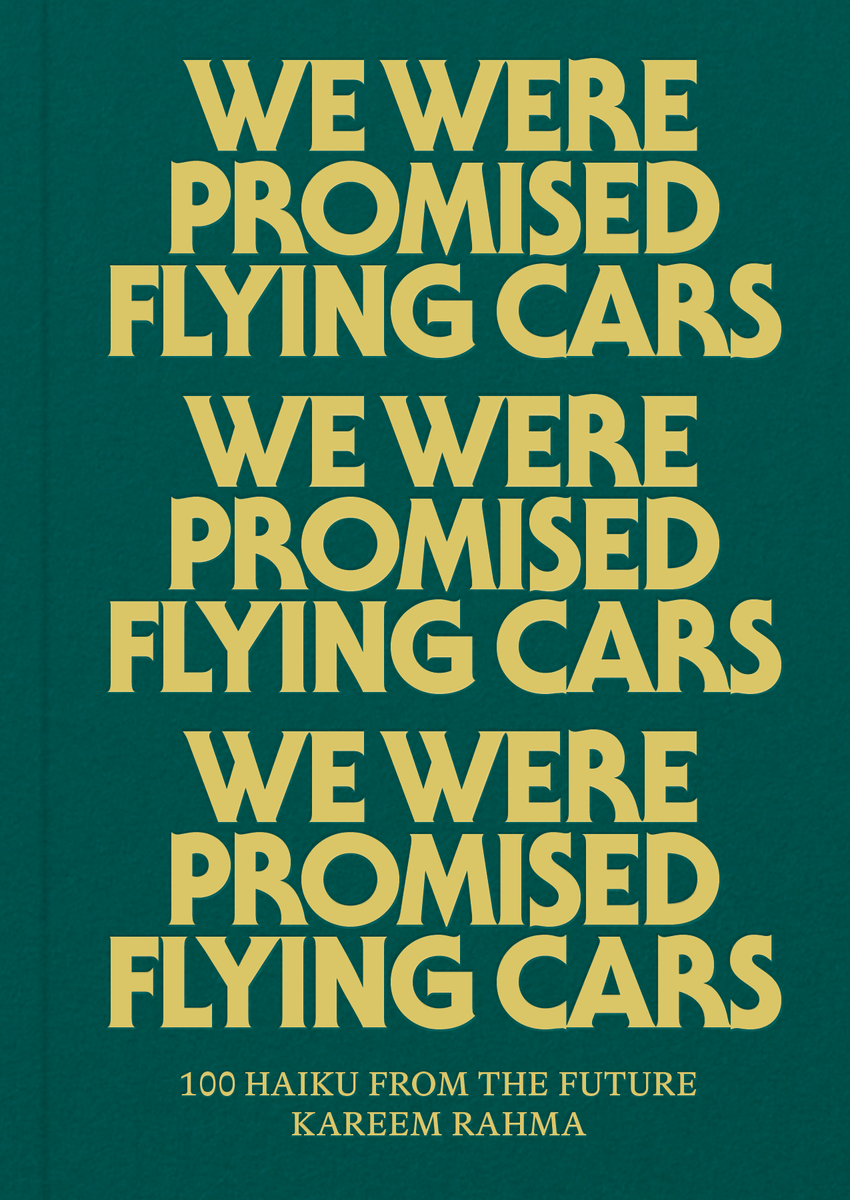
AMMAN: Egyptian-American artist Kareem Rahma’s latest project is an encapsulation of this polymath’s experience and talents. “We Were Promised Flying Cars” is a book of haiku — poems consisting of three lines of five, seven, and five syllables — which Rahma then used his extensive experience of digital media (he’s worked for Vice and the New York Times, and is a cofounder of Nameless Network) to promote, using an app called Cameo, which enables you to pay celebrities (many of whom really stretch the limits of that term) to read/sing/recite whatever you ask them to.
“I heard about (Cameo) maybe 16 months ago, and I really wanted to use it for some sort of art project but I couldn't figure out what,” Rahma tells Arab News. “I had the initial idea to have celebs congratulate me on publishing my book but (that) evolved when I realized it would be much more interesting and dynamic if the celebs read poems from my book. This really tied it all together with the themes of the book, because misinformation will continue to plague our society and eventually we won't care, because we'd rather be entertained than informed — which is already true, but I think it'll get more intense. The difference between now and then is that, in the future, we won't care that we're being lied to.”
And so we have Anthony Scaramucci — a.k.a. The Mooch, briefly Trump’s director of communications in July 2017 — reciting “Unnecessary Memories,” which runs as follows: “Nostalgia is banned/Hindsight is 20-20/What’s the use for truth?”
“The lack of self-awareness is truly magnificent,” Rahma says. “Here is a guy who is a lying, sociopathic narcissist who made a name for himself by being a moron reading a poem about regret and the dissolution of truth.”
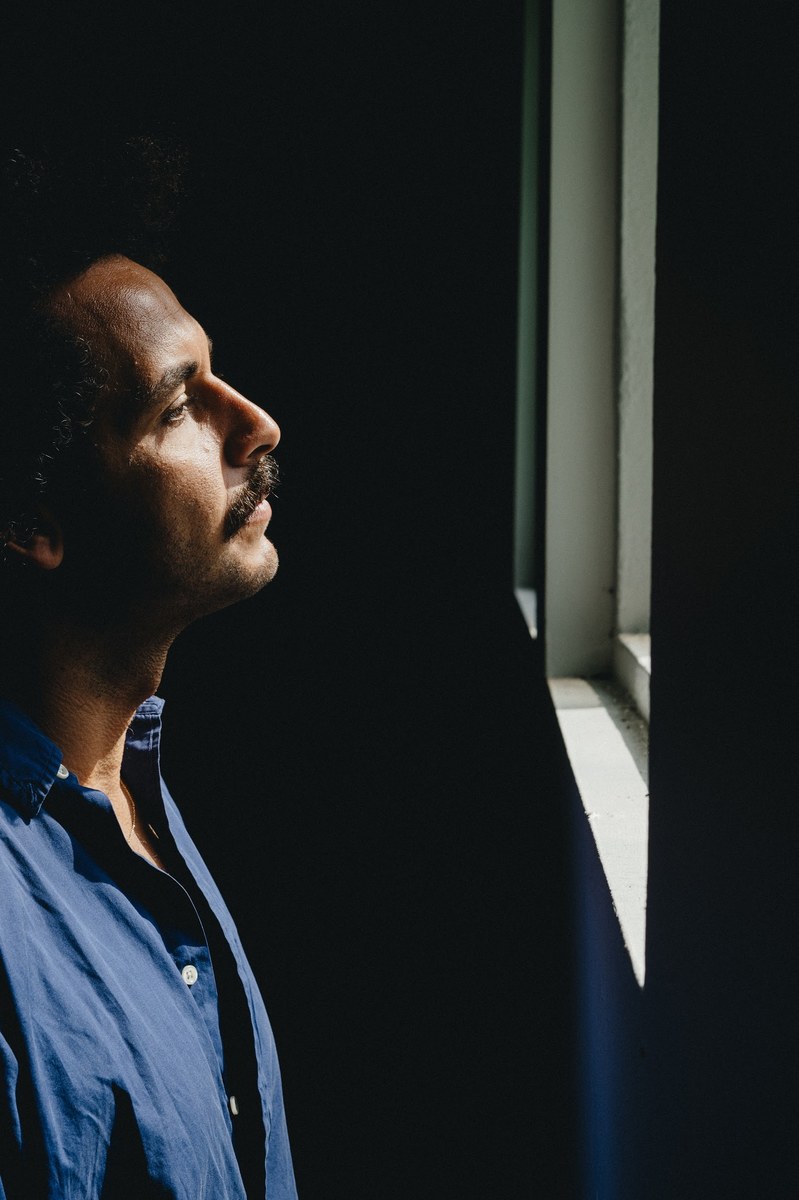
Rahma — born in Cairo and raised in Minnesota — has been writing poetry for the past five years. “I’ve always loved haiku because of how accessible it is,” he says of his choice of format for the book. “My goal is to express complex topics, philosophies and ideas by using the simplest vocabulary possible. I want my poetry to be for everyone.” The haiku forced him to “figure out how to communicate my thoughts more clearly,” he says in his book’s introduction. And when he found the way to do that, “I found real peace in having a path forward.”
Much of the poetry is, he says, “undeniably dystopian.” Take, for example, “Fun In The Desert.”
“The rich fled to Mars/They come back for Burning Man/Welcome to The Purge.”
Or “Out of Sight.”
“The Emergency/Came and took the poor away/We are happy now.”
But, Rahma adds, it also “allows plenty of space for humor, laughter and satire.” Sort of a haiku-version of “Black Mirror,” then. (He’s right, though, there are some very funny verses — “We love Muslims now/Ever since Ramadan became/A Bank Holiday.”)
“Ultimately it is an exploration of the world we live in right now and an attempt to predict our trajectory forward,” he says.
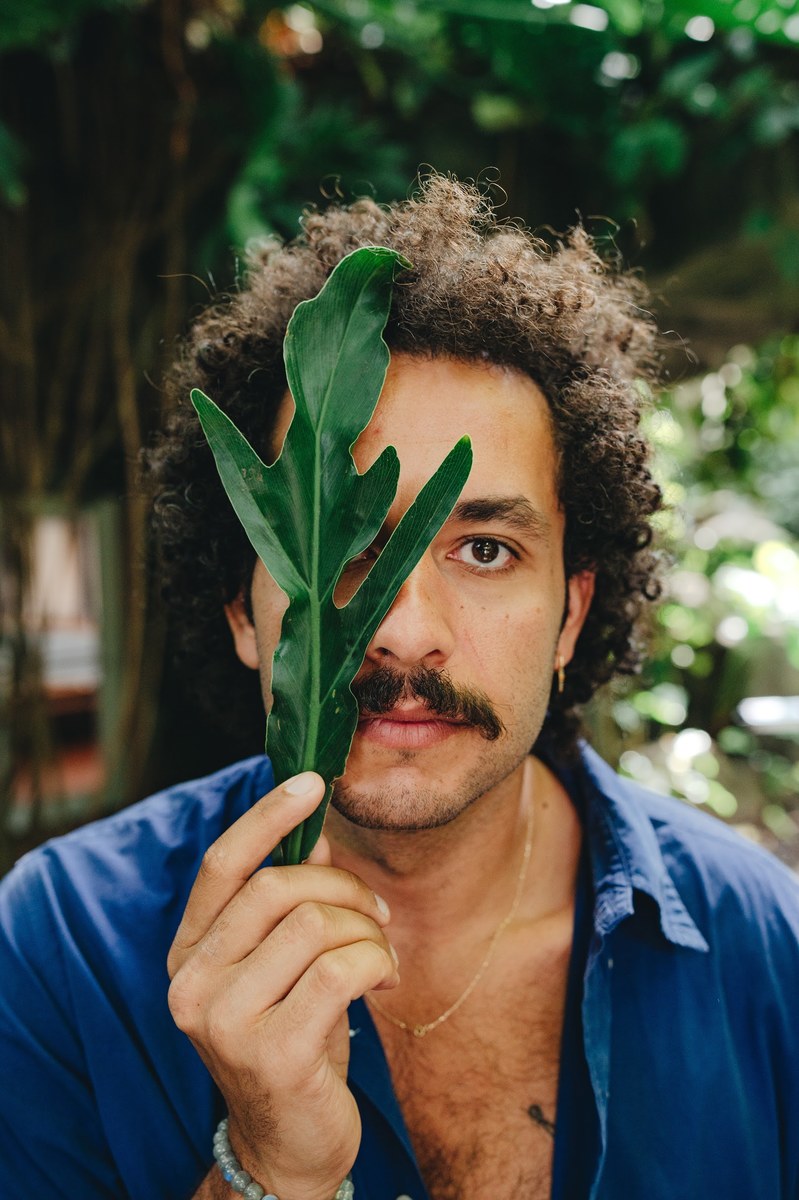
Rahma says he came up with the idea for the book while he was asleep in a Beirut hotel room.
“I was being drawn to Beirut for artistic reasons,” he says. “I really felt like I needed to be there in order to come up with some new ideas, and in the middle of the night on my fourth or fifth night, I woke up and wrote down ‘We Were Promised Flying Cars 100 Haiku From The Future.’ When I woke up, I looked at what I'd written and the idea had merit. Once I came back to the USA, I began to write and it was very therapeutic and fun, so I just kept going until I had nearly 200 poems written.”
The next step was to select the celebrities he wanted to read his haiku. “Tara Reid, Andy Dick and Gilbert Gottfriend were all $100 and those were the most expensive. A dog called Puggy Smalls was the least expensive — $10. Jennifer Love Hewitt, Freddie Prinze Jr. and Tomi Lahren all ignored my requests,” he says. “I'd ignore my request too.”
Rahma hopes the book will “open the door for new projects beyond poetry” and says he has already been approached about turning “We Were Promised Flying Cars” into “some kind of television anthology, which is exciting to me.”
And he’ll definitely be heading to the Middle East for inspiration again. “I'm always being pulled there, energetically-speaking,” he says. “The Middle East has a magnetic energy to me.”


