JEDDAH: For decades, the infamous name Juhayman Al-Otaibi had been buried in the memories of Gen X Saudis.
On Nov. 20, 1979, a well-organized group of terrorists stormed Makkah’s Grand Mosque, killing and wounding hundreds of worshippers and hostages in what came to be one of Saudi Arabia’s darkest days. Al-Otaibi was the mastermind behind the terrorist attack.
Fast forward four decades, and in his first American TV interview — with CBS’s “60 Minutes” — Crown Prince Mohammed bin Salman vowed to bring back the Kingdom’s pre-1979 moderation.
“We were living a very normal life like the rest of the Gulf countries,” he said. “Women were driving cars. There were movie theaters in Saudi Arabia. Women worked everywhere. We were just normal people developing like any other country in the world until the events of 1979.”
Al-Otaibi committed an atrocity in the name of religion, seizing the Grand Mosque for two weeks in a standoff with Saudi special forces.
Photos taken from fighter jets above the mosque showed the floor surrounding the Kaaba empty of worshippers, an image never witnessed before.
In a video published by the King Abdulaziz Foundation for Research and Archives, the late Sheikh Mohammed bin Abdullah Al-Subayil, the imam who performed fajr (early morning) prayers on the day of the siege, recalled what he described as “one of the most significant events” of his life.
He said he arrived at the mosque 30 minutes before prayers but did not sense anything untoward.
“But after concluding fajr prayers … a number of militiamen with weapons stormed the area heading toward the Kaaba,” he added.
“I headed to one of the rooms, where I immediately called Sheikh Nasser bin Hamad Al-Rashed, the chief of the Presidency of the Two Holy Mosques at the time. I told him of the situation, and I had him listen to the bullets being fired. I found out a while later that they (the terrorists) were allowing pilgrims to leave the mosque’s grounds.”
Al-Subayil decided to leave after about four hours. He removed his mishlah (a traditional flowing outer cloak worn in the Gulf), went down to the basement, lowered his head and left with a group of Indonesian pilgrims just as two militants stood at the gates that lead outside the basement.
Soon after, the gates were chained shut, and snipers took positions in the high minarets and shot innocent worshippers.
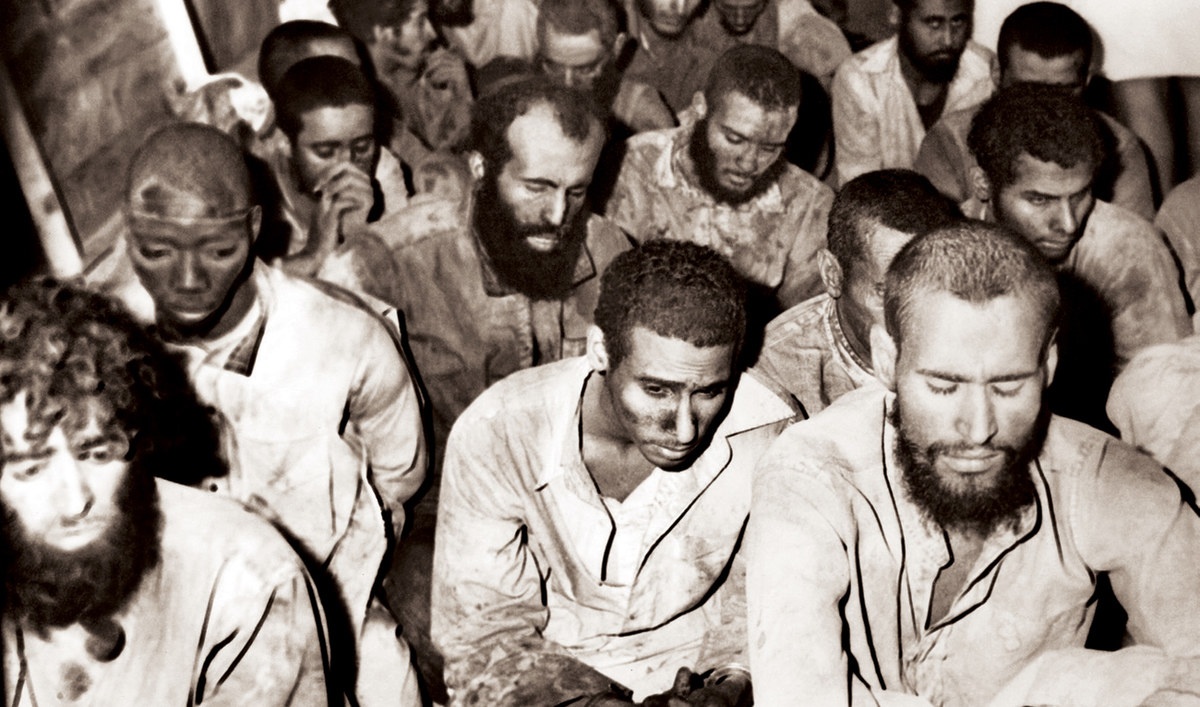
Arrested gunmen belonging to the group led by Juhayman Al-Otaibi that stormed Makkah’s Grand Mosque. (AFP)
Al-Otaibi’s followers, who had taken positions in the minarets, shot at bystanders and Saudi special forces if they came too close to the mosque’s grounds. An estimated 100,000 worshippers were in the mosque that morning.
The siege shocked Saudi society, which had been living a normal life, and whose country was transforming itself from a desert nation to a sophisticated state.
Born and raised in Makkah, housewife Fajr Al-Mohandis recalled the day she heard the news, and the dreadful atmosphere in the city during “those awful two weeks.”
She told Arab News: “I was a student in middle school, and just like every other day, I went to school just like all the school children did. Everyone went to their jobs, including those who worked in the Grand Mosque.”
She said: “We heard gunshots during the day, and that would’ve been the first sign something was wrong. But we were still oblivious to the fact that a terrorist attack was taking place until our parents came to pick us up.” She added: “Makkah was a very small city at that time … and news spread fast.”
Al-Mohandis recalled how schools were shut for the next two weeks. “The air was heavy with fear, no one knew what was happening and we were shocked to the core,” she said.
“This was the holy city. This was the Grand Mosque. How was this even possible? As I was young it was too much to process, but residents of the city who grew up here took the responsibility of keeping it safe, assuring young ones like me that it’ll be OK and Saudi special forces will free the mosque from the blasphemous group.”
A former member of the National Guard, Al-Otaibi was a member of the Salafist group Jama’a Al-Salafiya Al-Muhtasibah.
He was angered by Western influence in Saudi society, and had been recruiting followers from various nationalities for years under the guise of piety.
It was later discovered that his followers smuggled ammunition by hiding it in barrels disguised as construction equipment, and in the mosque’s basement and minarets, taking advantage of its expansion.
Saudi forces stormed the mosque, and the ensuing battle killed most of the terrorists, including Al-Qahtani. Sixty-seven of them were captured, including Al-Otaibi.
The siege ended on Dec. 4, 1979. On Jan. 9, 1980, well-known news presenter Hussain Najjar announced Al-Otaibi’s execution.