Fallen Tunisian autocrat Zine El-Abidine Ben Ali dies

1 / 10
Ben Ali and his wife Leila mark the 20th anniversary of Ben Ali's presidency, in Rades, outside Tunis in 2007. (AP)
2 / 10
Tunisia's President Zine al-Abidine Ben Ali waves to supporters after he took the oath at the national assembly in Tunis November 12, 2009. (Reuters)
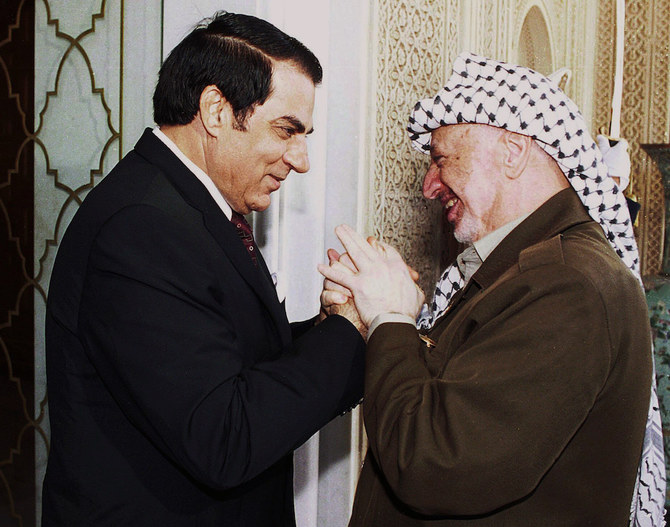
3 / 10
Ben Ali welcomes Palestinian leader Yasser Arafat prior to their talks in Tunis in 2001. (AP)
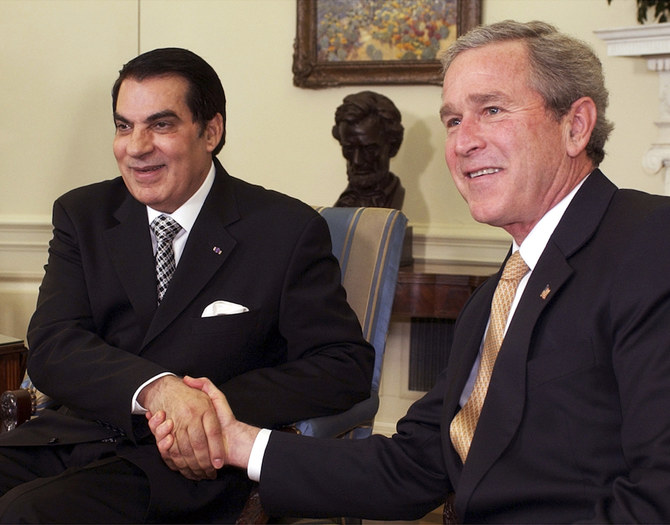
4 / 10
President Bush shakes hands with Ben Ali in the Oval Office of the White House in Washington in 2004. (AP)
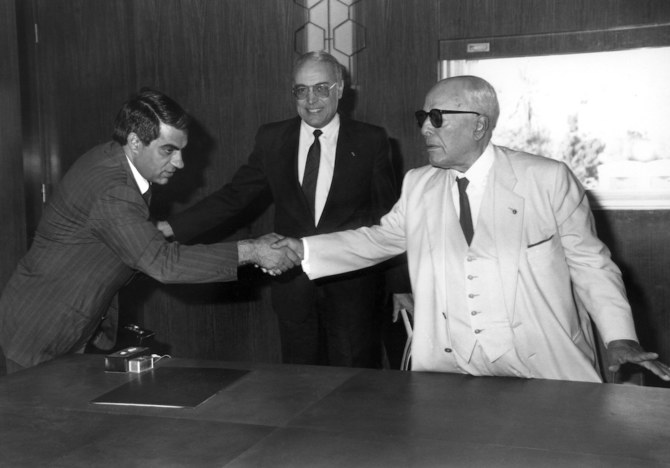
5 / 10
Former Tunisian President Habib Ben Ali Bourguiba (R) shakes hands with his then prime minister Ben Ali (L) in 1986. (AFP)
6 / 10
Ben Ali waves to the crowd upon arrival in Rades stadium where he delivered his speech on the 50th anniversary of independence of Tunisia from France in 2006. (AFP)
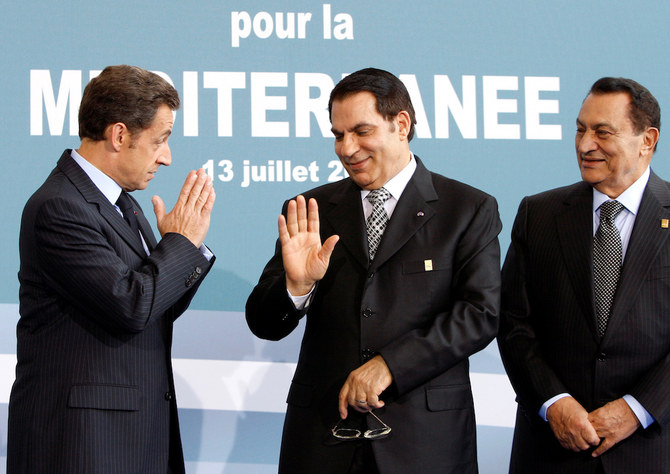
7 / 10
Ben Ali (C) is greeted by France's President Nicolas Sarkozy (L) and Egypt's President Hosni Mubarak as he arrives at the EU-Mediterranean summit in Paris, July 13, 2008. (Reuters)
8 / 10
Ben Ali poses for an official picture in front of the Tunisian flag in 1988. (AFP)
9 / 10
Ben Ali meets Libya's leader Muammar Qaddafi as they pose for a family photo during the third European Union-Africa summit in Tripoli in 2010. (Reuters)
10 / 10
Children welcome Tunisian President Ben Ali in 2008 as he arrives to a meeting marking the 21st anniversary of his accent to power in Tunis. (AP)
Updated 20 September 2019
Follow

Fallen Tunisian autocrat Zine El-Abidine Ben Ali dies

  • Ben Ali was the first of several Arab leaders to be driven from power during regional uprisings
  • Ben Ali ruled the North African country from 1987 until 2011

TUNIS: Former Tunisian president Zine El-Abidine Ben Ali, the first leader to be toppled by the Arab Spring revolts, died on Thursday in Saudi Arabia.
"We had confirmation of his death 30 minutes ago," Tunisia's foreign ministry said, without giving further details.
The 83-year-old's lawyer, Mounir Ben Salha, confirmed the news, citing family members and Ben Ali's doctor.
Ben Ali, who ruled his North African country from 1987 until 2011, was viewed by some as a bulwark against extremism, but faced criticism for muzzling the opposition and his reluctance to embrace democracy.
Eventually, growing frustration over unemployment and high prices snapped.
In late 2010, after a young trader died when he set himself on fire, protests erupted across the country and sparked a deadly clampdown.
Ben Ali fled Tunisia on Jan. 14, 2011 and sought exile in Saudi Arabia.
His rapid departure sparked a string of similar uprisings across the region, toppling Egyptian and Libyan strongmen Hosni Mubarak and Moamer Qaddafi.
The turmoil triggered what was to become Syria's devastating eight-year war.
In mid-2012, Ben Ali was sentenced in absentia to life in jail for his role in the deaths of protesters during the uprising that ousted him.
Ben Ali is survived by six children; three daughters by a first marriage and two daughters and a son by Leila Trabelsi.


Katz orders West Bank raid after deadly attack in Israel

Updated 12 sec ago
Follow

Katz orders West Bank raid after deadly attack in Israel

  • Friday’s stabbing and car-ramming attack in northern Israel triggered the minister’s action

JERUSALEM: Israel’s Defense Minister Israel Katz on Friday ordered the military to launch an operation in the village of Qabatiya in the occupied West Bank after it emerged that a Palestinian who killed two people came from there.
The minister instructed the Israeli forces to “act forcefully and immediately against the village of Qabatiya, from which the murderous terrorist emerged, in order to locate and thwart every terrorist and strike the village’s terror infrastructure,” Katz’s office said in a statement.
“Anyone who aids terrorism or sponsors and backs it will pay the full price,” it added.

BACKGROUND

Friday’s attack comes just days after Israeli soldiers shot dead a Palestinian teenager in the Qabatiya area.

The military said in a separate statement that it was preparing to begin an operation in Qabatiya in the northern West Bank, which has seen repeated violent incidents.
Friday’s stabbing and car-ramming attack in northern Israel triggered the minister’s action.
The assault came a day after an Israeli military reservist dressed in civilian clothes rammed his vehicle into a Palestinian man in the West Bank, where violence has surged since the war in Gaza began.
“Preliminary investigation indicates this was a rolling terror attack that began in the city of Beit Shean, where a pedestrian was run over,” Israeli police said in a statement about Friday’s attack, adding that the victim was a 68-year-old man.
“Later, a young woman was stabbed near Road 71, and the suspect was ultimately engaged with gunfire near Maonot Junction in Afula following intervention by a civilian bystander,” it said, adding that the attacker was taken to hospital.
Both victims succumbed to the injuries, Israel’s Magen David Adom emergency services said in a statement.
MDA also reported that a 16-year-old was slightly injured when “hit by a vehicle.
The Israeli military said the attacker had “infiltrated into Israeli territory several days ago.”
President Isaac Herzog condemned the attack.
Friday’s attack comes just days after Israeli soldiers shot dead a Palestinian teenager in the Qabatiya area.
The military has launched an investigation into the incident after footage emerged showing the teenager not posing any threat or throwing anything at soldiers who shot him.
The attack on Friday also came a day after an Israeli military reservist dressed in civilian clothes rammed his vehicle into a Palestinian man in the 
West Bank.
In videos on social media purporting to show that incident, the victim is seen praying by the roadside when the soldier rams him with his vehicle.